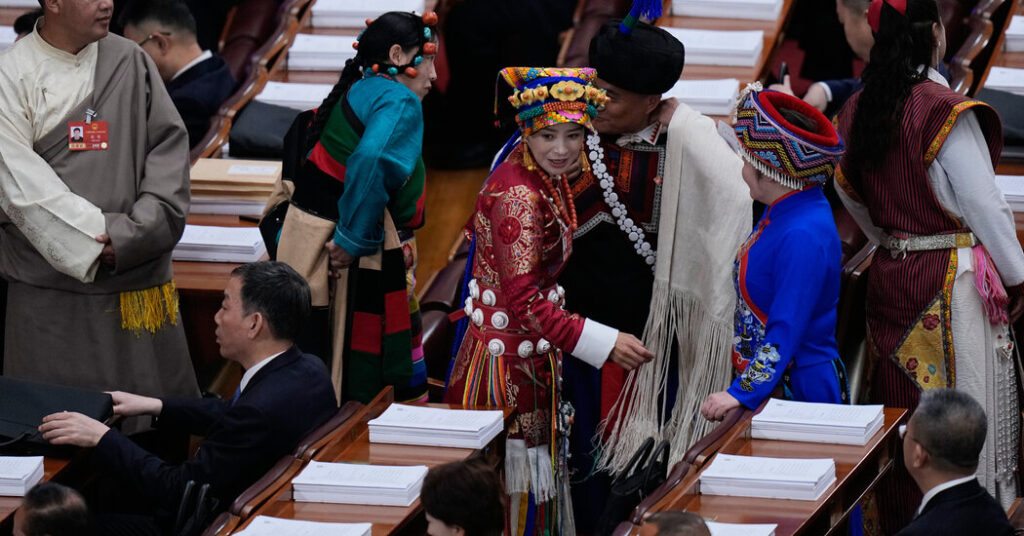
Since China’s leader, Xi Jinping, rose to power more than a decade ago, the ruling Communist Party has worked aggressively to make ethnic minorities in Xinjiang, Tibet and elsewhere in the country identify first and foremost as patriotic citizens.
Now, this campaign of assimilation has been codified into an expansive new law that makes “ethnic unity” the responsibility of all of society, including every level of the government, business owners and parents.
The law, which was approved at the close of China’s legislative meeting on Thursday, has wide-ranging provisions that touch on education, housing policy, entertainment and other areas. It embodies Mr. Xi’s mission to forge a single national identity molded by the party — seen as a way to protect Beijing’s rule from threats at home and abroad.
While Beijing says the law will protect the traditions of all officially recognized 56 ethnic groups, a main focus appears to be assimilating minority residents into the culture of the Han Chinese, who are the majority. It orders that Mandarin Chinese be the language of instruction in schools and in official communication. (In government communication when both languages are used, Mandarin should be used first and displayed more prominently.)
Under the new law, the authorities must guide citizens to have “correct views” on history, culture and religion and shed “outdated customs.” It also requires parents to “educate and guide children to love the Chinese Communist Party.” The law makes it illegal for anyone to oppose a marriage on ethnic or religious grounds and also calls for minority residents to live in mixed communities.
According to James Leibold, a professor at La Trobe University in Melbourne who focuses on China’s ethnic policies, the law marks the final “legal capstone” in Mr. Xi’s hard-line approach toward the country’s hinterlands like Xinjiang and Tibet, where demands for greater autonomy have in the past erupted into protests and violence.
In those regions, government measures — which have included mass detentions of residents, forced political indoctrination, the separation of children from their families and suppressing population growth — have led to the erasure of minority languages, religious traditions and cultural norms, he said.
The ethnic unity law is now “mobilizing all aspects of the party, state and society to forge a single national consciousness,” Dr. Leibold said. “In Xi’s China, there is very little room left for diversity of culture, language, identity, or even thought.”
Even before Mr. Xi came to power, Chinese officials and intellectuals were debating whether decades of granting limited autonomy to minority regions had gone too far. After a string of attacks by Uyghurs — including in 2014 when a group armed with knives killed 31 people at a train station in the southwestern city of Kunming — Mr. Xi oversaw an intense security crackdown and a shift in the party’s ethnic policies.
Officials restricted the use of minority languages in schools in Xinjiang and Tibet and other places where minority students had previously been able to choose their language of instruction. Until 2020, students in Inner Mongolia, an autonomous region between China and Mongolia, could study mostly in Mongolian. The ban caused widespread protests that were quickly put down.
The new law formalizes and applies that language policy across the country. It also mandates that children must start learning the language before kindergarten, with the goal of having a “basic grasp” of it by the time they finish the nine years of compulsory education.
The law, which requires local governments to support minority workers and students when they move elsewhere in China, is likely to accelerate official efforts to promote migration into and out of minority regions, which some experts see as diluting minority culture. The goal is to bind China’s minorities to the majority population, a relationship Mr. Xi has likened to that a tree and its branches, where Chinese culture is the trunk and each ethnic group is a branch.
Beijing is focused on the “contact, exchange and blending” of different ethnic groups, according to Aaron Glasserman, a postdoctoral fellow at the University of Pennsylvania who researches ethnic policy in China.
“Xi’s preferred metaphor for China’s minorities is telling. He says they should be ‘packed tightly together like pomegranate seeds.’ That is, small, similar and red,” he said.
Dr. Glasserman said the new law demonstrates the government’s confidence in its methods in Xinjiang and Tibet, despite criticism from international rights groups. It also empowers the authorities to pursue groups and people outside of China seen as undermining national unity or inciting ethnic division.
Chinese officials last year pressured a museum in Thailand to remove the names and works of four Uyghur, Tibetan and Hong Kong artists. The police last year detained an overseas Chinese student advocating for Tibetans, Tara Zhang Yadi, on suspicion of separatism, according to a group advocating for her release.
“Now the Chinese government is demanding this ideological uniformity not only within its territory but also abroad,” said Yalkun Uluyol, a China researcher at Human Rights Watch. “That is what you call transnational repression.”
Lily Kuo is a China correspondent for The Times, based in Taipei.
The post China Wants Its Ethnic Minorities to Blend In. Now It’s the Law. appeared first on New York Times.