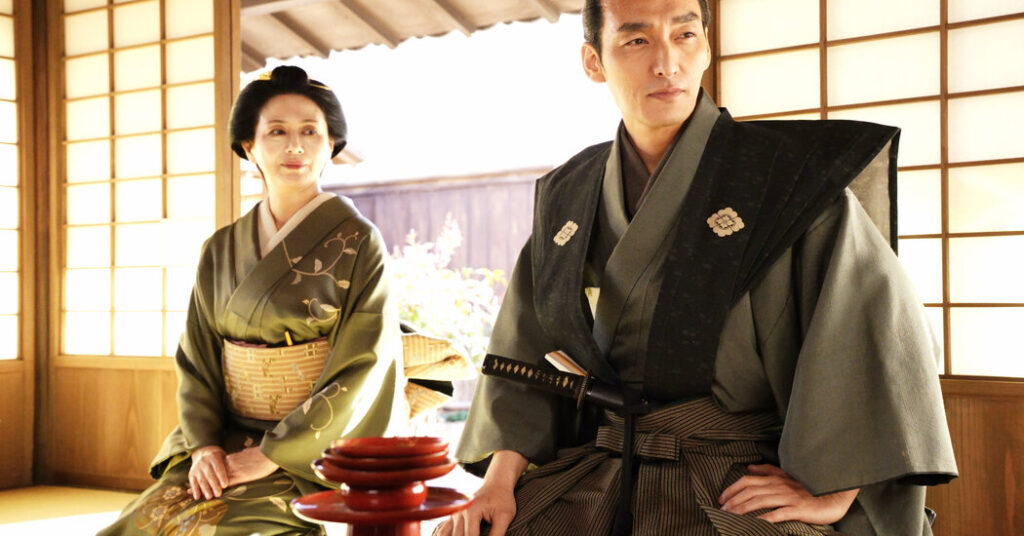
Little blood spills in “Bushido,” an engagingly slow-boiling Japanese drama about a destitute ronin, or vagrant samurai, that subtly interrogates the way of the warrior. Among the movie’s surprises is that many of its most intense scenes take place on that battleground known as Go, the ancient board game. Here, in strategic move after move, tense game after game — with unwavering focus, beads of sweat and small black-and-white stones — combatants take territory, capture pieces and reveal truths about their inner selves, their values, virtues and flaws.
After some routine time-and-place-setting in a pleasantly bustling 19th-century town, the director Kazuya Shiraishi (“The Blood of Wolves”) begins moving his pieces into position. In pride of place is Kakunoshin (the quietly charismatic Tsuyoshi Kusanagi), a vagrant samurai who keeps his sword lethally sharp, his back straight and gaze opaque. No longer in his one-time master’s good graces, Kakunoshin and his loving adult daughter, Okinu (Kaya Kiyohara), now struggle to survive. He carves wood signature seals while she does sewing, but their earnings are meager and the landlord is scratching at the door.
Kakunoshin’s fate dramatically shifts during an impulsive stop at a Go parlor when he sits down to play a stranger who’s loudly racking up wins and coins with undignified glee. A braggart, Genbei Yorozuya (Jun Kunimura), turns out to be a merchant and proves as comfortably well off as Kakunoshin is poor. The men seem like opposites in every respect, especially temperamentally, a distinction that’s amplified by their sharply etched contrasts — the ronin’s self-effacing reserve, the merchant’s self-aggrandizing ostentation — and underscored by their different Go stones. Once hunkered down across a board, each slowly reveals more about themselves and an unexpected alliance takes hold.
Shiraishi takes a few beats to get his filmmaking bearings — the early scenes are marred by some overly self-conscious painterly compositions — but he finds them once the players start playing. Using a dynamic mix of angles as well as close-ups and more contextualizing views, the filmmaker discreetly ratchets up the tension, making the board come alive. At one point, when Kakunoshin takes his turn, the filmmaker cuts to the ronin’s delicate hand cutting through the air with fingers straight as an arrow, a movement the camera mirrors. Soon, though, Kakunoshin unexpectedly resigns, piquing Genbei’s interest. They meet again, they play again, and they keep meeting and playing.
In bright and fading light, the ronin and the merchant play games that — strategic move by move — continue to shed light on their personalities and worlds. As they compete, their faces and demeanor soften appealingly, and Shiraishi seamlessly introduces more characters and plot threads. (One thread, involving an antagonist played with burning malice by Takumi Saitoh, merits a prequel.) The ronin’s inquisitive, rambunctious neighbors become a chorus of a kind, as do the merchant’s workers. There’s not much to the romance that develops between the ronin’s daughter and one of the merchant’s men (Taishi Nakagawa), but it adds to the mounting complications that solve the mystery of Kakunoshin’s past and threaten his family’s future.
Written by Masato Kato, “Bushido” holds you with its performances and a story that circles around questions of honor, loyalty, masculinity and the ties that bind and sometimes throttle. Among the movie’s most intriguing aspects is how it at once embraces bushido — which translates as “the way of the warrior” — and gently complicates the patriarchal values that have informed its modern-era representations. Shiraishi isn’t a wholesale revisionist; among other things, he knows the appeal of screen violence and how to put bodies and swords into kinetic motion. And, yes, there will be clanging metal and pooling blood. Yet it’s the movie’s questioning of what makes a man a man, as well as its stillness, that leaves the strongest impression. Here, when men face each other across a Go board, they find themselves.
Bushido Not rated. In Japanese, with subtitles. Running time: 2 hours 9 minutes. In theaters.
Manohla Dargis is the chief film critic for The Times.
The post ‘Bushido’ Review: A Samurai’s Dangerous Moves appeared first on New York Times.