Some artists don’t reveal much about themselves, so their lives and thoughts are usually interpreted through accounts from their family members, peers and friends — and, of course, their work. When Henry Darger died in obscurity at 81, he left behind a 15,000-page illustrated fantasy tale, an autobiography clocking in at 5,000 pages, a lengthy diary and many intricate art pieces.
Yet 53 years after his death, he remains the mysterious subject of much fascination: What inspired, what drove this untrained Chicago loner to spend years of his life creating a painstakingly detailed, horrifically gory, epically long story about little girls (albeit, often ambiguously sexed) fighting off adult enslavers? We have learned so much about Darger, and yet understand so little.
Unfortunately the new one-man show, “Bughouse,” directed by Martha Clarke and starring the performer John Kelly, does not illuminate much about this ur-outsider artist. It is enchanting to look at, but leaves us on the outside, looking in.
This is a paradox since “Bughouse,” which just opened at the Vineyard Theater, attempts to place the viewer inside Darger’s mind. Kelly (who himself has a parallel career as a visual artist) plays Darger as a mild-mannered but haunted recluse. He begins by recounting how he spent part of his childhood in an Illinois Asylum for Feeble-Minded Children, then took on menial jobs in hospitals.
Drawing from Darger’s writings, the script by Beth Henley (“Crimes of the Heart”) often returns to Elsie Paroubek, a real child who was abducted and killed in 1911. She inspired the character of the rebel Annie Aronburg in his magnum opus, “In the Realms of the Unreal” (full title: “The Story of the Vivian Girls, in What Is Known as the Realms of the Unreal, of the Glandeco-Angelinian War Storm, Caused by the Child Slave Rebellion”).
The martyred Elsie/Annie becomes a pivotal figure in the show, perhaps because she epitomized Darger’s outrage at her fate, since he believed that “children, especially all good and innocent ones, were more important to God than the grownups.” (Darger’s tombstone describes him as “Artist, protector of children.”)
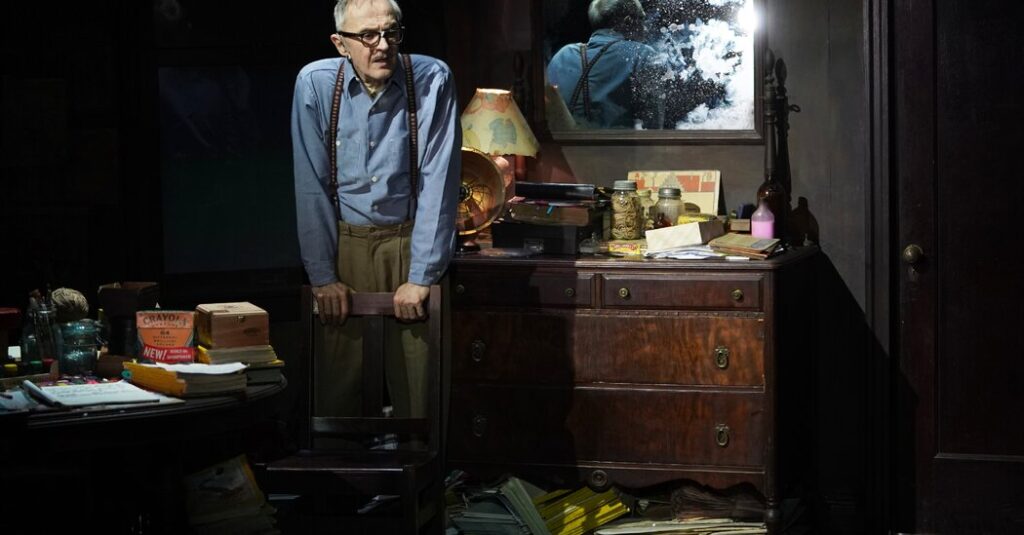
Trying to explain Darger’s psychological mechanisms is an ambitious task, but the show feels halfhearted about this endeavor, as if acknowledging the impossibility of it. Despite a captivating immersive feel evoked by John Narun’s projections, Fred Murphy’s cinematography and Ruth Lingford’s animation, “Bughouse” does not suggest the scope and intricacy of Darger’s art — mostly he comes across as a peculiar old man muttering to himself as furtive figments of his imagination take over his physical and mental space.
The production is most effective when it is simply trying to suggest a tormented, mystical mind in small impressionistic touches, helped as well by Christopher Akerlind’s lighting design. Clarke, who has been creating unclassifiable dance-theater works since the 1980s with such pieces as “Garden of Earthly Delights” and “Vienna: Lusthaus,” remains one of the most visually driven directors in activity — a compliment, to be clear.
Here, she and the production designer Neil Patel place us in Darger’s cramped living quarters, a hoarder’s paradise of bundled-up magazines and grimy windows that provide glimpses of the outside world but also of what may be inside Darger’s head. Clarke and Kelly, who had worked together on the captivating “God’s Fool” (2022), inspired by the life of St. Francis of Assisi, are especially simpatico, forming a creative partnership of which I certainly would love to see more — they are not afraid to leave things unexplained and let a mood take over.
But the visions remain oddly timid here. This is especially jarring if you are familiar not just with Darger’s own output, but with some of the many superb pieces he has inspired, including the Jessica Yu documentary “In the Realms of the Unreal: The Mystery of Henry Darger” (2004); and Philippe Cohen Solal and Mike Lindsay’s album “Outsider” (2012), which set Darger texts to music. Cohen Solal, from the Gotan Project, is so obsessed that he’s also helped curate a VR experience of the artist’s works in Paris and produced a multipart podcast about Darger featuring the great French actor Denis Lavant.
This raises the question of whether it’s possible to travel inside Darger’s head, as “Bughouse” purports to do, without addressing the relationship between mental illness and creativity, perversity and creativity, exploitation and voyeurism. It’s fine for a show to not offer answers; it’s more frustrating if it doesn’t seem to ask questions.
Bughouse Through April 3 at the Vineyard Theater, Manhattan; vineyardtheatre.org. Running time: 1 hour 10 minutes.
The post ‘Bughouse’ Review: Inside a Solitary Artist’s Unwieldy Mind appeared first on New York Times.