Money from artificial intelligence companies is flooding into the 2026 midterms.
AI giants like OpenAI and Anthropic have already collectively contributed over $185 million to contests around the country as tech leaders work to influence how, and how much, AI will be regulated, with Democrats and Republicans preparing for an onslaught of campaign spending that could remake key elections.
Candidates backed by AI companies have found early success — of the 20 candidates in the Texas and North Carolina primaries who received AI funds, including many in competitive, open primaries, only one lost her race.
“There is an extreme takeover being attempted … by people that know they are on the wrong side both of popular opinion and of history and are trying at the last second to get their way by drowning out elections with money,” said New York state Rep. Alex Bores (D), whose campaign for Congress has been both supported and attacked by groups funded by AI interests.
The public is increasingly skeptical of artificial intelligence and the proliferation of data centers needed to power it. A Pew Research Center survey released last year found that 50 percent of Americans were more concerned than excited about the increased use of AI, and a Marquette University survey last month found that 70 percent of registered voters in Wisconsin felt the costs of data centers outweigh the benefits. One of the main concerns among voters is the impact data centers have on energy prices, given that the U.S. Energy Information Administration found late last year that electricity prices had risen 28 percent since the end of 2021.
Former congressman Brad Carson, the co-head of Public First Action, a nonprofit that funds a group of super PACs with $20 million donated by Anthropic, said that public perception makes AI spending on the midterms all the more necessary.
“The pitchforks are coming. The bonfires are being raised. And if people don’t see that AI can be used for social utility, they’re not going to tolerate it,” Carson said.
Much of the spending is focused on lawmakers who will have some say in AI regulation or who explicitly want to be involved in the issue.
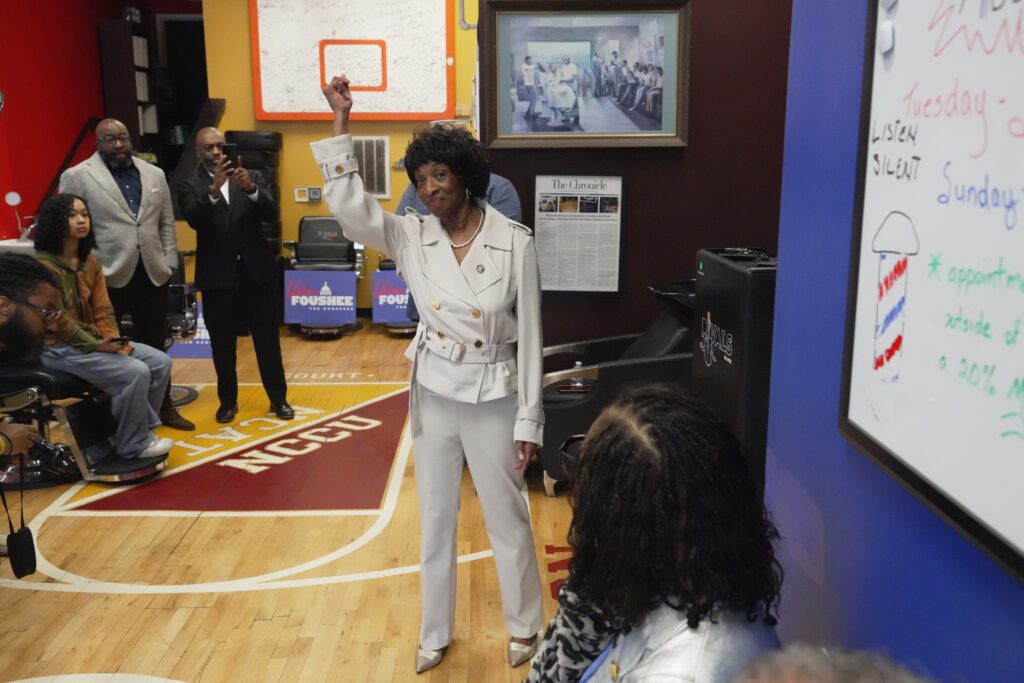
Jobs and Democracy PAC, a group affiliated with Public First Action, spent $1.6 million to back Rep. Valerie Foushee (D-North Carolina), an incumbent who was named co-chair of a Democratic commission on artificial intelligence task force late last year. Foushee narrowly defeated a primary challenge from Nida Allam, a Durham County commissioner, who ran a progressive campaign that included a moratorium on data center construction.
“As a candidate, part of me is honestly low-key flattered that they see that we are running a serious progressive challenger campaign and that our progressive grassroots campaign has built up so much momentum that they’re terrified,” Allam said shortly before Election Day.
Bores has been the beneficiary and target of AI funds. The lawmaker is behind a state-based attempt to regulate artificial intelligence in New York that requires the creators of large-scale AI models to publish and adhere to a safety and security plan and would allow state officials to impose civil penalties on companies that violate their own guidelines. The money that has poured into his campaign is indicative of the battle between competing visions on the future of artificial intelligence regulation.
On one side of that fight is Leading the Future, a group that received $25 million from Greg Brockman, president and co-founder of OpenAI, and his wife, Anna, and another $25 million from pro-AI venture capitalists Benjamin Horowitz and Marc Andreessen. (The Washington Post has a content partnership with OpenAI.)
Leading the Future strongly opposes state-based attempts to regulate the AI industry. Strategists within the group say they support federal regulation; the group’s critics say their primary goal is as little regulation as possible.
The other side is represented by Public First Action, which advocates for “reasonable guardrails” on the technology, starting at the federal level while allowing for a “balance” between federal and state regulations. The disagreement between the two factions is less about whether there should be regulations — both argue they favor some — than about how much regulation and by whom.
Leading the Future has already spent $1.9 million to oppose Bores, while Defending American Jobs, part of the Public First network, has reported spending about $350,000 to support him.
Josh Vlasto, a top strategist at Leading the Future and a former press secretary to Senate Minority Leader Charles E. Schumer (D-New York), said his group is advocating for a “national regulatory framework” to regulate the industry and “not allow for a patchwork of state regulations to slow us down.” The powers behind the group, such as OpenAI and others, have warned that overregulation could stifle the technology’s growth and cede power to foreign actors like China. Vlasto accused the other side of looking to “slow AI innovation to support their ideological agenda.”
Carson, the co-head of Public First Action, accused Vlasto and others of supporting “no regulation at all on AI,” and said his organization, by comparison, advocates for “reasonable” regulation of the technology and does not support selling AI technology to China. That view reflects that of Anthropic, whose CEO, Dario Amodei, has made advocating for key AI regulations a way to set his company apart in the technology industry. To date, the group has interviewed over 300 federal candidates for possible support and plans to spend $75 million on the midterms.
“Our polling shows that the issue is growing in salience faster than any issue in recent American history,” Carson said, arguing that people not only care about this issue, but also want to know their representatives support protecting them from the technology. He said those pushing for less regulation on the technology are “extremely dangerous to the AI industry itself.”
Of the 20 candidates in the Texas and North Carolina primaries who received AI funds, only one — Republican Texas comptroller candidate Kelly Hancock — outright lost her race, with four candidates headed to runoffs. AI interests are also involved in next week’s primaries in Illinois, including in the race to replace Rep. Raja Krishnamoorthi, where former congresswoman Melissa Bean has received $1.1 million from Think Big, a super PAC that has received funding from Leading the Future. In total, AI interests have spent $2.2 million on U.S. House primaries in Illinois and about $500,000 on state House races.
Together, these AI-funded super PACs have already spent over $10 million to influence this year’s elections, including $1.7 million on state-level elections in Texas and Illinois, according to federal and state filings as of March 10. Bores’ campaign has seen the most money of any race.
Major AI companies and their leaders spent at least $86 million last year to influence federal elections, excluding gifts to pro-crypto organizations, including $50 million to Leading the Future, and $31 million to MAGA Inc., President Donald Trump’s super PAC. And many companies and leaders, including Amazon, Microsoft, OpenAI leader Sam Altman, and smaller companies like C3 AI and Perplexity AI, also contributed to the president’s inaugural fund. (Amazon founder Jeff Bezos owns The Post.)
“We are going to be very robust in primaries,” Vlasto said. “When we engage in a race, if we believe it’s important, we are going to be a great ally,” he added.
Zac Moffatt, a longtime Republican operative and another top strategist for Leading the Future, labeled this work a “multi-cycle conversation” and said it would be “foolhardy to think that this is ’26 and done.”
The surge in spending has happened at the state level, too. In the 2022 midterms, major tech companies like Google, Meta, Microsoft and their leaders spent about $3 million on state-level elections, almost all of it in California and Washington, according to Transparency USA, a nonpartisan government accountability group.
Since the start of 2025, the same companies have contributed over $37 million to state-level political committees. Meta put $20 million into Meta California, $1.4 million into a Texas super PAC, and $750,000 into an Illinois super PAC, all of which are devoted to promoting state-level candidates who oppose AI regulation. Google joined Meta in contributing $5 million to a super PAC called California Leads, which is devoted to promoting “pragmatic” candidates for state office. Additionally, Meta gave $45 million to a federally registered nonprofit, American Technology Excellence Project, to back state and local candidates who “advocate for AI progress.”
“Money talks. And it’s hugely impactful,” said Matt Gorman, who ran communications for House Republicans’ campaign arm in 2018. “In a midterm election, you are competing for attention … and the ability to have a mass infusion of money that you don’t need to extend resources to get, that is a pure value add in every aspect.”
AI-backed committees have disclosed spending to influence Democratic and Republican primaries across the country so far this year, but they haven’t invested much in the upcoming general elections yet. However, Democrats are growing increasingly concerned about the impact the money could have on campaigns this cycle, worried that the groups will back more Republicans and that it could allow weaker candidates to win their primaries.
“There is a gold rush on,” said one Democratic operative who works for a candidate affected by the AI spending, who spoke on the condition of anonymity to bluntly discuss the impact. “It changes the natural course of the campaign.”
We are “absolutely worried,” said Usamah Andrabi, a top operative at the progressive Justice Democrats who accused the AI industry of being “desperate to buy the weakest Democrats in the bluest seat and strongest Republicans in the red districts.” The progressive group backed Allam over Foushee in North Carolina.
Some Democrats, however, are hopeful that polling showing antipathy toward the AI industry could lead voters to reject candidates who receive millions from the industry.
“It’s about as potent as it gets,” Rep. Greg Landsman (D-Ohio) said of the political power of AI. “I think more and more folks have already decided they don’t like that stuff. And they’re pretty frustrated with these folks that are coming in and spending enormous amounts of money, and sometimes it can backfire.”
For Bores, being in the middle of a fight over artificial intelligence has complicated his crowded primary in the heart of Manhattan — and his life.
“I don’t think you ever get used to having all of your neighbors and much of your family and friends get a new text every day about some made-up controversy or some other opinion of me,” he said with a laugh, noting that his high school constitutional law teacher texted him recently to ask about the attacks. “I’ve definitely gotten a much more visceral feel of what $10 million being spent against you means.”
The post AI money is already influencing the midterms. And more is coming. appeared first on Washington Post.