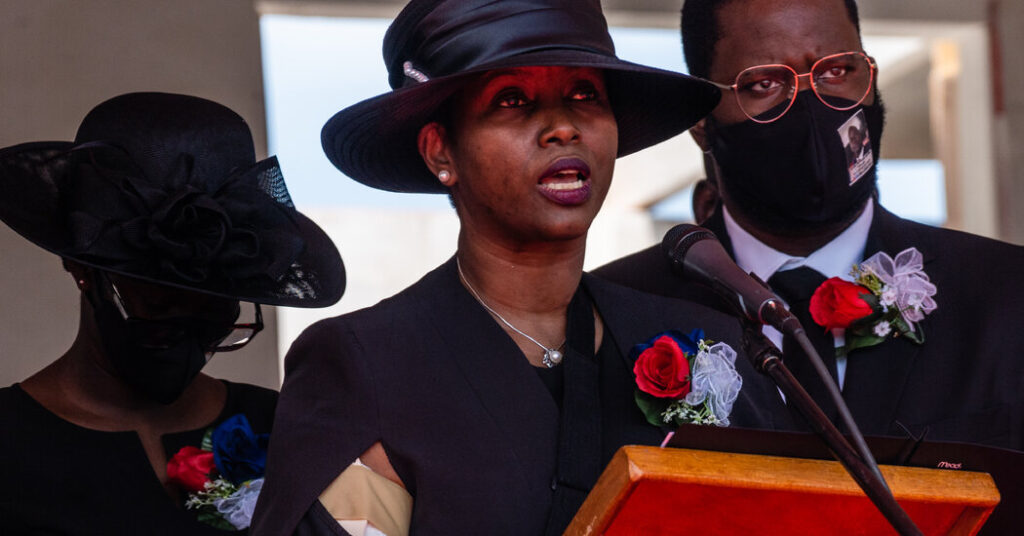
Nearly five years after Haiti’s president was assassinated in his bedroom, in front of his wife, she choked back tears on Tuesday as she began testifying in the U.S. trial of four of the men charged with plotting his murder.
“Please forgive me,” Martine Moïse said in Federal District Court in Miami, as she broke down moments after taking the stand. Using the name she called her husband of 25 years, President Jovenel Moïse, she added: “I promised Jo I would never cry again. I have been waiting so long.”
Dressed in a black jacket, blouse and skirt, Ms Moïse, 51, struggled with her emotions as she began to describe the events of the night in July 2021 when armed men stormed their residence, gunned down her husband and seriously wounded her, throwing their troubled nation even deeper into turmoil.
As the trial began Tuesday, she told the court that she was awakened at about 1 a.m. that night by the sound of gunfire, and turned, terrified, to her husband lying next to her. “I looked in his eyes. He was in shock,” she said.
Ms Moïse said she asked, “Honey, what’s going on?”
He replied, “Honey, we are dead.”
Mr. Moïse, 53, was gunned down at point blank range just before 2 a.m., in the culmination of what prosecutors say was a monthslong conspiracy orchestrated by a Miami area security firm, Counter Terrorist Unit Federal Academy, or CTU. The prosecution says CTU was hoping to overthrow the president in a “violent coup” in order to obtain lucrative security contracts from his replacement.
The four defendants, accused of conspiracy “to kill or kidnap” the president, included CTU’s co-owners, Arcangel Pretel Ortiz, who is Colombian, and a Venezuelan American, Antonio Intriago, who also faces charges involving the illegal export of body armor.
Also accused are a Haitian American security firm employee, James Solages, and Walter Veintemilla, an Ecuadorean American who helped finance the firm’s Haiti project. A fifth defendant, Christian Sanon, a Haitian American pastor and would-be presidential candidate, will be tried separately at a later date because of health problems.
The 2023 indictment charged 11 men in a bizarre plot involving a hit team of some 20 former Colombian soldiers, most of whom are jailed in Haiti awaiting trial there.
Five defendants in the U.S. case have pleaded guilty to taking part in the conspiracy and been sentenced to life in prison, and another pleaded guilty to a charge of providing body armor and was sentenced to nine years.
During opening statements on Tuesday before Ms. Moïse testified, the prosecutor, Sean McLaughlin, summed up the government’s case for the jury, saying the defendants were motivated by “greed, arrogance and power.”
The case against the four was “not complicated,” Mr. McLaughlin told the jury, explaining they were out to seize power and enrich themselves. “So arrogant and confident in themselves, the evidence will show, and thinking so little of the Republic of Haiti and its people, they actually thought they could pull it off,” he said.
He said the defendants communicated in thinly disguised coded text messages, calling Mr. Moïse “the rat” and “the thief.”
They also sometimes wore fake U.S. military uniforms and pretended to be officials from the State Department, the Drug Enforcement Administration or the C.I.A., he said.
Prosecutors say security firm also arranged meetings with violent gang leaders in Haiti to help overthrow Mr. Moïse, as part of several increasingly desperate efforts in 2021 to topple him.
After Mr. Moïse was killed, Mr. McLaughlin said, one of the defendants sent a text saying, “the rat is in the box.” Prosecutors say the defendants expressed “no genuine shock or horror,” and were focused on their escape plan, which failed as they were cornered and taken into custody.
Defense lawyers contend their clients are innocent and that the security firm was accidentally caught up in a sinister scheme by shadowy Haitian forces who contorted the firm’s legitimate security mission for their own plan to get rid of Mr. Moïse.
In their opening statements, the defense lawyers directed the blame repeatedly at several Haitians implicated in the plot, led by a former Haitian Justice Ministry official, Joseph Badio, who was fired by Mr. Moïse for corruption two months before the assassination.
“My client was set up,” said Orlando do Campo, the attorney for Mr. Pretel, who dismissed any potentially incriminating text messages as “statements made in false bravado.” He told the jury that his client was a dedicated former Colombian law enforcement officer who for many years had worked as an F.B.I. informant on sensitive cases involving drug trafficking and terrorism.
Far from directing a covert conspiracy, the lawyers said, the security firm’s owners wrote a letter to the United States Embassy announcing their presence in Haiti, even providing the names and passports of the 20 Colombian soldiers they had hired to work there.
“What kind of person who is planning an assassination goes to the embassy and announces themselves,” said Emmanuel Perez, the lawyer for Mr. Intriago. He said his client was at a family barbecue in Texas the night of the assassination and was oblivious to the attack on the president’s residence until later that morning.
Ms. Moïse will return to the witness stand on Wednesday morning. The trial is expected to last four to six weeks.
Her testimony is the first time she has spoken in detail about the assassination since 2021, including a lengthy interview with The New York Times barely three weeks after the attack.
In that interview, she described how her elbow was shattered by gunfire as the assassins stormed the room. “The only thing that I saw before they killed him were their boots,” Ms. Moïse recalled then. “Then I closed my eyes, and I didn’t see anything else.”
She entered and left the courtroom on Tuesday with her lower right arm at a crooked angle, and prosecutors say her elbow was permanently damaged.
She said in 2021 that she heard the attackers ransacking the room, searching methodically for something in her husband’s files. “‘That’s not it. That’s not it,’” she recalled them repeating in Spanish. Then finally: “‘That’s it.’”
People who have followed the case are curious if the trial will finally reveal what they were looking for.
Before court adjourned on Tuesday, Ms Moïse recounted how, after hearing the gunfire, she crawled downstairs to check on her two children, both in their early 20s, whom she found in her son’s bedroom with a family dog. She told them to take cover from stray bullets in a windowless bathroom, then headed back up to her own bedroom.
She found her husband hiding on the floor on the right side of the bed and he instructed her to do the same on the left side of the bed, using the mattress as cover. Lying on her stomach, she said she tried to squeeze her head and right side of her body under the bed, but it was too low.
That’s when the armed men broke in.
The post Widow Gives Harrowing Testimony About Assassination of Haiti’s President appeared first on New York Times.