For Zohran Mamdani, it has been a pretty sunny start.
A Siena poll in late January found that the mayor had the approval of 68 percent of New York City — almost 18 percentage points more than he’d gotten in the November election, and good enough for a net approval of plus 48. This put him in rarefied air alongside San Francisco’s Daniel Lurie, who more than a year into his mayoralty has been given credit for a profound turnaround in the city and who looks perhaps like the country’s most popular elected official. In February, after some frustrating snow, Mamdani’s approval dipped slightly — to 63 percent. His net approval was still higher than anything Eric Adams notched during the giddy period in which the former mayor was being celebrated as a future face of the national Democratic Party. It’s better than Michael Bloomberg ever managed, according to Marist, and in a political era widely seen to be drowning in negativity.
In 2023, as Adams faltered into scandal and made the city seem mired in dysfunction, my colleague Ginia Bellafante wondered whether New Yorkers would ever again have a really popular mayor. Just a few years later, the new mayor is starting off on a remarkable high note. To many, last year’s long campaign looked like a fractious and self-destructive saga, with Democrats turning on one another in the presence of a candidate routinely described by his opponents as divisive. Those fault lines are still there; they were pulled into sharper relief this weekend, when New Yorkers read about some 2023 Instagram likes by the first lady, Rama Duwaji, concerning the war in Gaza, and learned about an incident near Gracie Mansion, where there was what the N.Y.P.D. is calling an “ISIS-inspired” attack involving an explosive at a protest.
But whatever the future holds, the mayoralty has begun with a very high baseline of support. Mamdani’s thumping win in November has given way to what looks less like a liberal crackup and more like the city coming together behind an incredibly popular new mayor.
How did this happen? The short answer is actually pretty intuitive, I think: Mamdani is a really good politician offering a wildly appealing and easy-to-understand brand of transformational politics. Voters who wanted more from their government had grown to resent the way this desire had long been derided as pie-in-the-sky. Whether voters will think Mamdani delivered over the course of a full term remains to be seen. In the meantime, so long as New Yorkers believe that he is earnestly trying to make government work better on their behalf and improve their lives, he’s probably going to remain popular.
But the story is also a bit more contingent and complicated than that. Here are a few threads.
The mayor has actually made serious, concrete progress already, gratifying his enthusiastic voters.
In January, Mamdani secured from Governor Kathy Hochul a promise to fund a big chunk of his proposed child-care program, which had been mocked by critics throughout the campaign as a budget-busting nonstarter. Just this week, he announced he’s expanding the existing 3-K program, too. He’s managed to gain control of the Rent Guidelines Board, ; has staged the first of his “rental rip-off hearings”; and has revived an office meant to protect tenants.
He’s also conspicuously moderated, appealing to some skeptics.
Even before the election, Mamdani promised to keep Jessica Tisch on as the police commissioner; she is a favorite of the city’s centrist establishment. Then, despite some obvious policy disagreements, he persuaded her to actually stay on — at least for now.
After the election, Mamdani dropped his pledge to end mayoral control of schools, which had made him a bit of an outlier among the candidates. Once he became mayor, he quickly initiated reforms to permitting and housing development oversight, which made YIMBY centrists almost giddy. And in his proposed budget, he appeared to cut the city’s two-year fiscal gap almost in half, partly because of a rosier economic forecast that projected larger revenues. He’s pitching Albany on tax hikes now.
This isn’t just tactical maneuvering. During the campaign, Mamdani lamented the way that the left had allowed ineffectiveness and inefficiency to become right-wing talking points, and on election night he promised to “leave mediocrity in our past” and make “excellence” the “expectation across government.” Big government must work well to justify itself, he’s argued, even implementing a progressive version of the DOGE commission in the form of agency “savings officers.”
He’s also considering eliminating free parking, a policy change favored by urbanist technocrats and one that mixes aspects of Mamdani’s renter-populism (taxing drivers to subsidize other services) with something that looks like its opposite (eliminating a free public good). And his record so far in office suggests that, whatever the ideological and interpersonal animosity, the left wing of the progressive coalition and the “Abundance” caucus at its center can make for a remarkably appealing political fusion.
Whether you call it sewer socialism or just eager competence, Mamdani looks to most New Yorkers like he is working really hard.
The first couple of months have not been without difficulty. Snowstorms have punked mayoralties before; though the city has gotten remarkably efficient in keeping its streets clear in recent years, Mamdani’s snow clearance was nevertheless impressive — especially after the year’s second big storm, in February, when he doubled the number of temporary shovelers he hired to help.
More than a dozen people died outside from the cold on Mamdani’s watch. And the mayor’s approach to, and messaging around, homelessness in the frigid weather has been a bit confusing. His budget proposal has opened up some fault lines with his voters over cuts to funding for libraries and parks, among other issues. But as a successor to Eric Adams, Mamdani hasn’t looked to be in over his head. Quite the opposite: Since his first week in office, when he paved over a bump that had bedeviled bikers on the Williamsburg Bridge for years, he’s been popping up routinely to deal with issues that New Yorkers often considered below the concern, or beyond the reach, of city government.
And he seems to have forged what looks like a working relationship with Trump.
On the debate stage last June, Andrew Cuomo promised that in any confrontation with the president, “Mr. Trump would go through Mr. Mamdani like a hot knife through butter.” Like a lot of campaign bluster, this looks in retrospect kind of hysterical.
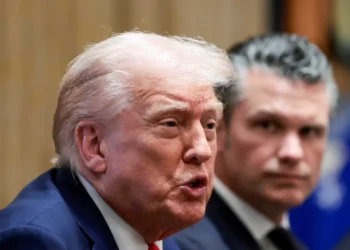
The mayor and the president have now had two highly publicized Oval Office meetings. In the first, Mamdani managed to elicit praise and promises of collaboration despite acknowledging that he thought Trump was a fascist; in the second, he pitched the president on a $21 billion affordable housing development over Sunnyside Yard. It’s not clear whether that funding will actually come, or whether Trump will ever choose to menace his hometown with an ICE incursion like those he has sent elsewhere. But for now this is obviously not a story about a hot knife and butter; on social media, at least, it looks more like a bromance.
He’s benefiting from the end of the Trump “vibe shift” and what seems like the beginning of another one.
Mamdani began his campaign, effectively, with a man-on-the-street video filmed in Queens and the Bronx right after the 2024 election, in which he asked local voters why they’d pulled the lever for Trump. A year ago, the video could’ve served as a postcard from the MAGA future, with disaffected working-class Black and brown voters swarming to Trump out of a broad sense of economic grievance (and, their professed frustration with Biden’s support for Israel in the war in Gaza).
A year later, it looks like a picture of a very different future, in which those demographic cohorts formed only the most passing attachment to Trump and MAGA, then jumped ship once the memory of the Biden era was replaced by the frustrations of Trump’s second term. That’s not to say that what has emerged is a new, permanent Mamdani coalition either. But what looked like an uphill battle for multicultural progressivism in November 2024 now looks like something racing downhill — especially in New York.
And of course Mamdani benefits from direct contrasts with Trump himself. Nationally, liberals continue to feel frustration if not rage that the Democratic Party seems to lack real leadership. But in New York, they have someone around whom they can actually rally.
He’s also benefiting from an astonishing decline in crime, homelessness and immigration pressure.
It’s hard to remember now, or perhaps even to believe, but Cuomo launched his campaign for mayor by arguing that the city needed an experienced moderate to restore order to an urban hellscape. Even at the time, the message was out of step with the data. To the extent that the city had been plagued by social disorder in the aftermath of the pandemic, for some of the worst crimes, those years were already well behind us.
The immigration crisis, too, which Adams had warned would “destroy New York City,” has abated, especially now that the United States’ southern border is effectively closed. The sheltered homeless population, which had grown in significant degree because of the pressure of newly arrived immigrants, has fallen by about a quarter since its peak in early 2024. And while New York’s large number of homeless people remains a social crisis, more than 95 percent of the population sleeps in shelters, compared with rates below 50 percent across cities in California.
Anybody elected last November would have benefited from these tailwinds — this is one reason Daniel Lurie, the San Francisco mayor, is so popular, too. These trends also point to a very different political mood than the one that has clouded American cities for the past five or six years, and there aren’t many mayors throughout the country, if any, more temperamentally and ideologically suited than Mamdani is to take advantage. That’s because …
Mamdani is offering something no other politician in America has seemed able to for years now: a relentless optimism about what is possible through politics.
From most vantages, these days, the political landscape looks grim. But when I come across the mayor in my social media feed, it’s like news beamed in from an entirely different universe — more colorful, more energetic, much less intimidated by local sclerosis and far more certain that government can do a lot more, for many more people, than it has.
Partly, I think, this is because a 34-year-old mayor can bounce around the city much more busily than a 68-year-old former governor (or perhaps an even older member of the gerontocracy). Partly it’s ideological, since Mamdani was swept into office on promises that the city can and should be remade, not just swiftly but mostly painlessly. Partly it’s a credit to the social media team that has won so much praise since Mamdani’s upset primary victory last summer, with the mayor’s messaging still focused on proving that voters were “right to believe” rather than voting more cynically. But it’s also a reminder of a corny truth: Even at a time when our politics is layered over with algorithmic rage, people want to be hopeful about the future — and want leaders who are, too.
The post Why Mamdani Is One of America’s Most Popular Politicians. For Now. appeared first on New York Times.