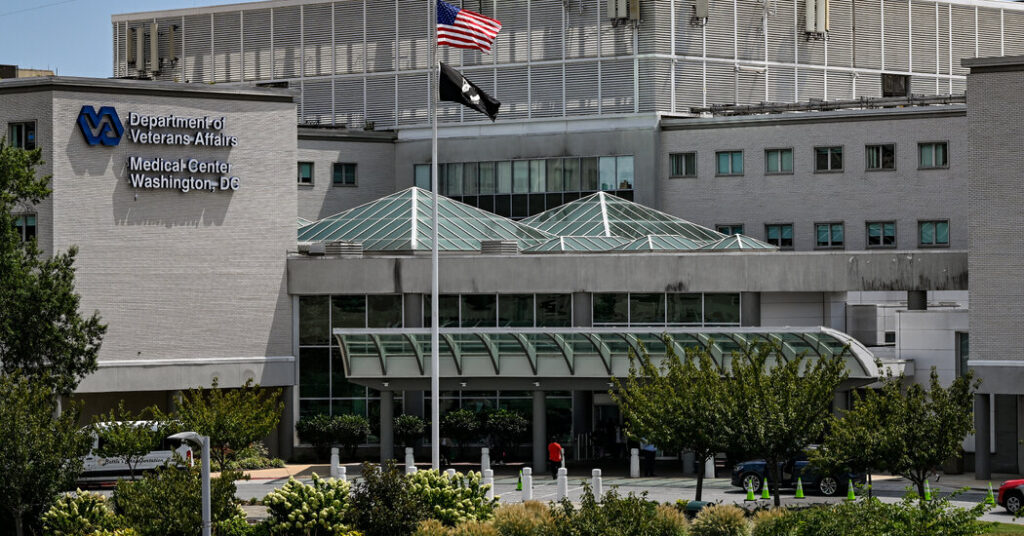
The Trump administration on Wednesday announced a new effort to initiate legal guardianships for homeless veterans, which could be used to force more of them into involuntary or institutional care.
The new system, carried out in partnership with the Justice Department, will invest Veterans Affairs Department attorneys with expanded powers that would allow them to initiate and take part in guardianship proceedings for veterans who have no family and are “unable to make their own health care decisions.”
The initiative represents the Trump administration’s most concrete action to advance its goal of compelling more homeless people into involuntary treatment for mental illness and drug addiction.
President Trump identified the issue as a priority during the 2024 presidential campaign and promoted it last July in an executive order that called on agencies to use civil commitment to move homeless people into “long-term institutional settings.”
Critics say the policy shift raises significant civil liberties concerns, noting that in earlier generations, people with severe mental illness were routinely stripped of their legal rights and confined to state hospitals.
The V.A. says the guardianship initiative would affect “hundreds” of veterans who are currently in V.A. facilities but need “a legal decision maker” to transition to a new setting. Some are homeless, and others are “at risk of homelessness” upon discharge, the agency said in a press statement.
“Our new partnership with the Justice Department reflects our ongoing commitment to ensuring that every veteran receives timely, appropriate care,” said Doug Collins, the V.A. secretary.
Guardianship powers are broader and longer lasting than civil commitment, which is used to compel someone to accept medical treatment.
Guardianship proceedings are typically initiated by family members, friends or health care providers, and are argued before state or probate judges, with the subject entitled to legal representation. If a court finds that the person is not able to make basic decisions about health and safety, a guardian is appointed.
Guardians can control a person’s assets, where the person lives and whom he or she sees. They can also require the person to accept medical treatment. Unlike civil commitment rulings, which expire after a specific time period, guardianships are intended to be durable, though they are revisited periodically and can be terminated or dissolved.
Rights advocates said they were alarmed by the proposal, which they saw as part of a drive by the administration to place homeless people in institutional settings against their will.
“My speculation is that they are seeking to have people placed under guardianship so they can have a person appointed who will force them into congregate or institutional settings when there isn’t anything else available,” said Jennifer Mathis, the deputy director of the Bazelon Center for Mental Health Law.
If there are veterans “sitting in V.A. hospitals” unable to be discharged, as the V.A. says, she said, it is “almost certainly” because there are long waits for intensive community services or independent housing. She added that it is highly unusual for the Justice Department to take a role in guardianship proceedings, which are governed by state laws.
“I don’t know what their authority is,” Ms. Mathis said. The federal government, she added, “has very little to do with guardianship.”
Stephen Eide, who studies homelessness at the Manhattan Institute, welcomed the Trump administration’s efforts to expand guardianship, which he said could protect people at risk of “slow-motion suicide.”
“More use of involuntary treatment is essential to solving street homelessness,” he said.
But he cautioned that successful implementation could be challenging, since it requires coordinated efforts among police officers, social workers, clinicians and lawyers, often employed by different levels of government. “It’s hard to change big systems,” he said.
A pilot project to expand guardianships at the V.A. has been under discussion for months.
The pilot, called “Project Safe Harbor,” identified five V.A. hubs that had been selected to test a “guardianship model for veterans experiencing homelessness” who lack capacity to make “appropriate medical and social decisions for themselves,” according to an internal memo shared with The New York Times. The sites were asked to refer veterans and take legal steps for “placement into appropriate care sites.”
There are about 33,000 homeless veterans in the United States, about 14,000 of whom live on the streets. Veterans make up around 5 percent of the unsheltered homeless population.
Ellen Barry is a reporter covering mental health for The Times.
The post V.A. Begins Drive to Put Homeless Veterans Into Guardianship appeared first on New York Times.