The United States is negotiating the extradition of a billionaire businessman linked to Nicolás Maduro, the detained Venezuelan president, according to seven Venezuelans and Americans familiar with the matter.
U.S. prosecutors in Miami filed a sealed indictment against the businessman and former government official, Alex Saab, on corruption charges in January, soon after the U.S. Special Forces captured Mr. Maduro in a dramatic raid on Venezuela’s capital, Caracas, some of the people said. Like others interviewed for this article, they requested anonymity because they were not authorized to speak publicly. Venezuela’s government, at Washington’s request, detained Mr. Saab in early February. The move showed the level of the Trump administration’s influence on the country’s new leader, Delcy Rodríguez, Mr. Maduro’s former vice president. It also underscored the rapid shift in power in Venezuela after its longtime leader’s downfall.
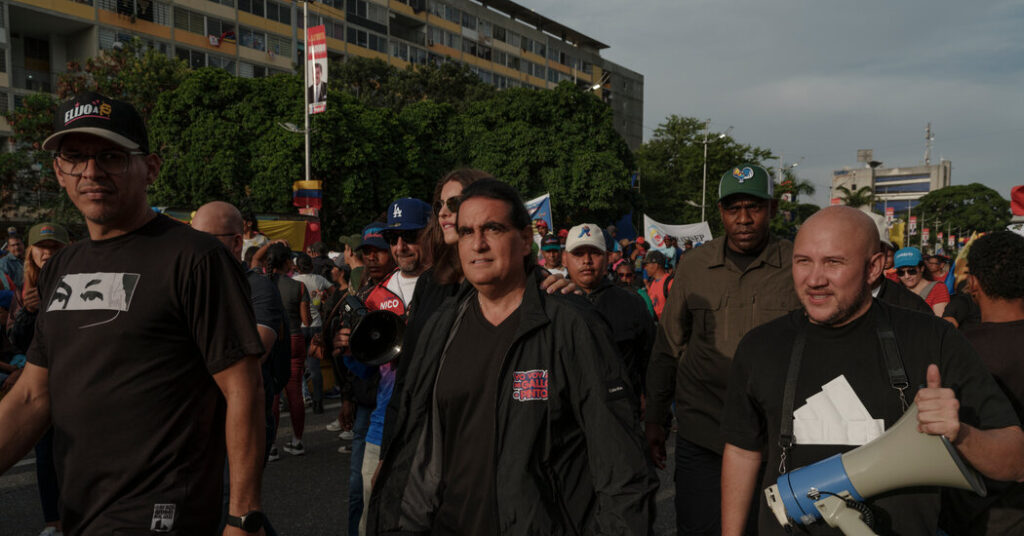
Mr. Saab, 54, is a friend of Mr. Maduro’s whom U.S. prosecutors for years have accused of enriching himself through lucrative government contracts. They also say he controls some of Mr. Maduro’s funds.
The people familiar with Mr. Saab’s case said the negotiations between U.S. and Venezuelan officials over his extradition were in an advanced phase, but added that no final decision on sending him to the United States had been made.
Mr. Saab’s lawyers in Venezuela declined to comment. U.S. diplomats representing Venezuela directed questions to the State Department in Washington, which did not immediately comment. The U.S. Justice Department and Venezuela’s communications ministry did not respond to requests for comment.
If the extradition proceeds, Mr. Saab could end up in a U.S. prison for a second time.
In 2021, Mr. Saab was detained at the request of the U.S. government in the West African nation of Cape Verde while traveling on business to Iran, a close ally of Mr. Maduro’s government. He was later extradited to the United States, where he spent nearly two years behind bars on money-laundering charges before being pardoned by the Biden administration. Mr. Saab denied any wrongdoing.
He was returned to Venezuela in a 2023 prisoner swap that included 10 Americans and was welcomed home as a hero by Mr. Maduro.
A Venezuelan investigative news outlet, Armando.info, reported that, between 2013 and 2020, Mr. Saab obtained contracts worth more than $10 billion through a network of companies registered in Panama, Hong Kong, Mexico, Turkey and the United Arab Emirates.
Two people close to Mr. Maduro’s family said they believed that the United States had renewed its pursuit of Mr. Saab in recent months to strengthen the criminal case against the former Venezuelan president, who is to be tried in U.S. federal court in New York on drug-trafficking charges.
But other people familiar with Mr. Saab’s case have downplayed the connection between the two legal cases. They said the Trump administration’s pursuit of Mr. Saab is partly driven by a desire to inflict political damage on Democrats since the businessman was pardoned by a Democratic president, Joseph R. Biden Jr.
Born in Colombia, Mr. Saab moved to Venezuela during Mr. Maduro’s time in office and is a citizen of both countries, a fact that may complicate his extradition, some of the people said. Venezuela’s Constitution explicitly prohibits the extradition of citizens, though some legal experts have argued that a provision in a 1922 treaty between the United States and Venezuela may allow exceptions.
Mr. Saab used his Venezuelan diplomatic passport as a legal defense during his previous criminal case in the United States, arguing that it gave him immunity. U.S. prosecutors argued at the time that Mr. Saab had obtained his Venezuelan passport illegally.
Ms. Rodríguez, Venezuela’s new leader, worked with Mr. Saab in the past, including helping to lead the country’s effort to withstand U.S. sanctions amid Mr. Trump’s effort to unseat Mr. Maduro during his first term in office. Ms. Rodríguez helped Mr. Saab to procure ships for food imports, according to people close to Venezuela’s government.
Ms. Rodríguez’s political ascent in the years that followed, however, eventually led to clashes with Mr. Saab, who continued to obtain contracts to export Venezuelan oil on Mr. Maduro’s orders after returning to Venezuela in 2023, according to people close to the government and internal data from the Venezuelan state oil company.
These tensions escalated into a rupture after Mr. Maduro’s downfall. At Ms. Rodríguez’s request, the U.S. Navy intercepted several tankers tied to Mr. Saab that left port without the government’s permission hours after Mr. Maduro’s capture.
Mr. Saab at the time denounced The New York Times’ report about his ties to the tankers as “fake news.”
Two weeks after Mr. Maduro’s capture, Ms. Rodríguez removed Mr. Saab from his post as the minister of industry and begun to sideline his allies. Most recently, she fired Mr. Saab’s wife, Camilla Fabri, a former Italian model, from her government post.
Jonah E. Bromwich and Patricia Mazzei contributed reporting.
Anatoly Kurmanaev covers Venezuela and its interim government.
The post U.S. Seeks Extradition of Maduro Ally Pardoned by Biden appeared first on New York Times.