The United States has for years deployed a carefully designed economic statecraft playbook to pressure American adversaries to change their behavior. This year the Trump administration has reached the limits of those tools, opting instead to use military force to remove the leaders of Iran and Venezuela.
The decision to abandon maximum pressure sanctions campaigns on Iran and Venezuela came after extensive attempts to use U.S. economic leverage failed to compel political change. In many cases, widespread evasion and lax enforcement of U.S. sanctions have diminished their power, even as the United States leaned more heavily on such measures to avoid armed conflicts. But in a global economy that is increasingly fragmented, with currencies besides the dollar gaining prominence, America’s financial might can do only so much.
“I think that consistently the Trump administration has chosen goals for sanctions that are beyond the capacity for sanctions to achieve,” said Edward Fishman, a senior fellow and director of the Maurice R. Greenberg Center for Geoeconomic Studies at the Council on Foreign Relations. “We’ve seen the exact same pattern play out with both Venezuela and Iran.”
President Trump has expressed a preference for tariffs over sanctions as his economic weapon of choice, but he has deployed sanctions on the energy sectors of Iran, Venezuela and Russia during both of his terms.
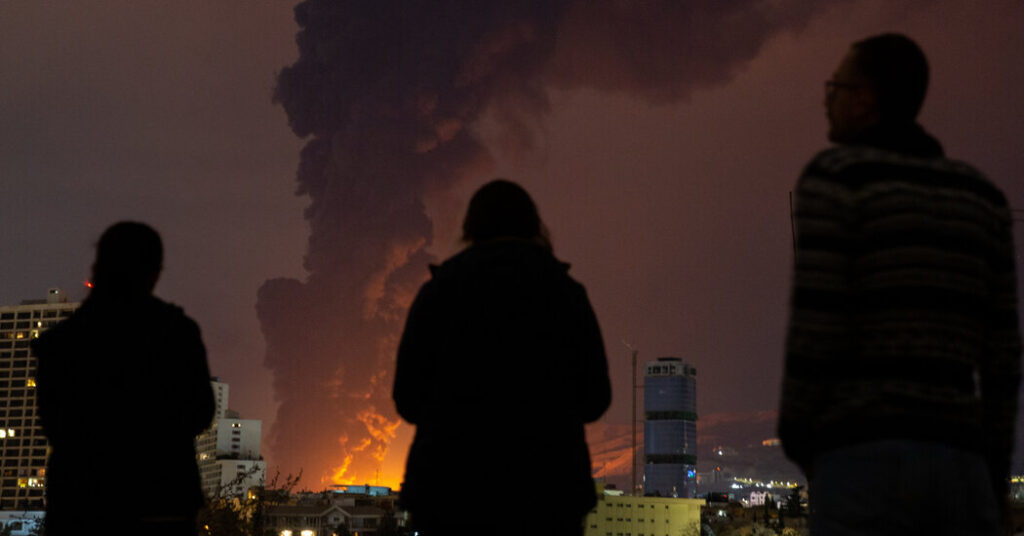
During Mr. Trump’s first term, he withdrew from the Iran nuclear agreement that was reached during the Obama administration and ratcheted up sanctions pressure on Iran in hopes of toppling its government. Despite those efforts, Iran’s government remained in place and continued to pursue its nuclear ambitions. Last month, the United States and Israel attacked Iran in a brazen attempt to eliminate its nuclear program permanently.
After President Nicolás Maduro’s controversial re-election in 2018, Mr. Trump also deployed an aggressive array of sanctions on Venezuela in hopes that he would break Mr. Maduro’s grip on power. Those sanctions helped to hobble Venezuela’s economy, but a U.S. military operation in January was required to capture Mr. Maduro in his fortified compound in Caracas and remove him from office.
The Treasury Department’s sanctions tools allow the United States to withhold access to property and block transactions associated with companies, individuals and governments. Sanctions experts argue that they are part of a suite of tools that governments can use to coerce adversaries.
“I think sanctions are designed to degrade not to sort of cause something to collapse,” said Adam Smith, a former sanctions official at the Treasury and a partner at Gibson, Dunn & Crutcher. “Sanctions, I think, change the board game but don’t get a checkmate.”
In his first term, Mr. Trump wielded sanctions aggressively, irking U.S. allies and prompting new evasion efforts. His former Treasury secretary, Steven Mnuchin, warned in 2019 that over time an irresponsible use of sanctions could prompt the world to shift away from the dollar as the reserve currency. He noted that the dollar’s global status has made it a major component of trade that banking systems rely upon, giving the United States certain advantages that could eventually erode.
Upon Mr. Trump’s return to the White House, his use of sanctions has been even more haphazard, and he has shown a willingness to break norms.
In July, the Treasury Department imposed sanctions on a Brazilian Supreme Court justice, Alex de Moraes, who had presided over the conviction and imprisonment of former President Jair Bolsonaro — an ally of Mr. Trump — for attempting to overturn the country’s 2022 election.
The use of sanctions as political retribution caused frustration among career staff within Treasury’s Office of Foreign Assets Control and several officials resigned soon after they were imposed, according to a former Treasury official. The department lifted the sanctions on Mr. de Moraes in December.
The Treasury Department has also been pushing the boundaries of financial tools domestically. In January, Treasury Secretary Scott Bessent announced that its Financial Crimes Enforcement Network issued a geographic targeting order in Minnesota to require banks and money transmitters in certain counties to report additional information about funds being transferred outside of the United States.
The policy led to confusion among local banks. Internal dissension over the policy was one of the factors that led to the departure last month of John Hurley, the under secretary for Terrorism and Financial Intelligence, from the department. Gene Lange, a counselor to Mr. Bessent, is now serving as administrator of T.F.I., according to people familiar with the matter. The Treasury Department did not respond to requests for comment.
Despite those decisions, the Trump administration has been watering down some policies intended to crack down on illicit financial transactions by making firms reveal their ownership structures. The Treasury Department is not enforcing reporting requirements that are part of the Corporate Transparency Act of 2024, which it believes is too onerous for small U.S. businesses. Proponents of the law argue that weakening it makes money laundering and fentanyl trafficking easier.
Now, with oil prices soaring, the United States has started to ease some sanctions on Russia that have been in place since its invasion of Ukraine in 2022. The Treasury Department said last week that it would allow sanctioned Russian oil that is stranded at sea to be delivered to India.
Mr. Bessent said that additional sanctions relief for Russia could help lower oil prices by freeing up hundreds of millions of barrels of crude oil.
For years, the United States has been warning about the risks of Russia’s “shadow fleet” of unmarked tankers that it has used to evade sanctions. Depending on how the Trump administration opts to ease sanctions on Russia, those tankers could become part of a strategy to allow more oil to be sold around the world.
“It’s another interesting angle on the cascading impacts of different sanctions policies and speaks to the more transactional approach in the use of sanctions,” said Alex Zerden, the founder of Capitol Peak Strategies and a former official in the Treasury’s Office of Terrorism and Financial Intelligence.
The White House contends that easing Russian oil sanctions will offer little benefit for Russia.
But critics suggest that letting Russian oil flow during war with Iran underscores the inconsistency of the U.S. sanctions policies.
“Admittedly, this is not a meaningful windfall or profit for Russia, but it does undercut Ukraine,” said Daniel Tannebaum, a senior fellow at the Atlantic Council who previously served as the Office of Foreign Assets Control compliance coordinator for the Federal Reserve Bank of New York. “If we can bear the pain to confront Iran, why not to pressure Russia too?”
Alan Rappeport is an economic policy reporter for The Times, based in Washington. He covers the Treasury Department and writes about taxes, trade and fiscal matters.
The post Trump’s Actions in Iran and Venezuela Show Limits of U.S. Sanctions appeared first on New York Times.