Holograms are a mainstay of science fiction, popping up across the great expanses of Star Wars, Star Trek, Halo, and The Expanse. If a story is set in the future, or in space, it’s probably got a hologram in it. Unfortunately, this is less the case in real life, despite many tech companies eager to make holograms a reality.
The latest effort to beam a holographic device into our world comes from Looking Glass, a Brooklyn-based company that has been dabbling in 3D holographic screens for nearly a decade. Today, it announced the Musubi, a consumer-focused digital picture frame.
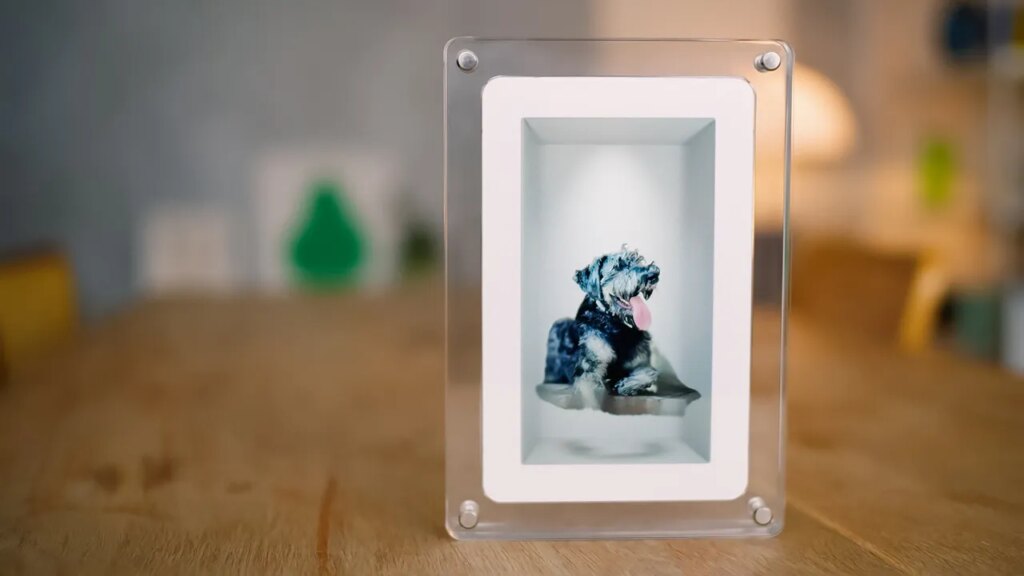
Upload any picture or video, and Musubi uses artificial intelligence to extract the most important part and hover it in space as a 3D image within the frame. That could be a video of a child’s first steps or a snapshot of a birthday party. (Or, like one of Looking Glass’ examples, a cat exposing its butthole.) The image will be displayed in 3D form, viewable in all its holographic glory across nearly 170 degrees.
“The goal for us is to bring holograms to everybody,” says Looking Glass CEO Shawn Frayne. “In a way, it gets as close to the sci-fi dream as humanly possible.”
The Musubi is a far cry from something like the hologram-adjacent Ava AI that gaming company Razer announced at CES this year and revealed more details about this week at the Game Developers Conference in San Francisco. Razer’s offering is an AI chatbot character that floats in a 3D tube you can put on your desk. The company is pitching it as a “Friend for Life” that can chime in while you’re gaming or help organize tasks in your daily life. (Yes, it is rendered to look like a cute anime girl, but there are other characters.)
The Musubi is a 7-inch photo and video frame. There is no Wi-Fi connection required, no app, no cameras on the device, and no subscription service to keep it working. The actual processing required to turn an image or video into a hologram is done in a program on a PC or MacBook, which Looking Glass includes for free. Once the images are edited, you can add them to the device via a USB-C cable; the Musubi can store up to 1,000 images. (Videos take up more space, but are limited to 30-second-long clips.) The Musubi can be plugged into a wall socket and has a built-in rechargeable battery that lasts up to three hours.
Frayne is keen to point out that this is one of the first devices to use completely local AI and machine-learning generations to power its holographic images. He says the goal is for people not to have to worry about their images being fed into AI generators by giant tech companies. After all, that’s his daughter taking her first steps in the emotional image Looking Glass is using in a video to market the Musubi. Frayne says he’s not saying Looking Glass will never make a camera-equipped product, but the goal was to make the device as simple as possible.
“Looking Glass doesn’t have access to that data, and neither do any of the big AI companies,” Frayne says.
Looking Glass makes display screens with a technology it calls Hololuminescence. This mimics the holographic experience by turning 2D images on a display into moving 3D images viewable by multiple people at once. Though its screens are thin, the backgrounds are portrayed as fixed rooms, maintaining a sense of space that feels like looking through a doorway. The picture, spacious as it feels, still sits behind a screen. So, not exactly a Cortana-style hologram you can hold in your hand, but a view that recreates the process nonetheless.
The process sounds very similar to the features you can find on Google or Meta’s platforms that let you animate with AI, turning a still picture into one of you dancing. Frayne compares the technology to Apple’s Project Sharp, a method for synthesizing images with photorealistic depth.
Looking Glass announced its first Hololuminescent Displays in 2019. They have been mostly large, expensive displays aimed at business clients like medical clinics, museums, or powering big advertisements on bus stops. Prices range from $2,000 for the smaller screens to $20,000 for a human-sized display.
Looking Glass has flirted with the consumer space before with its $229 Looking Glass Go. (Which WIRED included in its best of CES picks in 2024.) But that was intended as a developer kit. What Looking Glass hopes to achieve with its first consumer product is a much simpler frame that can be used in the home by just about anyone.
The Musubi costs $99 for the first 24 hours on Kickstarter. After that, it’ll cost $149. (While Looking Glass has successfully launched products on Kickstarter before, Frayne says the company will still produce the Musubi even if it doesn’t meet its goal on the crowdfunding platform.) The first units will ship sometime in June 2026. After that, Frayne says the company will evaluate how the experiment has gone.
It’s hardly the first time AI and art are mixing in a physical picture frame. Even just a few months ago, at CES 2026, a company called Fraimic showed off an E Ink digital frame powered by generative AI. Speak a prompt of what you want to see, and it will drum up the image in the art style of your choosing. But few frames have the realistic depth of the Musubi.
“We’re kind of at the very beginning of this AI revolution, and we wanted to try to do something different than what else is out there,” Frayne says. “We’re curious if people do value the ability to have a completely local model.”
The post This Digital Picture Frame Wants to Bring People Closer to a Holographic Future appeared first on Wired.