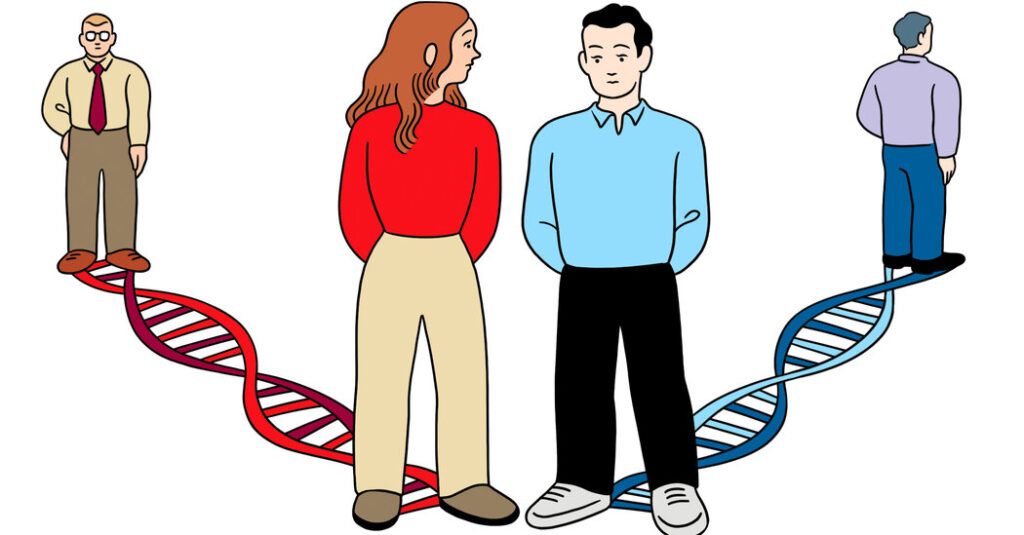
Through a commercial DNA-genealogy website, I discovered that my youngest brother has a different father than I do. My brother is not a subscriber to this site, but his daughter is, and it’s clear that she’s a half-sibling’s child with no relation to my father. My parents were also subscribers, though my father died before this revelation, and their divorce, years earlier, was for unrelated reasons. I’m less troubled by the affair itself — the marriage was miserable — than by my mother’s decision to join a site where this could so easily surface. I haven’t bothered to confront her; I suspect she’d only deny it.
My quandary is whether to tell my brother. Our father was a tyrant; and it would seem my brother has a right to know that he has a biological father out there, possibly still alive. The complications: We are estranged (due to his drug use and criminal history), and he is also estranged from his daughter (she was raised by her mother and none of us have seen her since her infancy). My other siblings, though close to me, are unaware. I worry about their reaction and don’t want to hurt my elderly mother. I’ve steered my own children away from the website, citing privacy concerns, but really I’m uncomfortable with them learning their grandmother’s secret.
Do I keep this to myself, or will I regret denying my brother the chance to know his real father and maybe heal his past? There’s a slim possibility my mother already told him, but that kind of honesty would be extremely out of character. — Name Withheld
From the Ethicist:
You say that you haven’t bothered to raise this matter with your mother. Well, do bother. You can make it clear that you’re simply letting her know that you’ve come across this information. It might ease her discomfort if you let her know that you’re not especially troubled by the news. The information you have bears directly on your youngest brother’s life, and he is entitled to it. She should be prepared for the idea that he — and, independently, others — will learn what you’ve learned. And because your brother has a right to seek his biological father, he may want to know whether he has other relatives, or learn more about his origins. There’s value in having a realistic understanding of one’s circumstances. Your mother is the person best placed to provide that.
Readers Respond
The previous question was from a reader who felt deeply torn about whether to provide support for a mentally ill sibling whose actions had shattered their family. She wrote:
My sister has bipolar disorder and late-onset schizophrenia. About five years ago, she beat our mother so badly that she spent months in a coma. … She had stopped taking her medication because she didn’t like how it made her feel. Our mother died two years later, after a series of strokes that doctors linked to the brain injury. … My sister will be released soon, and I am simply beside myself. The trauma her actions caused is indescribable, especially to her children, who were teenagers, and my own children, who were very close to their grandmother. … Now my sister’s psychiatrist wants to reunite us so she will have “family” support after release, and says she will do better with a strong network. No one wants that, especially her children, to whom I’ve become a surrogate mother. … If I refuse, her future looks shakier. If I help, my family, especially all the children, may never forgive me. What do you suggest? — Name Withheld
In his response, the Ethicist noted:
Modern moral theories tend to focus on issues of intentions and control, as if this were all that matters. In truth, harm has its own weight. … For clinicians, it’s natural to consider family as a continuation of the institutions of care. … But how to ask people to structure their lives around the person who destroyed the one they had? Meanwhile, you have responsibilities to members of a traumatized family, yourself included. And you shouldn’t agree to play a role that will leave you isolated from them. What you can do is talk with everyone in your new family about why you want to help your sister, and ask what, if any, emotional or logistical support they’re willing to provide. The answer could be a little, or it could be none. The burden can’t fall on one stressed sibling, though. You care deeply for your sister. But you can wish her a better life without being in a position to help her build it.
(Reread the full question and answer here.)
⬥
I cared for a relative who, owing to a similar diagnosis, tried to kill one of his co-workers. I was already helping him out when I learned of this history. When I was weighing whether to continue, the fact that he adhered to his doctor’s advice and always took his meds made me feel safe. My bipolar father, on the other hand, never stayed on his meds. I felt little guilt in stepping away from him. Sometimes people need social permission to walk away. I hope the letter writer feels enough social permission to protect herself here. — Erika
⬥
The therapist has no business placing the sister’s ostensible “needs” over the needs of the family she shattered. The therapist should certainly be a zealous advocate for their client, but they should also understand the incredible trauma that this will continue to inflict on the family. The Ethicist and the therapist should also consider the possibility that this person is still capable of harming someone in the family (or outside of it). — Betty
⬥
Psychologist here. What a tragic, distressing situation. If this were my patient, I too would reach out to the family to see what support might be available. But pressuring an understandably reluctant family member would not best serve my patient. Far better to help my patient grieve lost relationships while making plans for any community support that is realistically available rather than having unrealistic expectations and hopes. — Lynn
⬥
My thoughts, based on personal experience with our son: The sister has been in a very sheltered and structured environment where she has had continual encouragement to stay on her meds. She should have a lengthy track record of consistently taking meds of her own free will before the family opens themselves up to renewing their relationship with her. There are other options, such as halfway houses, to provide support in the meantime. — Connie
⬥
I have bipolar disorder. I am compliant with my medication, yet my behavior has been disruptive to my family. While I have never laid a hand on anyone, I have verbally abused family members, including my parents, and I am ashamed and horrified by that. My family has walked away from me because of my toxic behavior. There’s a fine line between taking responsibility for your actions and recognizing that they are driven by a disease that is not necessarily in your control. I have found support through group therapy and friends I have met in treatment. Even knowing what I know about mental illness, if this were my sister, I would walk away. It’s simply not worth the risk. — Mary
The post Should I Tell My Estranged Brother About His Biological Father? appeared first on New York Times.