The United States may once again be poised to turn the Kurds into their foot soldiers in a Middle East war, this time inside Iran. Regime change is seemingly one of the American goals in the latest U.S.-Israeli attack. But the air campaign alone, while devastating, is unlikely to bring that about, so Washington appears to be assessing if it should use Kurdish fighters in Iran.
This will most likely backfire terribly — both on the Kurds and on other U.S. allies in the region. It could also set in motion the nightmare scenario of a civil war.
Although President Trump has flip-flopped about supporting the deployment of armed Iranian Kurds, saying on Saturday that he did not want them to go in, several developments suggest that such U.S.-Israeli plans exist.
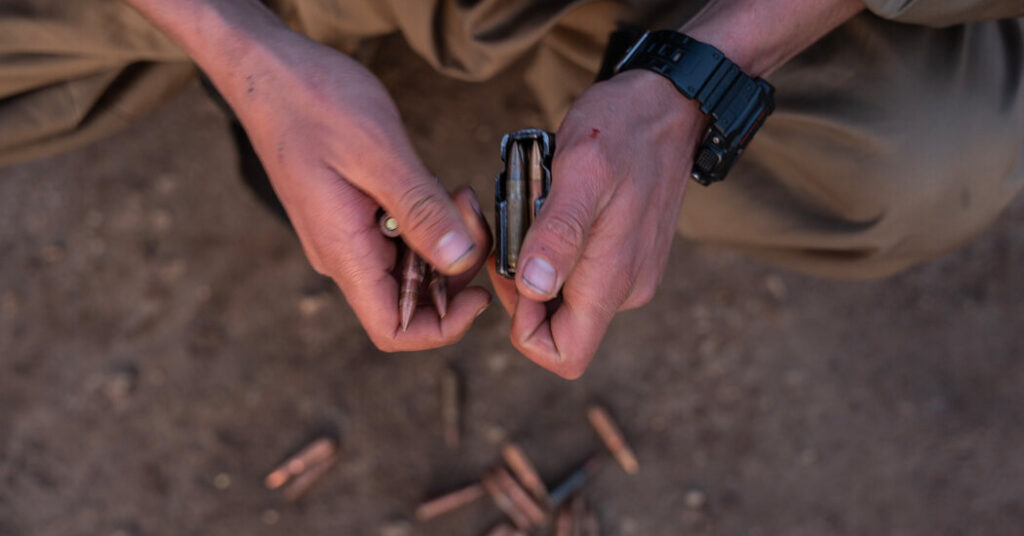
The country’s Kurdish region in the west has been heavily targeted during the bombing campaign in an apparent effort to weaken Iranian security forces there. The United States has also made a political push to rally Kurdish factions. On the second day of the war, Mr. Trump spoke to senior Kurdish leaders in the semiautonomous region of Iraqi Kurdistan, considered U.S. allies. He reportedly pressed them to allow armed Iranian Kurds — long operating out of Iraqi Kurdistan — to cross the border into Iran. There have also been leaks to the media that the C.I.A. and Israel have increased the arming of Iranian Kurds in recent months.
Like Kurds who fought Saddam Hussein in Iraq and Bashar al-Assad in Syria, the Iranian Kurdish minority has been harshly treated throughout history and has long sought self-rule. Since the brutal crackdown on Iranian protesters in January, six Iranian Kurdish dissident groups running operations from Iraqi Kurdistan have come together for the first time. According to the groups, they were considering the proposal to join the fight on the condition that a no-fly zone would be imposed and enforced by the United States to protect Kurdish troops. Iranian Kurds will no doubt also want stronger U.S. political assurances that they will have autonomy in whatever version of Iran emerges after the regime falls.
At first glance, it seems plausible that an Iranian Kurdish deployment could help the United States and Israel weaken the regime and possibly bring about its collapse. In Syria, local Kurds, backed by the United States, helped to loosen Mr. Assad’s grip, assisted America’s fight against ISIS and gained control of oil-rich territory. Iranian Kurds may adopt a similar blueprint regarding Iran’s mineral-rich region and use their land as a safe haven to launch ground attacks against Iranian security forces farther afield. If the United States and Israel were to deploy ground troops of their own — as has been broached — they could use Kurdish positions as a buffer zone to operate from.
But short-term gains for the Iranian Kurds risk betrayal. They have no guarantees that Mr. Trump — as he demonstrated in Syria, when he effectively withdrew support from Kurds there — will not discard their aspirations for self-rule. The United States encouraged a Kurdish uprising against Saddam Hussein in Iraq following the 1991 gulf war but failed to help as Hussein crushed the rebellion.
Like Turkey, Iran has long treated armed Kurdish groups as terrorists. In the January nationwide protests, deadly clashes in Iran’s Kurdish region reportedly made the area seem like a war zone. If Tehran loses local control over that part of the country, it is likely to use heavy munitions from afar, possibly missiles and drones, to target the Kurds.
Kurdish militancy is also likely to be met by resistance from other opposition groups and the wider Iranian population. Over the course of Iran’s history, central authorities have been viscerally opposed to giving Kurds, as well as Iran’s other ethnic minorities, independence or extensive local control.
Like all other Iranians, the Kurds rightfully deserve a place in the country’s future. However, a U.S.-Israeli move to back them would also no doubt damage the chances of bringing cohesion to a fractured exiled opposition. Even the prospect of Mr. Trump’s backing Kurdish militants is likely to push some ordinary Iranians to rally around the flag and dampen their opposition to the regime on the streets of Iran.
At worst, this emerging dynamic risks plunging the country into an ethnic civil war, especially if other Iranian minorities, such as the Azeri Turks in bordering Azerbaijan or the Baloch next to Pakistan, start an armed resistance. This may speed the collapse of the Iranian state, which could be a U.S.-Israeli goal, judging from recent bombings of critical infrastructure such as oil facilities and water desalination plants.
Mr. Trump also undermines the interests of two regional U.S. allies. The region of Iraq dominated by Kurds, which houses Iranian dissident groups, has already been targeted by Iran and by Iraqi groups allied with it in recent days. Such attacks have halted some oil production in Iraqi Kurdistan, including operations run by a U.S. firm.
An Iranian Kurdish uprising also could force the hand of Turkey, which borders Iran. The Kurdistan Free Life Party, Iran’s most heavily armed Kurdish group, is closely affiliated with the Turkish-based Kurdistan Workers’ Party, which Turkey sees as a bitter enemy. An eruption of militancy next door will no doubt undermine the fragile peace process underway between Ankara and its Kurdish population.
Turkey will surely push the White House hard against moving ahead with supporting a Kurdish ground offensive in Iran. If the situation inside Iran spirals downward, Turkey may feel compelled to mobilize its own military against the Kurds fighting in Iran as a matter of national security. The Iranian Kurds would suffer, and this would place the United States and Turkey, two NATO allies, on opposing sides of the war.
These huge costs should be weighed against the potential rewards. Using the Kurds may provide America and Israel with an initial boost, but it would be a temporary and limited one. The ultimate outcome is more likely to be a prolonged civil war than a Kurdish-led or Kurdish-inspired national uprising.
Mr. Trump has tried to reassure the markets and the American public that this conflict may soon wind down. The risk remains, however, that after the bombs stop falling, the U.S. and Israel may pivot to a new phase, by supporting and arming ethnic groups to rise up against a weakened Islamic republic.
Mr. Trump seems to understand these grave risks: he recently acknowledged that a map of Iran will “probably not” look the same after the war. But such an outcome would fundamentally stain America’s reputation for generations of Iranians.
President Trump should pull back from this reckless gamble and instead focus on reaching a political offramp before the United States loses control over how this war plays out.
Ellie Geranmayeh is the deputy head of the Middle East and North Africa Program at the European Council on Foreign Relations.
The Times is committed to publishing a diversity of letters to the editor. We’d like to hear what you think about this or any of our articles. Here are some tips. And here’s our email: [email protected].
Follow the New York Times Opinion section on Facebook, Instagram, TikTok, Bluesky, WhatsApp and Threads.
The post Leave the Kurds Out of It appeared first on New York Times.