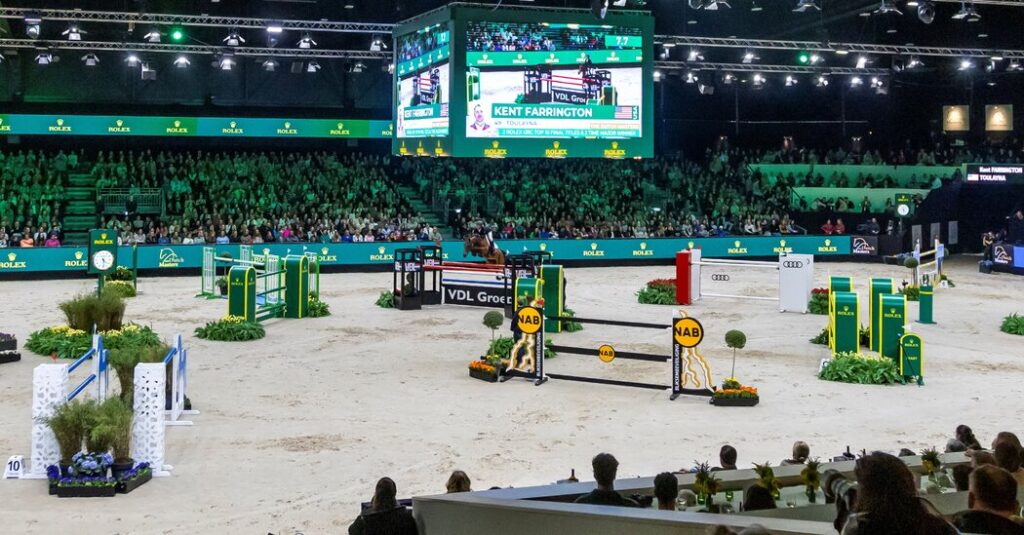
To an untrained observer, the arena for a show jumping competition may look like an oversized, abandoned game of pickup sticks.
Colorful poles fill the ring. The jumps, built from those poles, are placed at seemingly odd angles and at random distances to each other and the walls. If the competition is held in a small indoor arena — like at the Dutch Masters — there seems scarcely enough room for riders to navigate between the five-foot fences, much less generate the speed and approach needed to fly over them.
But a show jumping track is never random. Instead, it is the creation of a course designer. Each jump is measured and placed in relation to the others in an order that will let great horses shine and highlight weaknesses in others.
“The idea is to get the best horse-rider combination on that given day to come out as the winner,” said Guilherme Jorge, who was the course designer for the 2016 Olympic Games in Rio de Janeiro.
Though show jumping performances are measured objectively, with horses incurring penalty points if they knock down jumps, refuse to go over obstacles or go too slowly, there is a subjective and even aesthetic quality to a well-designed course.
“When you see the top rounds — the good rounds, the clear rounds — the experts will say, ‘It was technically perfect, huh?’ But horse people, they feel the groove,” said Louis Konickx, the course designer at the Dutch Masters, which begins on Wednesday in ‘s-Hertogenbosch, the Netherlands. “There is a rhythm in that round, in the gallop, and it looks very easy. But it’s totally not.”
For the courses they build, designers determine the number of jumps, the types, the materials and the distances between them. If they’re setting for a grand prix class, they are actually designing two courses: one for the first round and then a shortened track for the jumpoff.
During the first round of a grand prix, riders must complete the course within the time allowed, with penalties added for every second they go over. Anyone who finishes that course without penalties, known as going clear, moves on to the jumpoff, where the fastest clear round wins.
The sport’s international governing body, the Fédération Équestre Internationale, sets specifications for the classes it sanctions. The highest level of show jumping — like at the Olympic Games or Dutch Masters — is a five-star grand prix, with jumps set at 1.60 meters, or about five feet.
Even with the basic standards pre-established, course designers wield power with their creations.
“When we are designing the course, we have the most obvious ways of making a jump harder: that is the height and the spread,” Jorge said. “Then we go with the distance in between the jumps, and that also adds a very obvious way of making it harder or easier.”
Every course begins on paper, sketched in two dimensions.
“Everything I do has to flow on paper, and then it should flow when you’re riding it,” said Alan Wade, the show jumping course designer for the 2028 Olympic Games in Los Angeles.
Courses challenge the athletic prowess of horses, but they are also tests for riders, who must direct their mounts to the correct takeoff spots. A brief moment of miscommunication between horse and rider can cause fallen poles or even refusals.
“What you are testing is that flexibility to shorten and lengthen the strides without losing power, and the strength to jump without losing their balance in their body,” Konickx said. “That’s the athletic part of what we’re testing. And, on the other hand, these days you need a smart horse, and smart for us means he needs to focus on his job. Then you can say, yes, he’s with the rider.”
Most grand prix courses have common elements: oxers (wide jumps with spread created by two parallel poles), verticals (more upright jumps), combinations (where two or three fences are set on a closely related distances of one or two strides), liver pools (jumps with water trays underneath the poles), a wall (which looks solid, but comprises light blocks that will fall if hit by the horse) and usually a triple bar (wider than an oxer, using three parallel poles).
Some outdoor courses include an open water jump, a low, wide obstacle that’s a relic from the sport’s roots in fox hunting. The horse is penalized if it touches the tape lining the water or puts a hoof in the water.
Each part of a course tests something different, and the combination of elements, including the rush to finish inside the time limit, creates its own trial.
“The idea is to create a course that they really need to be focused from the beginning to the end,” Jorge said, “and one jump is a consequence of the other jump, the previous jump.”
Course designers use different colored poles. Striped ones are “a little bit easier to be jumped,” Jorge said, because they stand out more, while plain poles are a little more difficult because “they are less impressive for the horse,” meaning that the horse may pay less attention to the poles and knock them down.
The number of poles composing a fence will alter the difficulty, too. More poles, or a solid wall, requires boldness and bravery; fewer poles “make a very careful jump,” he said.
The most common width for a jump is 12 feet, but designers often include what are called skinnies, jumps that are 10- or even eight-feet across.
A grand prix course usually contains 14 to 18 jumps, so it becomes an endurance challenge, too.
“When we add more jumps to a course, we are asking a little more on the fitness of the horse and stamina,” Jorge said. “But we also can spread the questions [jumps] more evenly, so the effort the horses are going to make on each jump doesn’t need to be too extreme to get the correct result.”
While riders walk around the course before they compete, measuring the number of strides horses will take in between fences, their mounts see the jumps for the first time when they step into the ring.
For that reason, the word designers use repeatedly when describing these jumps is test, not trick. Before a competition begins, Wade walks the track he’s designed, taking in the view from a horse’s perspective.
“I don’t like hiding fences behind other fences,” he said. “I like that the test is all there in front of you.”
While designers don’t want a first round so simple that every pair qualifies for the jumpoff, they prioritize safety, especially as equestrian sports face heightened attention on equine welfare.
“You want to get a certain number of horses for the jumpoff,” Jorge said. “You don’t want too many, but you also want them to solve the questions. It’s a very fine line of a course that can be too difficult or too easy.”
Konickx emphasized that the thrill of show jumping isn’t just in the scores, but in witnessing the partnerships.
“The best combinations, you see the confidence between” the horse and rider, he said. “People are always talking about excitement and the most clears, but I’m sure that a lot of visitors are beyond that and look to the confidence and the harmony, rhythm — all the words we know from music and art.”
The post In Show Jumping, Course Designers Challenge Horses and Riders appeared first on New York Times.