The leaders of the United States war effort on Tuesday cast President Trump as the country’s sole arbiter on the future of its war in Iran, even as Mr. Trump has offered shifting rationales, aims and timelines.
Asked what would constitute Iran’s “unconditional surrender,” one of the definitions of victory Mr. Trump has offered, the White House press secretary, Karoline Leavitt, said he would be the one to determine whether that objective had been reached.
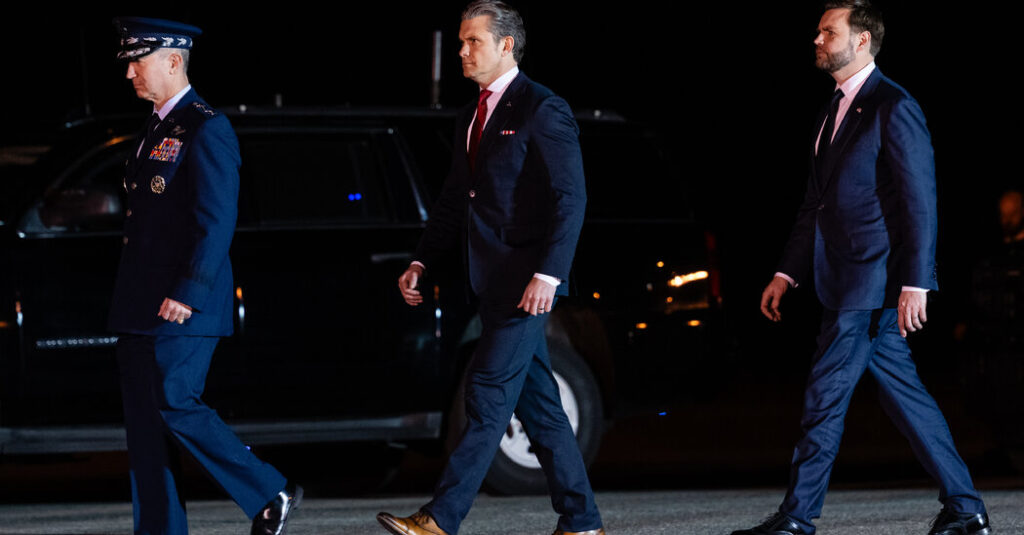
Defense Secretary Pete Hegseth declined to answer questions about how much longer the war would last, saying only that the American military was giving Mr. Trump “maximum options” to conduct the war and that Mr. Trump “gets to control the throttle.” The Pentagon said that in addition to seven American service members who have been killed, 140 were injured, including eight severely.
Here’s what else happened on Tuesday:
-
Death toll: At least 1,940 people have been killed since the start of the war, largely in Iran. Information on the latest death toll from Iranian authorities was not immediately available, though Tasnim, a semiofficial Iranian news agency, reported that more than 15,000 people had been injured, citing the health ministry.
-
Iran: Iranians said that intense American-Israeli attacks on Tuesday were hitting civilian targets and critical infrastructure. “It seems they are striking everywhere: homes, schools, mosques, hospitals,” one resident said. Officials said the strikes also damaged a UNESCO World Heritage site in the ancient city of Isfahan. In Tehran, residents have been reporting disturbing health effects after plumes of smoke blanketed the sky and black rain fell after attacks on Iranian oil depots. Health experts have said that there are long-term respiratory and neurological risks associated with smoke from burning oil and that various toxins, including carcinogenic compounds and heavy metals, had been released.
-
Lebanon: Lebanese leaders and international aid groups were warning of a growing humanitarian crisis in Lebanon on Tuesday as tens of thousands of people in Beirut, the capital, and its densely populated metro area left their homes and moved into schools, government buildings, their cars and open sidewalks. The U.N. migration agency, citing government figures, said that nearly 700,000 people had been displaced by Israeli attacks. More than 100,000 people registered on the government’s online displacement platform in just the past 24 hours, the agency said.
-
Persian Gulf: The United Arab Emirates and Qatar said their armed forces were intercepting missile attacks from Iran on Tuesday. Saudi Arabia’s civil defense agency said, without attributing responsibility, that a drone had caused some damage after it fell onto a residential site north of Riyadh. There were no injuries, the agency said.
-
Israel: Prime Minister Benjamin Netanyahu of Israel addressed the Iranian people in a message on social media in which he said his country was going to “create the conditions for you to grasp your destiny.” It echoed the rhetoric he has issued since Israel and the United States began the war on Iran: that the war was giving the Iranian people a chance to overthrow their government. A man injured in an Iranian missile attack on Monday died of his injuries, a medical center near Tel Aviv said. His death brought the number of Israelis killed since the start of the war to 14, including two members of the Israeli military.
Anushka Patil is a Times reporter covering breaking and developing news around the world.
The post Here’s What Happened in the War in the Middle East on Tuesday appeared first on New York Times.