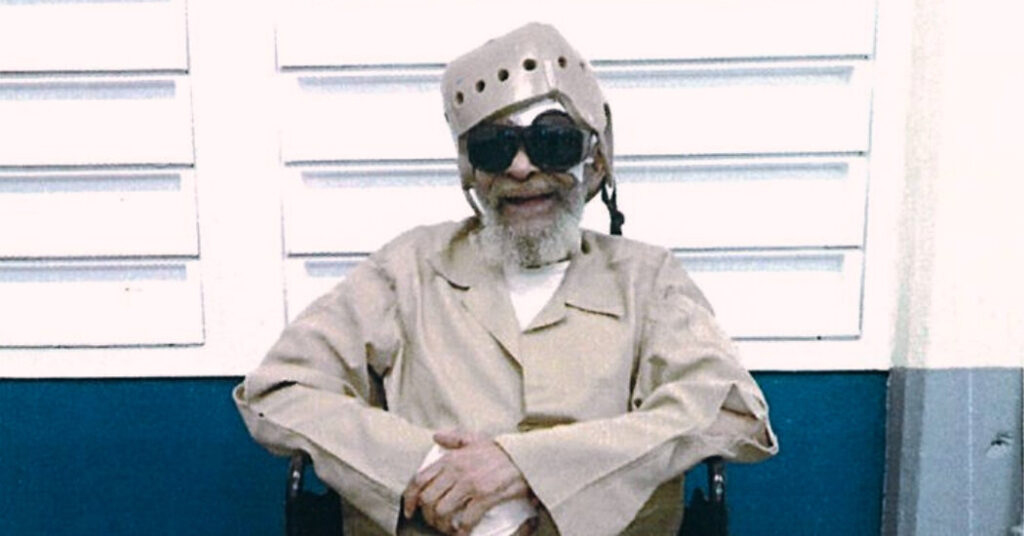
Charles Burton was already running out of the AutoZone store in Talladega, Ala., in the summer of 1991 when one of his five robbery accomplices fired a gunshot and killed a customer.
Prosecutors agreed that Mr. Burton, known as Sonny, had never pulled a trigger. But in Alabama and other states, people who participate in a felony, such as robbery, that ends in a death can still be convicted of murder, and Mr. Burton was sentenced to death. This week, after decades of waiting, he was set to be executed with nitrogen gas.
But in an extremely rare move that shocked Mr. Burton’s supporters, Gov. Kay Ivey commuted his sentence on Tuesday to life in prison without the possibility of parole, two days before he was scheduled to die. It is only the second commutation for Ms. Ivey, a Republican who has presided over 25 executions since becoming governor in 2017.
“I cannot proceed in good conscience with the execution of Mr. Burton under such disparate circumstances,” Ms. Ivey said in a statement.
Looming over Mr. Burton’s case was what had happened to the actual gunman, Derrick DeBruce. He had also been sentenced to death for fatally shooting the victim, Doug Battle, but his sentence was reduced to life in prison without parole in 2014 after he argued that his trial lawyers had been ineffective. Mr. DeBruce died in prison in 2020.
That prompted an outcry of support to spare Mr. Burton’s life. His lawyers, as well as a swell of supporters, had argued that Mr. Burton, now 75, did not deserve a worse fate than that of Mr. DeBruce.
In the end, the governor agreed.
“I believe it would be unjust for one participant in this crime to be executed while the participant who pulled the trigger was not,” said Ms. Ivey, who is term-limited and will leave office next year.
The rule of felony murder essentially states that if someone is killed during the act of committing a felony, the people involved in that criminal activity can also be charged with murder, not only the killer. Some legal experts have criticized the rule, saying it leads to an “over-prosecution” of defendants. Proponents say it is a deterrent of crime. Most states still have some version of the legal doctrine.
Death penalty opponents had flooded the governor’s office in recent days with pleas to spare Mr. Burton. Mr. Battle’s daughter, Tori Battle, who was 9 when her father was killed, wrote an opinion essay in The Montgomery Advertiser in December asking that the state not execute Mr. Burton.
“No one from the state has ever sat with me to explain why Alabama believes it must execute a man who did not kill my father,” Ms. Battle wrote. “My love for my father does not require another death, especially one that defies reason.”
Even some of the jurors who had elected to sentence Mr. Burton to death in 1992 recently supported his request for commutation.
It is unclear what led Ms. Ivey to change her mind, as her office had not indicated in recent weeks that she would commute Mr. Burton’s death sentence.
Alabama Post-Conviction Relief Project, an organization that assists death row prisoners, released a video last month in which Mr. Burton expressed regret for his actions and begged for mercy.
“Every time I think about it, right, I hate myself,” Mr. Burton says in the video. “But over the years, I learned to accept what I had did, and I’m paying for it every day — every day.”
Last year, Ms. Ivey commuted the death sentence of Robin Myers, 64, saying that there were “enough questions” about his guilt to prevent the state from proceeding with execution. At the time, Ms. Ivey said she was undecided about whether Mr. Myers, known as Rocky, was innocent or guilty. His sentence was reduced to life without parole.
In recent years, Alabama has become a hotbed for executions.Since the 1970s, more than 75 people have been executed in Alabama, according to the Death Penalty Information Center, which collects data on executions. Only a handful of states have had more executions in that time, including Oklahoma, Texas and Missouri.
In 2024, Alabama became the first state to use nitrogen gas in an execution after it had problems procuring the drugs used for lethal injections, an issue that other states have also faced. Witnesses of such executions have described disturbing scenes in which prisoners writhe on a gurney before being pronounced dead. Proponents of the method, known as nitrogen hypoxia, say it is less painful and less prone to error.
Ms. Ivey defended her decision to now give Mr. Burton “the same punishment as the triggerman,” saying in her statement on Tuesday that “the murder of Doug Battle was a senseless and tragic crime, and this decision does not diminish the profound loss felt by the Battle family.”
Laura Porter, the executive director of U.S. Campaign to End the Death Penalty, said in a statement that it was “uplifting to see that more and more governors across the ideological spectrum are recognizing problems with death penalty cases.”
Eduardo Medina is a Times reporter covering the South. An Alabama native, he is now based in Durham, N.C.
The post Alabama Governor Spares Death Row Inmate Who Didn’t Pull the Trigger appeared first on New York Times.