Lise Davidsen’s soprano can rattle your skull with its resonance and leave you awed by power you almost never hear in the human voice. Yet as she entered the rapturous climax of Wagner’s “Tristan und Isolde” at the Metropolitan Opera on Monday night, her sound was suddenly so soft, it seemed to nearly die.
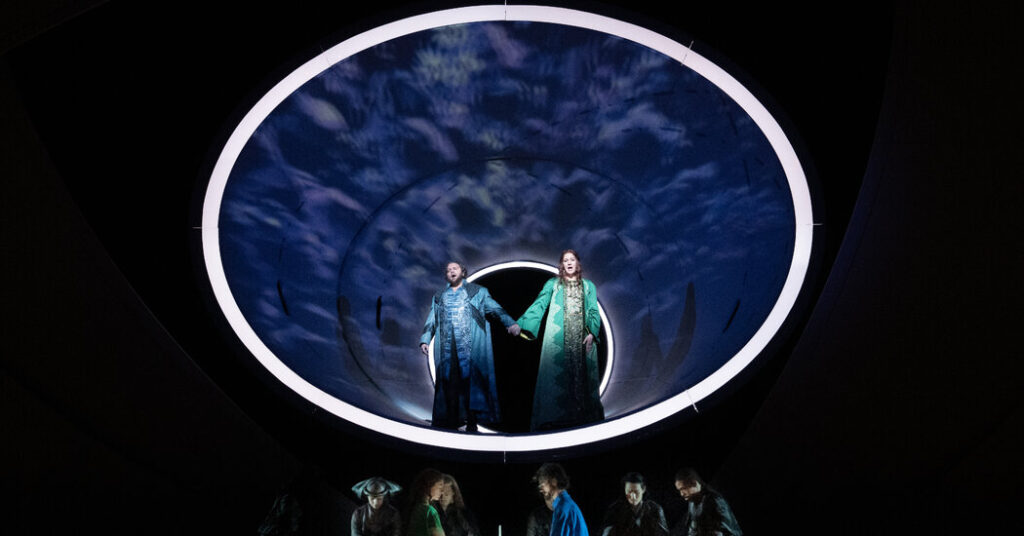
Singing Isolde at the Met for the first time, just weeks after making her role debut in Spain, she started “Mild und leise,” better known as the “Liebestod,” with a hint of mournfulness. In Yuval Sharon’s new staging, she is already at the threshold of a higher plane, looking down on her death from a deep, immense tunnel above. Then she sees the product of her suffering: a newborn baby.
In a twist on tradition, Isolde sings her final monologue not about Tristan’s corpse but about the child, a Sharon invention, to whom she must say hello and goodbye in the same breath. Seeing it, Davidsen’s sad tone turned quickly to pride, the titanium core of her voice emerging from a silken sheath. Her volume grew to epiphanic radiance then retreated, soft once more yet serene, before she turned around and walked through the tunnel, toward a white light that eventually engulfed her.
It’s a scene that captures what makes this new “Tristan” the event of the season at the Met. (It will be broadcast to cinemas on March 21.) Davidsen, a generational artist bound for the pantheon of dramatic sopranos, is entering a new, mature phase of her career that will soon lead to the Wagnerian summit of Brünnhilde in the “Ring.” And Sharon, a great hope among directors in the United States, is making his house debut with an audience-friendly staging that holds innovation and clarity in equal measure.
Together on Monday, Davidsen and Sharon ushered in a new era at the Met, showing how a fresh and promising generation might stake its claim to the core repertoire and shape the years to come. How thrilling, then, that they will return in a couple of years with the “Ring.”
Davidsen seems ready for the mighty Brünnhilde. Not once in “Tristan” did she struggle to be heard, no matter the extremes of ecstasy in the orchestra, and that comfort made space for the luxury of nuance. With a sound that carried even at its smallest, she could trace an exhilarating crescendo or, in the case of the melodic phrase for “death-devoted heart” in Act I, plunge an octave with chilling darkness.
Her dynamism was never more apparent than when she shared the stage with the tenor Michael Spyres, in his first outing as Tristan. Compared with her, he budgeted himself: temperate in the first act, stronger in the second and impressive in the third, even with a thin upper range. In the past, his voice has been effortlessly big, at times as unwieldy as a fire hose. That’s fitting for Wagner’s ejaculatory music, but this is still one of the most difficult roles in opera, and it make him work visibly harder than he ever has at the Met.
For much of the night he was helped by Es Devlin’s set, with a tunnel at the heart of its design creating a kind of loudspeaker as the singers’ voices bounce off its surfaces. That also gave Ekaterina Gubanova a boost as Isolde’s maid Brangäne, raising the volume of her mezzo-soprano. The bass-baritones Tomasz Konieczny and Ryan Speedo Green, as Kurwenal and King Marke, needed no amplification to communicate their heroic strength.
Virtually every singer was favored by Sharon’s production, which kept performers downstage and well blended with the orchestra. Yannick Nézet-Séguin, the Met’s music director, is a conductor who relishes extremes of sonority and rubato, and you can imagine he would be a good fit for Wagner’s pruriently domineering control of tension and release in this opera. It wasn’t clear at first, however, whether Nézet-Séguin had a grip on it; he operated within a narrow, elevated dynamic range in the Prelude, but by the introduction to the third act, he more movingly reflected the score’s crests of force and precipitous desolation.
Not that there was much focus on the music in the Prelude anyway. Sharon builds on, but doesn’t necessarily improve, the opening of “Tristan.” Earlier Wagner operas foreshadow the entire plot in the overture, but here the composer sets the mood with upward phrases of longing that lead to a chord begging for but continuously denied resolution. Often, directors leave it alone, but Sharon’s production, which constantly underscores the work’s text and subtext in case they didn’t reach the cheap seats, stages the whole thing.
Davidsen and Spyres, dressed in contemporary outfits designed by Clint Ramos, meet at a table and reach toward each other. She picks up a large hourglass and turns it over, which inspires a towering projection of its falling sand. Eventually, the singers are swapped out for doubles, who remain at the table, acting out motivic gestures while Davidsen and Spyres, now in stylized medieval costumes, perform in the tunnel above them.
Visually, there’s a lot going on here, and it doesn’t let up. It’s almost as if Sharon took a “why not?” approach to his first Met production. He uses the full height of the theater’s 54-foot proscenium, covers the surface of the stage’s shutter-like frame with projected videos by Ruth Hogben and, as if that weren’t enough, allows dancers to intrude with choreography, by Annie-B Parson, that adds nothing of substance.
Beyond the spectacle, though, Sharon has created something smart. As a director, he has had his share of high-concept head trips; this isn’t one of them. Here, he is acting even a tad conservatively as a gentle translator for the audience, making Wagner’s opera of ideas readily accessible, and lightly introducing something new in his depiction of death as rebirth in “Mild und leise.” Now that he has had a taste of the Met’s scale and possibility, perhaps his “Ring” won’t be so overwrought.
And, really, the Met needed a show like this “Tristan.” The gold standard for grand opera in the United States, the company is in a financial crisis that has depleted its endowment and left its general manager knocking at the doors of Saudi royalty and Elon Musk for money.
Hearteningly, the house was full on Monday, and “Tristan” has sold so well that an extra performance was added next month. An artistic and box office success, it’s evidence of what the Met is capable of, and what’s now at stake.
Tristan und Isolde
Through April 4 at the Metropolitan Opera, Manhattan; metopera.org.
Joshua Barone is an editor for The Times covering classical music and dance. He also writes criticism about classical music and opera.
The post Review: ‘Tristan und Isolde’ Heralds a New Era at the Met Opera appeared first on New York Times.