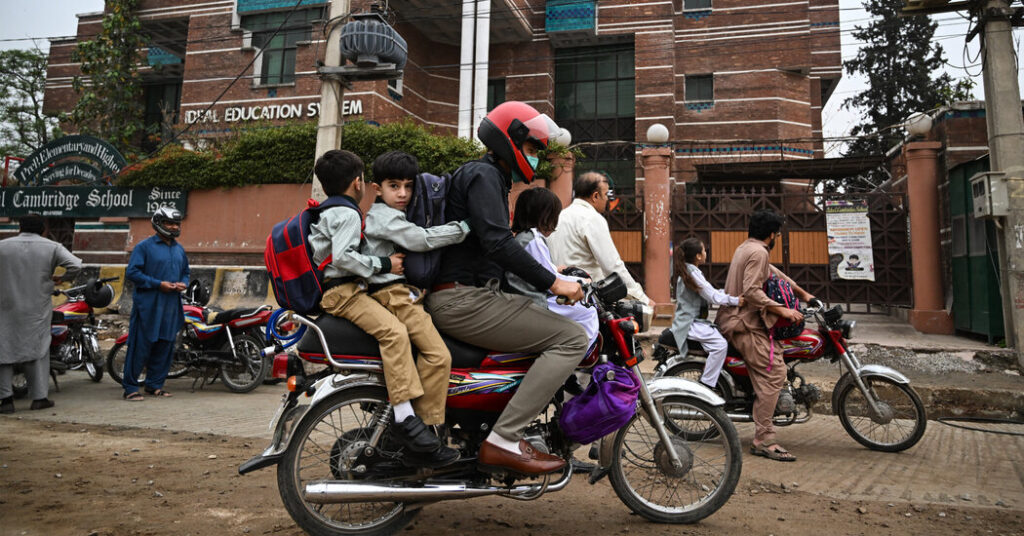
Schools closed until the end of March. A four-day workweek for the next two months. Warships escorting commercial vessels.
Pakistan, a South Asian nation of 250 million people and Iran’s neighbor, has been striving to remain neutral in the Middle East conflict. But with its economy, heavily reliant on oil imports, under threat from the choking of tanker traffic in the Persian Gulf, Pakistan’s government and military have been forced to act.
The Pakistani navy said Monday that its warships would escort the country’s commercial vessels in the Middle East “to ensure the uninterrupted flow of national energy supplies.” It said two vessels from Pakistan’s national shipping company were already under navy escort, posting images on social media of a warship sailing next to a crude oil tanker.
The navy did not say which route the tankers were sailing, and did not say which countries posed the “multidimensional threats” to shipping.
Pakistan imports most of its natural gas from Qatar and crude oil from Saudi Arabia and the United Arab Emirates. All of this is brought over sea, but shipping companies have stopped energy transports from those countries because of security risks, especially along the narrow Strait of Hormuz, through which around a fifth of the world’s oil transits.
President Trump and President Emmanuel Macron of France have both floated the possibility of naval escorts for commercial vessels, as the conflict roils global energy markets and threatens economies around the world. Mr. Trump on Monday threatened even more intense strikes if Iran disrupted the flow of oil through the Strait of Hormuz.
India was also considering sending its warships in response to requests from Indian shipowners for naval escorts, according to Capt. P.C. Meena, a senior official at India’s main maritime authority.
It was unclear if the deployment of Pakistani warships would be enough to prevent an oil supply crunch. Pakistan has less than two weeks left of crude oil reserves, and enough liquefied natural gas to last until the end of the month, according to the oil ministry.
Prime Minister Shehbaz Sharif of Pakistan said Monday that he had to make “difficult decisions” to protect the economy as he announced sweeping fuel-saving measures, including trimming the workweek to four days for the next two months and a two-week school break.
Half the staff in both the public and private sectors, except for essential services, would work from home to save fuel, Mr. Sharif said.
Pakistan has been trying to carefully balance its relationships in the Middle East during the conflict. The billions of dollars Pakistani workers remit every year from Arab countries in the Gulf region are crucial for Pakistan’s economy. Pakistani officials have also indicated that they want to avoid a confrontation with Iran.
So far, the Pakistani government has not named the United States in its public condemnation of the strikes on Iran. Pakistan has also been bound since last year by a mutual defense agreement with Saudi Arabia under which an attack on one country would be considered an attack on the other. But Pakistan has so far refrained from intervening in the conflict even as Saudi Arabian air defenses intercept drones and missiles.
Mr. Sharif said the measures he announced on Monday would aim to shelter Pakistanis from the crisis, but after the government raised fuel prices by about 20 percent last week, some citizens said they were already feeling the pain.
Syed Yasir, a 45-year-old delivery driver, said at a gas station in the city of Rawalpindi on Tuesday that he only had the equivalent of $1.80 to buy fuel for his small pickup truck. “Our lives are being destroyed,” said Mr. Yasir, a father of two.
Salman Masood and Suhasini Raj contributed reporting.
Elian Peltier is The Times’s bureau chief for Pakistan and Afghanistan, based in Islamabad.
The post Pakistan Sends Navy Escort for Its Ships in the Middle East appeared first on New York Times.