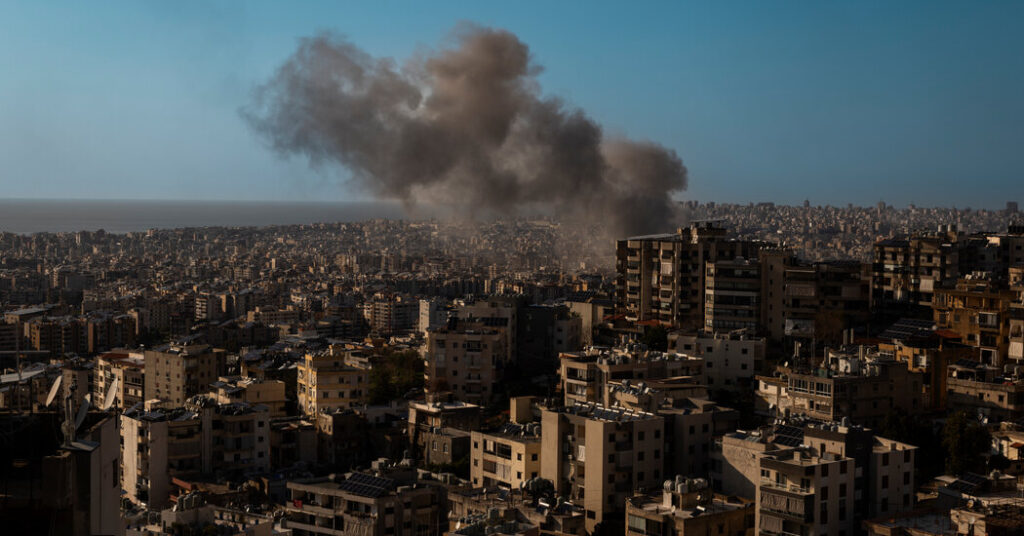
Nearly 700,000 people have been driven from their homes in Lebanon, the United Nations said on Tuesday, as Israel’s mass evacuation orders and bombing campaign against the Iran-backed armed group Hezbollah transform the country into a major new front in the metastasizing Middle East war.
The mass movement of people has prompted Lebanese leaders and international aid groups to warn of a mounting humanitarian crisis in a country still recovering from the last war between Israel and Hezbollah that ended in 2024. After Hezbollah fired rockets at Israel last week in retaliation for the killing of Iran’s supreme leader, Ayatollah Ali Khamenei, the Israeli military went on the offensive: launching a wide-scale bombing campaign and ordering the evacuation of southern Lebanon as well as parts of Beirut.
Israeli airstrikes pounded Lebanon on Tuesday, including in southern Beirut, a densely populated cluster of neighborhoods known as the Dahiya, where Hezbollah has long held sway.
The area, home to hundreds of thousands of people just a week ago, has now largely been emptied.
Hezbollah, long the most powerful group in Iran’s network of regional proxies, has responded in kind, engaging Israeli forces as they widen their ground offensive into southern Lebanon and launching rockets and explosive drones across the border into Israel.
As the fighting intensifies, pressure is mounting on Lebanon’s new government, formed last year after the previous war left Hezbollah battered and politically sidelined, to prevent further devastation. Lebanon’s president, Joseph Aoun, signaled on Monday that his country was ready for direct peace talks with Israel as he stares down growing calls at home and abroad to disarm Hezbollah, which for decades has styled itself as Lebanon’s defender.
Lebanon’s cash-strapped military has been tasked with that fraught mission, though it is unclear whether there is enough political will to see it through amid growing fears of domestic instability.
More than 667,000 people have registered on the Lebanese government’s online displacement platform, the U.N. migration agency said on Tuesday, citing government figures. That included more than 100,000 in the past 24 hours, the agency said.
The true number of displaced people is likely higher, officials said, as many families have fled without registering.
Tens of thousands are living in schools and government buildings outfitted to serve as emergency shelters. But with resources and capacity so thin, others are sleeping in cars and on street corners, transforming Beirut’s seaside promenade into a makeshift refuge for displaced families.
Human Rights Watch warned last week that Israel’s evacuation order for everyone south of the Litani River — a line that effectively divides southern Lebanon from the rest of the country — raised “serious risks of violations of the laws of war.” Israel has defended the move as a means to prevent civilian harm.
Nearly 500 people have been killed in Lebanon since the fighting escalated a week ago, according to Lebanon’s health ministry.
Euan Ward is a Times reporter covering Lebanon and Syria. He is based in Beirut.
The post Nearly 700,000 Displaced by War in Lebanon, U.N. Says appeared first on New York Times.