Liza Minnelli, who turns 80 on Thursday, has been performing in one form or another for at least seven-eighths of her life. That’s a lot of material — and a lot of Lizas.
There’s the impossibly wide-eyed hoofer who cameoed on her mother’s variety show as a teenager. The Broadway ingénue who collected her first Tony Award before she could vote. The Hollywood actress who starred in movies by Otto Preminger, Stanley Donen, Martin Scorsese and Bob Fosse.
Later generations may know her best for an impressively game sitcom turn, when she played a vertiginous Orange County widow forever beset by “a touch of the dizzies.” Or as the aging showbiz legend who, according to her newly released memoir, “Kids, Wait Till You Hear This!,” didn’t especially love being paraded out in a wheelchair to present at the 2022 Academy Awards.
But don’t let her longevity fool you: One doesn’t achieve the status of instantly recognizable pop cultural icon without a bit of consistency, and Ms. Minnelli has cultivated a remarkably consistent image for over half a century. Ahead of a milestone week for the extraordinary entertainer — and one of only three people on earth who can call Judy Garland “Mama” — New York Times reporters and critics examined the specific visual signifiers that, taken together, add up to an icon.
Her Eyes
Glued-On Lashes That Stuck
Unmade-up, her eyes recall her mother’s: big and brown, with a slight droop as they reach for the cheekbones.
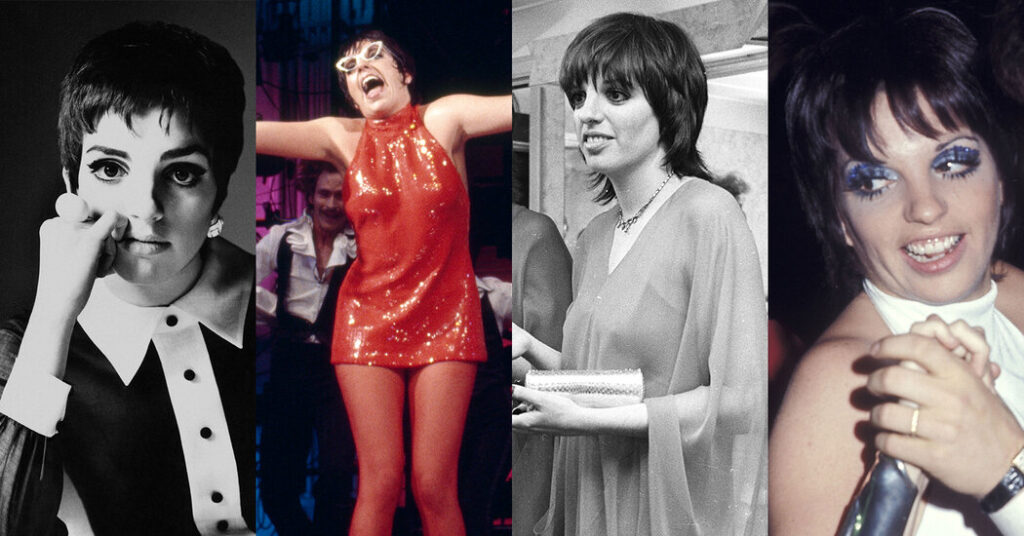
But Liza Minnelli’s eyes are rarely bare, at least in public. Since the early 1970s, when Christina Smith, Ms. Minnelli’s longtime makeup artist, fitted her for “Cabaret” with custom lashes that were part tarantula and part Betty Boop, mascara has been the star’s extreme sport. Inky eye shadow raccoons her lids, making the whites pop with the appearance of pleasure but also invoking bruises. The effect was perfect for playing Sally Bowles, that good-time girl knocked around by life yet brightly urging us to put down the knitting and come to the cabaret.
The image stuck, becoming Ms. Minnelli’s signature. For 50 years, she has looked surprised, like a just-off-the-bus naïf hardly able to take in the bewildering sights of a new world she is thrilled but unprepared to enter. That’s exactly the opposite of what she really was (and remains): a lifelong showbiz creature. A child of Hollywood royalty had no time to be a naïf. By the age of 3, she had already appeared, albeit briefly, in the Garland vehicle “In the Good Old Summertime.” At 10, she danced with her mother on the London stage; at 13, with Gene Kelly on TV. She starred in her first Broadway musical at 19. Bambi she wasn’t.
Perhaps that’s the paradox we see when we look, even now, at her eyes: the endless effort to inhabit innocence from the position of having seen too much of its opposite.
— Jesse Green
Her Hair
Lopped on a Lark, It Became a Signature
There are haircuts that are simply haircuts. And then there are haircuts that are transformative, that become an integral part of a person’s identity. Consider Liza Minnelli’s pixie. Were you simply to draw its silhouette, her fans would certainly be able to identify it as Liza’s. It has become one of her signifiers.
Though there are differing accounts about how the singer’s pixie came to be, the most consistent story places its origin in 1966, when Ms. Minnelli impulsively lopped off her locks, and her boyfriend at the time, Peter Allen, and her close friend Mia Farrow did the finishing touches.
Though Ms. Minnelli had been acting professionally since she was 17 and won her first Tony Award at 19, for her Broadway debut (the title role in “Flora the Red Menace”), to many, she remained inescapably Judy Garland’s daughter. The two were as entwined as their alto voices. But that simple haircut allowed Ms. Minnelli to distinguish herself from her famous mother, evolving from being Garland’s mini-me to striking out and becoming her own person.
Arguably, Ms. Minnelli looked her best in the 1970s, when her dear friend Halston was styling her, with the signature mod black pixie she wore in “Cabaret” evoking Louise Brooks and Lya de Putti. Over the past 60 years, Ms. Minnelli has riffed on the pixie with other styles — a shag in the late ’70s; a perm in 1982; an asymmetrical do for a spell in the late ’80s; the poofy, spiky hair of Lucille Austero, her character in “Arrested Development,” in the early aughts. But after that cut in 1966, the template was set for the look that will forever be Liza Minnelli.
— Kera Bolonik
Her Legs
Rocket Launchers, Guided by Fosse
At 5-foot-4, Liza Minnelli may be petite, but she has never felt small. Her voice is big and her look is bold, but it’s the way she uses her body as a detonator for her explosive energy that leaves us with the afterimage of someone much larger.
Let’s begin with the legs, those sculpted stilts proudly showcased by her Sally Bowles garter and signature minidresses. Not stork-slim and carefully posed but muscular and athletic, cheeky and unpredictable, primed to pounce and strut or stab the ground in a wide stance that instantly conveys her command of the stage.
She’s equally attuned to the impact of her other limbs, as well: the rotating wrists, animated fingers and nonchalant shrugs, so breezily deployed as to seem almost improvisational. As Gia Kourlas, The New York Times’s dance critic, wrote of Ms. Minnelli, “It’s a special skill to be able to perform choreography so effortlessly that it has the casual look of being tossed off.”
Of course, it was anything but. Ms. Minnelli’s physical flair bears all the hallmarks of Bob Fosse, the director-choreographer behind “Cabaret” and “Liza With a ‘Z,’” her 1972 made-for-TV concert film. His sharp, sensual moves paired perfectly with her frenetic spirit, giving it a purposeful shape without any sense of constraint. She, in turn, brought a winking playfulness to his often moody style.
Crucially, he also identified and integrated the idiosyncrasies stemming from her lifelong scoliosis, turning a potential liability into her performance superpower. Fosse took all her “mistakes” and things she “thought were awful,” Ms. Minnelli recalled in 2020, “and he used them.” The result was a singular firecracker on rocket-launcher legs, ready to burst for our delight.
— Brian Schaefer
Her Halstons
Muse, Model, BFF
The most glamorous besties in 1970s Manhattan were Liza Minnelli and Roy Halston Frowick, the designer known simply as Halston. The duo were inseparable, partying nightly at Studio 54 and appearing together constantly in Page Six. Ms. Minnelli became Halston’s muse and, in turn, wore his shimmering designs wherever she went.
When the paparazzi’s camera flashes went off, Ms. Minnelli could dependably be seen wearing outfits from her deep wardrobe of Halston — a mirrored minidress, a slinky halter with a burgundy knit sweater, a white suit with a fedora, a feathery floor-length emerald green ensemble. Accepting her Oscar for “Cabaret” in 1973, Ms. Minnelli wore a canary yellow Halston confection. When she married for the second time, she wore a buttercup yellow pantsuit he designed for the wedding.
And when Halston faced off at the fabled Battle of Versailles, a fashion show at the Palace of Versailles that pitted five French designers against five American ones, Ms. Minnelli dazzled in one of his glittering dresses, helping him and the Americans give the French couturiers a run for their money.
Halston’s career entered sharp decline in the 1980s, during which he lost control of his company and fell prey to substance abuse and excess. He died from complications of AIDS in 1990. But for years after his death, Ms. Minnelli continued to ride hard for her bestie. When his revived line was presented at a special show in Manhattan at the Gagosian Gallery in 2008, she sat in the front row, wearing a black and scarlet Halston number.
“It’s Halston vintage, 1975,” Ms. Minnelli told a reporter. “And I think it’s great to celebrate the first designer who put American fashion on the map.”
— Alex Vadukul
Her Perettis
Bones Worn Outside the Body
Scene: Fifth Avenue, in summer, at dusk, with building lights flecking a sky the color of Parker’s ink. A limo. In the back are two people. One of them, Liza Minnelli, is singing a song. What’s the tune? I no longer recall. What I remember with clarity, though this took place decades ago, is picking Ms. Minnelli up at her Upper East Side apartment and conducting an interview that produced not answers but oracular snippets and a general sense of inscrutability about this woman with a face that time and art had reduced to its core elements: a spiky cap of dark hair, a gash of red lips, huge eyes with lashes that put one in mind of Meret Oppenheim’s teacup. And jewelry, too: diamonds at her ears and one wrist, and on the other, a gold cuff molded in the shape of a bone.
The bracelet was created by Elsa Peretti, an Italian heiress and model who arrived in New York in the late 1960s, in short order becoming a muse to the designer Halston and then, improbably, a contract jewelry designer for Tiffany & Company. Her wildly successful organic designs, inspired by skeletal fragments or common beans or articulated snakes, went on to become not only durable best sellers but talismans, emblems of the overhyped Studio 54 era — and of Ms. Minnelli herself.
As she sang in the automobile, her hands drifted to her throat. The cuff glinted in the dark. Her voice was quavery yet true. I thought then of a gift given to very few people — Ms. Minnelli and Ms. Peretti, who died in 2021, are two — to concentrate things to their essence. In a world of the ersatz, bogus, counterfeit and pseudo, they stood as reminders of the rarity of something pure.
— Guy Trebay
Reporting was contributed by Kera Bolonik, Jesse Green, Brian Schaefer, Guy Trebay and Alex Vadukul.
The post Liza Minnelli: A Visual Dictionary appeared first on New York Times.