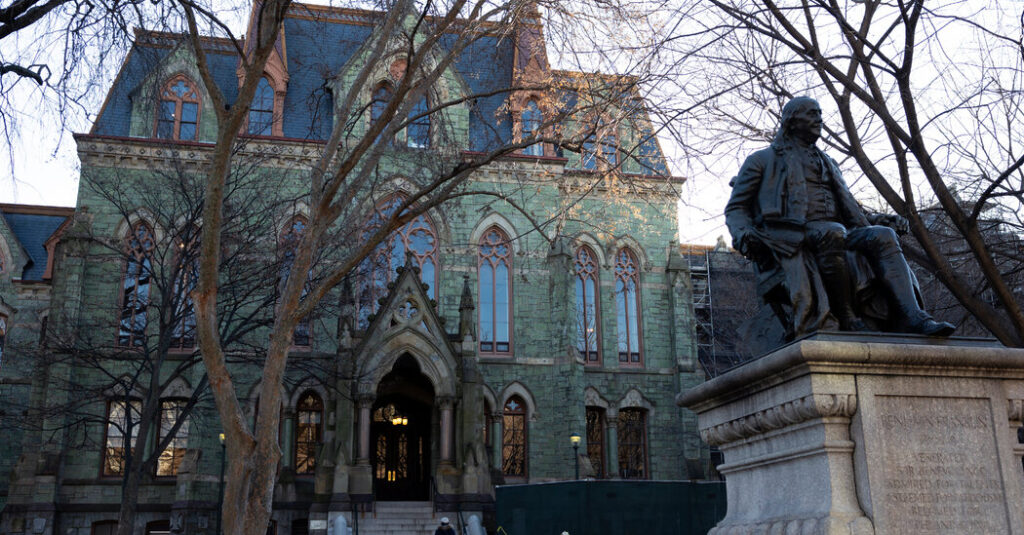
Jacob Naimark, a law student at the University of Pennsylvania, has worried ever since he learned that Trump administration investigators had demanded that his school turn over the names of many Jewish people on campus.
“It was disturbing,” said Mr. Naimark, a co-president of the school’s Jewish Law Students Association, adding, “We know very well the history of governments assembling lists of Jews does not end well.”
On Tuesday, a federal judge in Philadelphia, Gerald J. Pappert, considered whether the government’s tactics went too far. Although the judge did not immediately rule, he appeared receptive to the Trump administration’s argument that it should be able to subpoena such information as it investigates potential episodes of antisemitism on campus, including some related to protests over the war in Gaza.
But the Equal Employment Opportunity Commission’s demand has upset many Jewish faculty and students, and Penn has refused to comply, calling the Trump administration’s subpoena unconstitutional and “disconcerting.” Some say the government’s attempt to force the university to give information about Jewish people makes them feel less safe, in part because it recalls the methods of Nazi-era Germany.
Judge Pappert warned that his role in the case was a narrow one: to decide whether the government’s claim of potential workplace discrimination was valid under federal law, and if information sought by the E.E.O.C.’s subpoena was relevant to its investigation.
“It seems to clear the low bar,” he said about 45 minutes into the three-and-a-half-hour hearing.
Judge Pappert, a former Republican attorney general in Pennsylvania who was nominated to the federal bench by President Barack Obama, bristled over arguments that the government’s demand threatened Jewish employees. He said objections from university leaders and faculty — two groups not typically aligned inside a courtroom — would complicate the E.E.O.C.’s attempt to investigate antisemitism.
He also repeatedly questioned whether their arguments amounted to an attempt to get him to rule on “whether the Trump White House was filled with antisemitic extremists.”
Amanda Shanor, a lawyer representing several faculty groups, rejected that suggestion, adding that the judge had leeway to decide whether the E.E.O.C. could investigate in a way that was “less burdensome.”
Judge Pappert targeted his sharpest questions for Penn’s lead litigator, Seth P. Waxman, who served as U.S. solicitor general under President Bill Clinton. Mr. Waxman argued that the government had failed to anchor its allegation of antisemitism to any specific episodes. But Judge Pappert said his role was not to decide the merits of a charge — only the existence of one.
The Trump administration has repeatedly adopted a hard line toward elite universities, which it regards as opposed to its ideology and as hot spots of discrimination. Last year, the government paused $175 million in federal funding to Penn amid a dispute about a transgender swimmer, before it reached a settlement with the university.
The case against Penn is testing how far the government can go to investigate its suspicions about antisemitism at American universities. The outcome could determine how aggressively the Trump administration pursues inquiries on other campuses.
The E.E.O.C. has argued to Judge Pappert that there is nothing out of the ordinary about its investigation. Andrea R. Lucas, a Penn alumna, filed the case in 2023 as an E.E.O.C. commissioner, asserting that she believed Penn had “engaged in a pattern or practice of harassment based on national origin, religion and/or race against Jewish employees.” Ms. Lucas, who is now the chairwoman of the E.E.O.C., said the allegations were based on news reports and congressional testimony, among other sources.
In March 2025, the commission asked for a range of records, including complaints about antisemitism. It also asked for a list of “all clubs, groups, organizations and recreation groups” that were “related to the Jewish religion, faith, ancestry/national origin,” as well as membership rosters of those groups for potential interviews with employees about discrimination on campus.
The commission also sought a list of employees in Penn’s Jewish Studies Program since November 2022. After Penn balked, the commission issued a subpoena for the records and added more demands, including notes taken during “listening sessions” of a campus antisemitism task force.
Penn told the commission it was willing to inform all employees about the inquiry and how to contact the commission directly. But Judge Pappert castigated the university for that offer, suggesting it was out of the ordinary for the target of an investigation.
“Penn is an employer; the people the E.E.O.C. are concerned about are employees,” Judge Pappert said. “Since when does the employer have the right to step in and dictate the terms of the investigation?”
But the judge also pressed the government about the delay between the filing of the E.E.O.C. case and the more aggressive tactics it pursued after President Trump took office. Debra Lawrence, who was named the top lawyer for the commission’s Philadelphia district in 2010, said she was unaware of any specific reason beyond her office being understaffed and overworked.
“We’re not looking for a list of Jews or registry of Jews or a catalog of Jews,” Ms. Lawrence told the judge. “How about a spreadsheet that identifies the contact information for potential victims and witnesses? That’s all that we’re looking for here.”
The university has also argued that the government’s demands threaten employees’ First Amendment right of association and that the university does not even possess some of the information the commission has subpoenaed.
In the courtroom, Judge Pappert appeared open to the argument that the university didn’t have the specific information sought by the government.
Before Tuesday’s hearing, some at Penn said the case had unified the campus after years of acrimony tied to the campus protests.
“Somehow, the E.E.O.C. has managed to find the one thing in the last three years that at least everybody I’ve talked to agrees on,” said Lorena Grundy, the vice president of Penn’s chapter of the American Association of University Professors, which has also joined the case.
“There’s a lot of division right now,” she added, but “I have not talked to a single person who wants the list of information to be released.”
Dr. Grundy did not know how many A.A.U.P. members might be affected by the subpoena if Judge Pappert upholds it. “I don’t have a list, and I shouldn’t have a list,” she said. “There shouldn’t be a list!”
The E.E.O.C. has been central in other negotiations between the Trump administration and top universities. It has broad powers to investigate discrimination, and universities routinely cooperate with government investigations.
But the Penn inquiry has revived concerns about the aggressive steps the Trump administration is using to stamp out antisemitism.
“It’s good for governments to be concerned about prejudice and to combat it,” said Steven Weitzman, the director of Penn’s Katz Center for Advanced Judaic Studies. “But the tactics from the Trump administration have been too coercive.”
Mr. Naimark, whose grandfather survived the Holocaust, said he did not believe that the sharing of the names would swiftly lead to a “second Holocaust.” But, he said, he and others feared what could happen if the list fell into the hands of a bad actor inside or outside the government.
“We’d like to sound the alarm before there’s a five-alarm fire,” he said.
Dr. Grundy warned that a victory for the E.E.O.C. could lead to similar scenarios for other institutions because the commission’s purview extends beyond universities.
“It is absolutely the slipperiest of slopes,” she said.
Alan Blinder is a national correspondent for The Times, covering education.
The post Judge Is Skeptical of Penn’s Argument Against Trump Demand for List of Jews appeared first on New York Times.