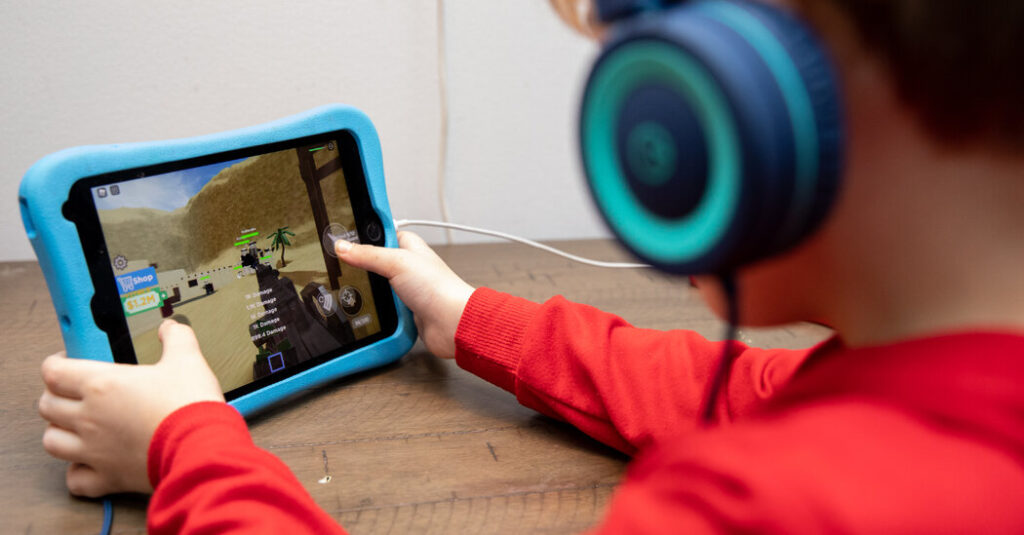
A few months before her daughter started kindergarten, Claire Benoist saw a Facebook post that stunned her. Another family with an incoming kindergartner was wondering if it was true that children in the Croton-Harmon School District, 40 miles north of New York City, receive iPads when they start school.
Other parents confirmed that during school, kindergartners often used iPads to play games and watch television shows and YouTube videos. School administrators assured Ms. Benoist that iPad time would be limited to 15 minutes a day, she said. But once school started, her daughter suddenly knew jingles from the diaper and car commercials that would play before YouTube videos she saw in the classroom.
“I don’t understand how we’ve created a system that fosters this kind of screen time in school,” Ms. Benoist said.
There is mounting evidence that excessive screen time can harm young children — contributing to anxiety and depression, delaying social and emotional skills, increasing the likelihood of obesity, straining eyes and decreasing attention spans.
In response, many parents are cutting back on device use at home. But some families are encountering an unexpected challenge as they try to rein in screen time: their children’s schools.
Elementary schools and districts that ramped up their use of technology during the coronavirus pandemic have largely maintained those practices. Eighty-one percent of elementary teachers across the United States who were surveyed by The New York Times in October said that at their schools, students receive devices in class by kindergarten. Parents and experts say too many schools have become reliant on screens to teach and entertain children and, in some cases, just to keep them quiet.
“Screen time, when it’s purposeful, can augment the work of the teacher, and it can be wonderfully complementary,” said Dr. Michael Glazier, chief medical officer of Bluebird Kids Health, which runs a half-dozen pediatric offices in Florida. “The problem is, in many schools, it’s becoming less of a complementary activity and more of a default.”
In Croton-Harmon, Stephen Walker, the school superintendent, declined to answer questions for this article, but said in a statement that the district’s schools “are committed to ensuring that technology use is active, intentional and used to create learning experiences that wouldn’t have been possible without technology.”
In late February, the district announced that it would reduce spending on technology and end the practice of sending devices home with elementary school students.
In other parts of the country, parents are pushing school districts to set limits, with varying success.
In Evanston, Ill., a parent-run group, Screen Sense Evanston, organized a petition last summer requesting that the district remove noneducational apps from students’ devices and set daily time limits on screen use for each grade. More than 1,000 parents have signed on. Last year, parents successfully pushed the district to limit YouTube access in classrooms.
Miriam Kendall, a parent of three and the head of Screen Sense Evanston, monitors her first-grade daughter’s iPad activity with online tools. She noticed that her daughter was watching Taylor Swift music videos in the middle of a school day.
“It’s unreasonable to assume that somehow students aren’t going to be distracted and only supposed to use these devices for education,” Ms. Kendall said. “Literally millions of hours of very, very smart people’s time has gone into making these things absolutely irresistible on purpose.”
Similar demands to cut screen time have cropped up among parents and teachers in California, Maryland, North Carolina and Texas.
Parents across the country have lodged complaints about children playing board games virtually or watching someone on YouTube read a book to a class, instead of their teacher doing it. In some classrooms, “brain breaks” are accompanied by loud, flashy dance or movement videos. Parents say their children are watching movies and television shows during indoor recess, lunch and snack time.
For the youngest children, experts say, screen time presents additional concerns. Beyond teaching academic skills, school is a place to absorb social skills, said Dr. Glazier, the pediatrician. “That doesn’t happen if they’re just in front of a screen, and they’re not interacting.”
The American Academy of Pediatrics does not suggest a specific time limit for screen use in schools but says that when students are using a screen, they should be engaged in critical thinking activities such as coding or media and video production, not watching entertainment content.
Some parents and experts say that even some education apps are problematic. They worry that apps that are “gamified,” for example, could encourage early addictions to screens by getting students hooked on the dopamine rush that comes from mastering new levels and earning digital rewards.
Richard Culatta, the chief executive of the technology nonprofit ISTE+ASCD, agrees that some apps are better than others and that schools should do a better job of vetting them. But there are benefits to research-based games, he said.
“When kids hate learning because it’s boring, it will have far more damaging consequences than if they are playing a game that is helping them find learning more interesting,” Mr. Culatta said. Rather than a wholesale removal of tech devices, he said, schools should seek a better balance.
“We do have to be really careful that we don’t actually end up harming kids by taking away tools that are really helpful for them for their future,” he said.
Samantha Harvey, a parent in the Croton-Harmon district, did not realize how much screen time her daughter was getting at school until the kindergartner began talking about “apps” soon after the year began.
“I wouldn’t mind if it were once a day after school, or a special thing,” Ms. Harvey said. “It just seems like it’s ubiquitous. It’s every day, and it seems to pop up in every room.”
One day, Ms. Harvey was recording a video of her daughter dancing to send to her grandparents. When the song ended, her daughter finished her dance, looked at the camera and said, “If you like what you saw, click below to subscribe.”
In part because of concerns from parents and educators, districts across the country, including some in California, Connecticut, Kansas and Missouri, have already begun rolling back technology use, removing devices from kindergarten and reducing screen time for the youngest children.
Lawmakers in several states — including Massachusetts, Missouri, Utah and Vermont — have introduced legislation to limit screen time or review technology products more closely.
In addition to state and district efforts, teachers are making changes within their own classrooms to move away from screens.
Jill Anderson, a third-grade teacher, has experienced the screen time debate on both sides. Her children attend Croton-Harmon schools, and she teaches just south in the Ossining Union Free School District, which takes a more gradual approach to introducing students to screens. Children in Ossining schools don’t take home a device until fifth grade, and, unlike some districts that require students to complete a certain number of lessons on educational apps, Ossining does not mandate screen time.
In Ms. Anderson’s classroom, school-issued devices are tucked away in a cart that is often hidden by a large easel and barely touched by students.
Ms. Anderson embraced classroom technology when it started rolling out in schools before the pandemic. But then she started noticing that her students were having difficulty maintaining their focus and attention.
She has since replaced screens with more hands-on activities and writing. Instead of a digital whiteboard, Ms. Anderson works through math problems on paper on her easel while students follow along on individual dry-erase boards. When she wants to reward the class, students play board games, get an extra outdoor recess or have a dance party instead of Chromebook time.
“I feel like I see students detoxing under my eyes,” Ms. Anderson said.
Michael Hanna, the district’s director of technology, said that while students have more access to technology than they did before the pandemic, administrators are mindful of how it is used.
“I’m not a proponent of using technology with our littlest,” Mr. Hanna said. “By putting them on a device, I think it’s taking away so many opportunities for them to engage with their friends and with their peers.”
Last year, Ms. Anderson formed a community group, now with more than 250 members, aimed at educating families about the effects of technology and helping them cut down on screen time.
Ms. Benoist, the Croton-Harmon parent, joined Ms. Anderson’s collective and said that since January, she has heard less about her daughter watching TV shows and ads at school.
She said she welcomes the district’s shift away from screens for elementary students but still feels defeated, especially when she thinks about how much screen time her daughter has already been exposed to in school.
“I’ve done everything I can to shepherd her through this world that’s already so technology-driven, to shield her childhood, to have her have a normal, analog childhood,” she said. “And I just handed her off to a school district, and they destroyed that within three months.”
This story was produced by The Hechinger Report, a nonprofit news outlet that covers education. Hechinger is an independent unit at Teachers College, Columbia University.
The post iPads in Kindergarten, YouTube on Breaks: The School Screen-Time Battle appeared first on New York Times.