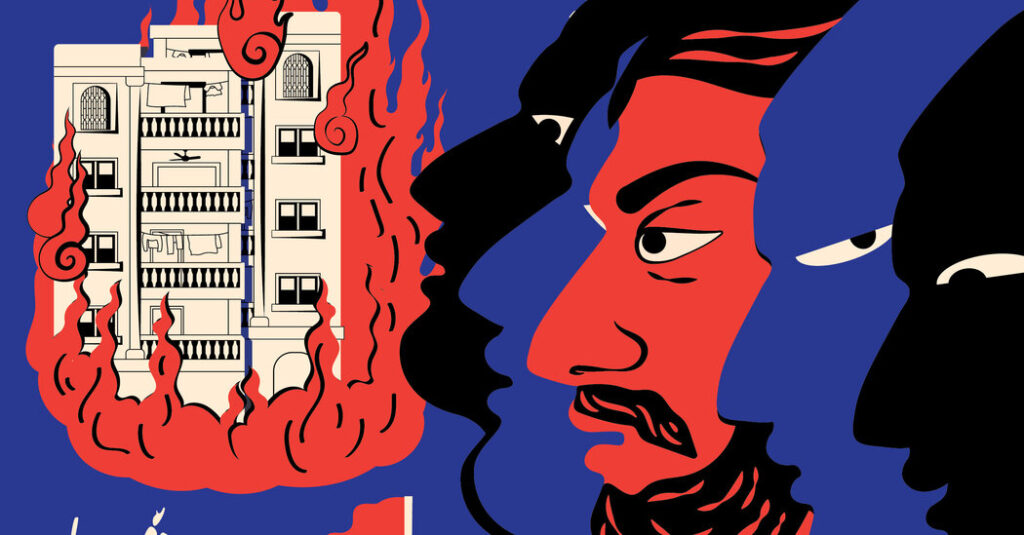
THE COMPLEX, by Karan Mahajan
The late great S.P. Chopra, the fictional politician whose influence forever looms over the characters in Karan Mahajan’s new novel, was more of a prolific father than an attentive one. With a long, illustrious record of public service (framer of India’s Constitution, governor of its Reserve Bank), he seemed to belong as much to the nation as to his family.
One might trace this back to his relationship with his own father, whom he did not meet until he was 12, after the elder Chopra was advised by an astrologer that any sight of his newborn son’s face would kill him. Now, S.P. lives posthumously in the heads of his nine adult children less as a collection of memories than as a vague but crushing set of patrimonial expectations.
His emotional legacy may be murky, but his material one takes the very concrete form of two multistory buildings in Delhi. These have been divided haphazardly into apartments in which more than 20 of his descendants and their families live in irritable proximity: the “Complex” of the novel’s title. (“Compound” might have been a better word for this real estate setup, but of course it lacks the piquant alternative meanings.)
While it’s true that Delhi prices make both the property and the land extremely valuable, the Complex itself is no palace: “Old paint on the wall, mere powder in places — paint chosen by her father and never recoated. Old black switches, the wires running in covered plaster rails along the walls. To live in this house was to live inside their father’s mind: half village, half city.”
S.P.’s heirs have the means, and sometimes the desire, to leave home, even to emigrate to the West; but family dynamics, good or bad, tend to pull them back. Thus the novel’s field of action — at first quite global, with long interludes in Michigan and in London — gradually contracts to this claustrophobic setting, where there is so little space that the returning family members squabble over who has the right to build new rooms on the roof, or in the dilapidated servants’ quarters.
The Chopra family members who suffer most tend to be the women, especially those who marry into it. One of them is back in Delhi after moving excitedly to her new husband’s home in England, only to learn that he was already married to a white Englishwoman there, who had borne him a son. But that’s far from the worst of it. Another of S.P.’s sons, Laxman — the Chopra whose struggles and misdeeds grow to dominate the novel — has the seriously unfortunate habit of sleeping with his relatives’ wives. Nor is he always, to attempt to put it delicately, a stickler for consent.
When one of Laxman’s victims, Gita — his brother’s wife — finally summons the nerve to tell a family member about his having forced himself on her, she is amazed to learn that the family (or some of them, at any rate) already knew about it, and further, that they had hoped it might turn out to provide a genetically acceptable “solution” to the shameful problem of Gita’s childlessness. Rape as blessing in disguise, as it were.
This revelation is somehow more staggering to the reader than to the characters. Indeed, as the novel pushes past this development and continues to narrate the relatively ordinary tribulations of this pathologically insular family — business ventures gone bad, squabbles over living space, routine domestic violence — one starts to wonder: Where could all this possibly be going?
Mahajan knows exactly where it’s going. His previous novel, the rapturously received “The Association of Small Bombs” (2015), was about the long tail of violent, “political” acts in the personal lives of individuals caught in their orbit, willingly or not. In “The Complex,” Mahajan approaches that same truth from the opposite direction, showing us how organically and dangerously certain qualities can turn men into political leaders, and how even a movement of millions can have one man’s atavism at its heart.
Laxman — son of a “great man,” business flop, cheerful sociopath, rapist, masterly avoider of blame or consequence — eventually fails his way into the world of local politics. He succeeds with terrifying ease, as befits someone with no real convictions and an instinct for power.
The political events he exploits for his personal advancement, like the Mandal Commission’s affirmative-action programs and the mass protests against them, or the assassination of Indira Gandhi, are all real-life ones. Ultimately, Laxman (who is Hindu) finds a way to ride the wave of anti-Muslim violence in early-1990s India — in which at least 900 people died — into a position of national influence that syncs up with his grotesquely inflated self-image. Some in the family take it better than others:
How had this happened? Gita wondered. How had the worst person in the family become its doyen? Or was this the fate of all groups? That power accrued to the person with the most energy, regardless of whether that energy was good or evil?
“Small Bombs” could be somewhat puckish on the subject of the interplay between the personal and the political, the way small currents redirect big ones and vice versa. “The Complex,” Mahajan’s third novel, is a more magisterial performance, mostly in good ways. His work has always woven a subversive, contemporary sensibility into a traditional, almost 19th-century approach to form and style.
The narration in “The Complex,” though technically (indeed, almost secretly) delivered by Laxman’s nephew Mohit, exercises an easy omniscience, even within scenes, and is given to apothegms that might be risky if it weren’t for the fact that the author so consistently nails them: “No one was friends in any family. It was just another network of power masquerading as a nest of love.” Mahajan is a confident, ambitious and increasingly important writer, from whom one only wishes we heard more often.
The crime at the end of the book is revealed in its opening pages, as is the identity of the criminal — so straightforwardly that I found myself trying to anticipate a twist, a reveal. But it’s telling that the twist never comes. There are fewer ironies in “The Complex” than in “Small Bombs”; the new book seems more like a study of revealed inevitability. “Say what you would about Laxman,” Mohit observes, “but he had been exactly what he appeared to be. There was no artifice. He saw the world and he took and took. He never apologized.”
THE COMPLEX | By Karan Mahajan | Viking | 435 pp. | $30
The post How Did the Worst Member of the Family Become a National Leader? appeared first on New York Times.