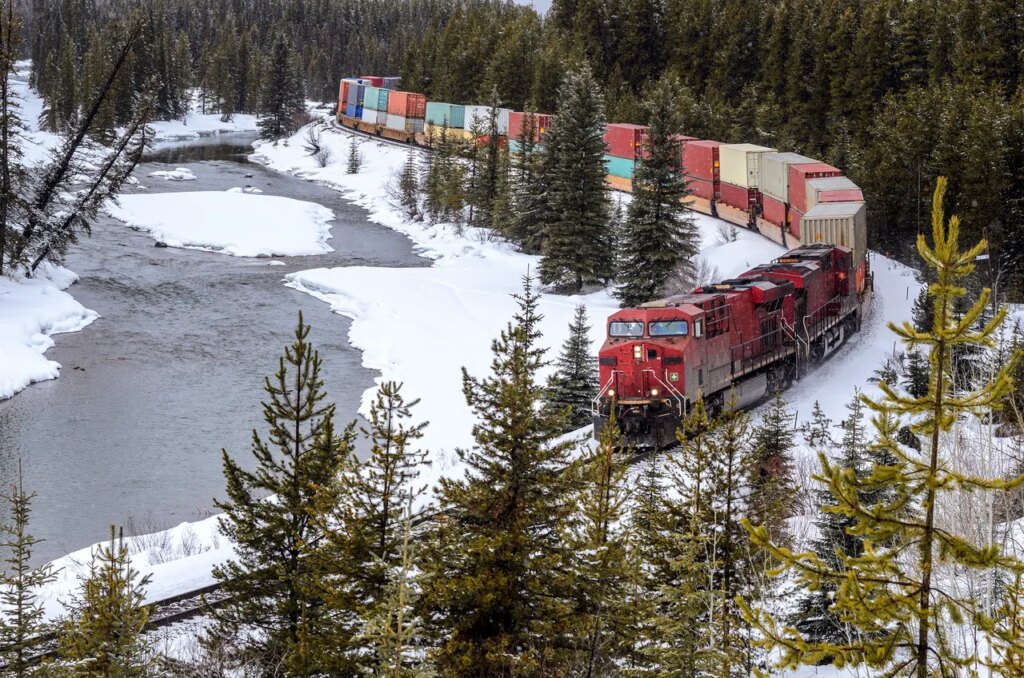
Have you ever watched a mile-long freight train rumble by and wondered how one locomotive can pull more than a hundred fully loaded cars? The locomotive weighs maybe 150 metric tons, and each car is about 100 metric tons, which means it’s hauling 10,000 tons.
I mean, if you weigh 170 pounds, this would be like pulling three SUVs totaling 12,000 pounds. Ridiculous, right? I’ll give you a hint: It’s not about weight or mass—at least not directly. It’s about friction, which is the resistance to motion between two surfaces that are in contact.
Friction gets a bad rap—we use it as a metaphor for something that hinders productivity. But without it, things would not go smoothly. You couldn’t walk; you couldn’t even tie your shoes. You’d drop your latte. Your bicycle tires would spin in place and you’d fall over—luckily, since you’d have no brakes. In fact, all the nuts and bolts holding your bike together would fall off.
So, yes, to answer our question about freight trains, we need to understand how frictional forces work. All aboard the physics train!
What Is Static Friction?
Let’s start with something simple. Place a book on a table and give it a little nudge on the side. Just a light push—not enough to get it moving. Newton’s second law says the net force on an object equals the product of its mass and acceleration (Fnet = ma). Since the book isn’t accelerating (a = 0), the net force must be zero, meaning all the forces are balanced. Here’s a diagram:
Let’s look first in the vertical direction: We have a downward pull from gravity, and the strength of that force depends on the mass of the book (m) and the gravitational field (g) of the planet you’re on (Fg = mg). But the book isn’t accelerating downward, so there must be an equal force from the table pushing up. We call this a “normal force.” Result: The net vertical force is zero.
I know, the idea of an inert table pushing up on a book doesn’t seem very normal. Maybe it’ll help if you realize that gravity doesn’t pull you to Earth’s surface, as people often think—it pulls you to the center of the Earth. The normal force is what keeps you from plunging through the floor. (By the way, “normal” means perpendicular—it’s always perpendicular to the surface.)
Horizontally, we also have two forces. There’s the force of you pushing on the book from left to right, and again there must be an equal force pushing in the opposite direction. We call that resisting force static friction—“static” because the book’s not budging. This depends on just two things, the specific materials in contact, captured in a coefficient μs, and the normal force (N):
This coefficient μs is just a number, usually between 0 and 1, which you can look up in a table for all kinds of different materials. For rubber tires on asphalt, it’s 0.9; for tires on ice it falls to 0.15 (hence snow chains). And N, as we saw above, equals the gravitational force, which in turn depends on the object’s mass. The greater the mass, the more friction you get.
Now, see that less-than-or-equal sign? This says μsN is the maximum static friction force in a given situation. If you push the book with a force of 1 newton, the frictional force will be 1 newton. Double the pushing force and the frictional force also doubles. It does whatever it has to in order to keep the two surfaces stationary—up to a point. If you keep pushing harder, your applied force will eventually exceed μsN and the book will start to slide. At that point, kinetic friction kicks in.
Kinetic friction is the resistance you get when the book is sliding across the table. It’s always lower than static friction, because it’s just harder to start something moving than to keep it moving. “OK,” you’re saying, “I got it. Static when stationary, kinetic when in motion.”
Ha! Then here’s a paradox: The force that enables you to move—let’s say to walk—is static friction, not kinetic friction. When you push off the ground with your back foot, static friction keeps your foot from sliding out from under you. (For laughs, see my recent article about trying to climb out of an ice bowl.) The same is true for the locomotive: It uses static friction to drive itself forward.
Train Tug-of-War
Now, suppose we have two identical locomotives chained back-to-back. What happens if they pull in opposite directions?
There’s a bunch of forces here, but the only new one is what we call the tension force (T) in the chain. This results in an equal force pulling each locomotive in the backward direction. Resisting that pull is the static friction force (Ffs), which is now pushing in the forward direction.
Now, since both locomotives have the same mass (even the drivers are the same size), they will have the same normal force (N) and therefor the same maximum static friction. The result is easy to predict: The trains will huff and puff to no avail—it’s a stalemate.
What if the train on the right has a higher mass? That means it will have a larger normal force, and therefore a greater maximum value for friction. The lower-mass train on the left wouldn’t be able to pull as hard and would lose the battle. Its wheels will lose traction and skid backward.
Now, this seems to suggest that a locomotive towing a bunch of cars would have to be more massive than all the cars put together. That would be true if the cars were using static friction—but they aren’t!
Static Friction Beats Kinetic Friction
Take a dining room chair and push it in circles around the room. If anybody asks, tell them it’s for science. You’ll soon get tired, because the floor resists this sliding motion. That is the kinetic friction force. The equation looks very similar to the one for static friction:
But there are two key differences. First, we have a different coefficient, μk. This is always less than the coefficient of static friction, μs, so kinetic friction is lower. (This is why cars have antilock brakes: If you keep the wheels from locking up and skidding, you can stop in a shorter distance.) As an example, when two steel surfaces interact (like a train car wheel on a track), the coefficient of static friction would be 0.74, but the coefficient of kinetic friction would be 0.57.
The second difference is the equal sign instead of less-than-or-equal. This means the frictional force is constant as long as the object is sliding—it doesn’t equal the applied force anymore. That means the net force isn’t zero. Push harder on the chair by running and the chair will speed up.
Let’s go back to that tug-of-war. The driver on the right now has an idea: Instead of gunning his engine, he throttles down to maintain a static friction interaction with the rails. Slow and steady. The guy on the left floors it—and what happens? His wheels spin and he gets a kinetic frictional force. Well, static friction beats kinetic friction, so the right train wins!
This would work even if the train on the left is somewhat heavier. So, it is possible for a train engine to pull cars that are more massive. But wait! There’s an even more important factor: A moving train car is rolling, not sliding. The wheel just touches the rail at one point and then rolls on to another point on the wheel. This is the magic of wheels: For the cars being towed, there is no longer any friction with the rails.
But there has to be kinetic friction somewhere, and indeed there is—it’s between the wheel axles and the car itself. To rotate, the axle has to slide along some surface in the housing that holds it in place. But with roller bearings and lubrication, μk can be massively reduced, from 0.56 for dry steel on steel to something like 0.002.
Now we’re talking! This is how a locomotive can pull a long train of cars with a much greater mass. The engine is pulling forward using steel-on-steel static friction, which is pretty high (0.74), giving it good traction. And the cars have a resistive kinetic friction force with a coefficient that is orders of magnitude smaller.
Some Extra Tricks
Still, that huge weight of 10,000 metric tons makes for a very high normal force—like roughly 100 million newtons. And remember, static friction is higher than kinetic friction. So even if you can keep a train moving, you might not be able to get it started.
That’s why trains have a trick called slack action. If you’ve ever been near a train as it starts moving, you probably heard a bunch of cracking that moves down the line of cars. The reason is that the connection from one car to the next is loose. So when the locomotive pulls the first car, the second car remains stationary until the slack is gone. With this trick, the locomotive can get one car moving at a time and add it to the group of moving cars. Pretty smart!
One last cool thing. There’s yet another type of friction called rolling friction. You see this on a truck with rubber tires: Under the weight of the vehicle, the tires flatten out on the bottom. So when the truck is moving, the tires are continually being deformed and returning to their proper shape. This flexing heats up the tires, and where there’s heat there’s energy loss. Since energy is conserved, this means the wheels slow down, and the truck has to burn more fuel to maintain its speed. Trains, on the other hand, have very little rolling friction, because their steel wheels barely deform at all. This makes trains a more energy-efficient mode of transportation.
So, you see—it is indeed possible for a locomotive to pull a bunch of cars that have more mass. You just need to use a little physics.
The post How Can a Locomotive Pull a Long Train That’s Much Heavier? appeared first on Wired.