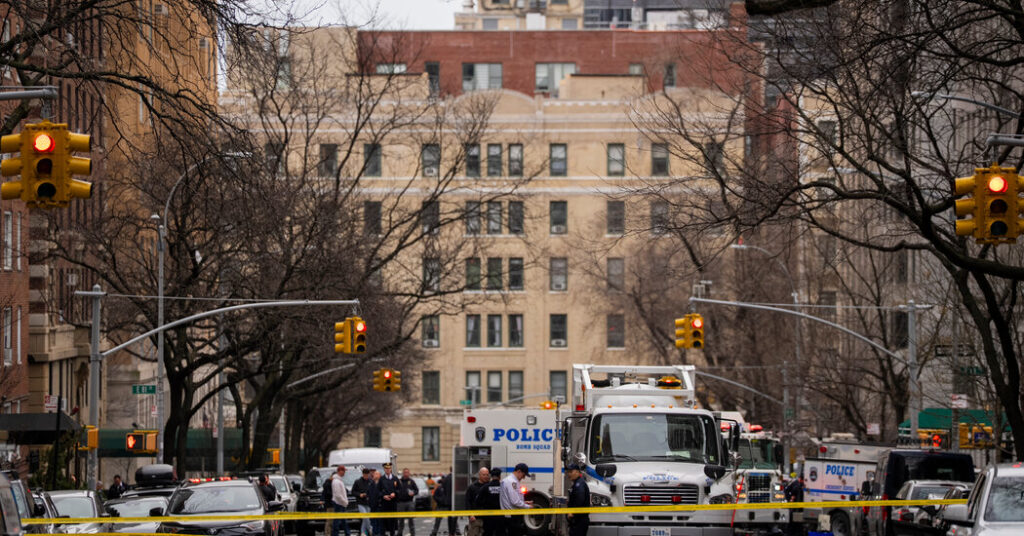
The sight of a man igniting a homemade bomb then hurling it into a crowd of protesters stunned people in New York City, where no one has attempted to use an explosive device in a public place for nine years.
The device, a jar wrapped in tape and filled with screws, nuts, bolts and fuses, was in fact a makeshift bomb packed with a cheap but highly volatile chemical compound used in terrorist attacks worldwide, local and federal authorities said on Monday.
The device did not detonate. Neither did a second, similar homemade bomb that the man, a supporter of the Islamic State, dropped near a group of police officers keeping watch over an anti-Muslim rally on Saturday led by a right-wing provocateur, law enforcement officials said. No one was injured even as the devices emitted plumes of smoke that sent people running for cover at the protest in Manhattan, outside Gracie Mansion, the official residence of New York’s mayor, Zohran Mamdani.
But the scene that unfolded could have turned deadly and put a spotlight on the dangers facing the country’s largest city, where the police have increased security since the United States and Israel launched airstrikes against Iran last month. It also served as a reminder of the continuing influence of the Islamic State, known as ISIS. Despite having been greatly diminished, it has inspired deadly attacks through online propaganda across the world for years.
Police Department officials in recent weeks have continued to warn of the dangers of those seeking to cause havoc in the city. Rebecca Weiner, the deputy commissioner of intelligence and counterterrorism, said at a news conference on Monday that Saturday’s events were “very much in keeping with the trend we were seeing with ISIS- inspired adherence.”
“Younger and younger individuals are radicalizing” toward ISIS and other terrorist organizations across the ideological spectrum, she added.
Federal prosecutors in Manhattan have since tried to learn more about Emir Balat, 18, who they say threw the bomb, and Ibrahim Nikk Kayumi, 19, who they say handed Mr. Balat one of the devices.
The men, who drove about 100 miles from where they live in Pennsylvania to New York, told law enforcement officials that they supported ISIS, according to a criminal complaint. They were charged on Monday in federal court in Manhattan with using a weapon of mass destruction and transporting explosive materials across state lines.
When law enforcement officers asked Mr. Balat if he was familiar with the 2013 Boston Marathon bombing, and if that was what he had hoped to accomplish, the complaint says he responded, “No, even bigger. It was only three deaths.”
The events on Saturday began in the late morning, when Jake Lang, a far-right social media personality, arrived with a goat and about two dozen followers wearing American flag hats and sweatshirts that said “Freedom.” The protest was aimed at Mr. Mamdani, the city’s first Muslim mayor. Soon after, Mr. Lang and his supporters were met by about 100 counterprotesters, who held an opposing demonstration they called “Run Nazis Out of New York City,” the complaint says.
Around 12:15 p.m., Mr. Balat ignited one of the devices, raised it over his head and, while shouting, threw it into the crowd on East End Avenue near East 88th Street, according to the complaint, which contains photos of the incident. Moments later, Mr. Balat ran down the block where he met up with Mr. Kayumi, who handed him a second device, the complaint says. Mr. Balat then dropped that device near several police officers, who arrested him shortly after.
The police commissioner, Jessica S. Tisch, who also spoke at a news conference, said that an analysis of one of the two makeshift bombs showed that it contained TATP, “a dangerous and highly volatile homemade explosive that has been used in I.E.D. attacks around the world.”
A third device was discovered on Sunday inside a black Honda parked on East End Avenue between East 81st and 82nd Streets, several blocks south of Gracie, Ms. Tisch said. The Police Department bomb squad determined that the device did not contain explosive materials.
After his arrest on Saturday, Mr. Kayumi said he had watched ISIS propaganda on his phone, “and was partly inspired to carry out his actions that day by ISIS,” the complaint says. Meanwhile, as Mr. Balat was being taken from the rally to a Manhattan police precinct, he told officers that “this isn’t a religion that just stands when people talk about the blessed name of the prophet,” the complaint says. “We take action” he said, and “if I didn’t do it, someone else will come and do it.”
Once he arrived at the precinct, Mr. Balat waived his constitutional rights to remain silent and have a lawyer present, the complaint says. He then asked for a piece of paper and wrote on it that he pledged his allegiance to the Islamic State and called for the death of nonbelievers. Mr. Balat’s lawyer, Mehdi Essmidi, said his client is a high school senior and a U.S. citizen with no prior arrests.
On Monday, during their arraignment, the men wore white, hooded prison jumpsuits with shackles around their ankles and metal chains around their waists. Mr. Balat sat motionless, his head slumped. Nearby was Mr. Kayumi, who turned his head to look at the people sitting in the packed courtroom.
Judge Sidney Stein ordered them to be detained until their next court appearance on April 8. The men were led out of the courtroom, their chains clinking as they went.
Nate Schweber, Olivia Bensimon, Yan Zhuang and Neil Vigdor contributed reporting.
Chelsia Rose Marcius is a criminal justice reporter for The Times, covering the New York Police Department.
The post Homemade Bombs in ISIS-Inspired Attack Were Deadly, N.Y.P.D. Says appeared first on New York Times.