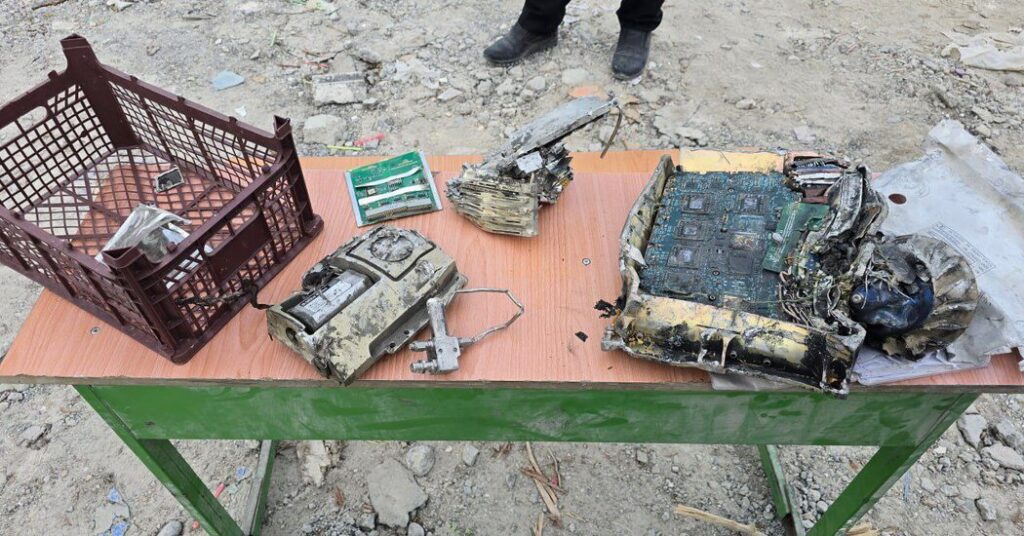
Mangled missile fragments purporting to be from the deadly strikes that hit a naval base and elementary school in southern Iran on Feb. 28 bear the markings of an American cruise missile, according to an analysis by The New York Times.
Photos of the fragments were posted to Telegram by Iran’s state broadcaster and were characterized as showing “the remains of the American missile that landed on the children of Minab school.”
The debris is displayed on a table near the shell of the Shajarah Tayyebeh elementary school, most of which was destroyed in a precision strike, according to an earlier analysis by The Times. At least 175 people, most of them children, were reportedly killed.
While it is not clear where or how the fragments were recovered — or whether they pertain specifically to the school strike — they contain serial numbers and other details that are consistent with how the Department of Defense and its suppliers categorize and label munitions. The remnants appear to be from a U.S.-made Tomahawk cruise missile manufactured in 2014 or later.
Evidence analyzed by The New York Times has been mounting that the school was hit during a series of U.S. strikes targeting an adjacent naval base. On Sunday, a video was uploaded by Iran’s semiofficial Mehr News Agency, that The Times and other outlets identified as a Tomahawk cruise missile striking a medical building in the naval base. The Pentagon categorizes the Tomahawk as a precision-guided munition.
The Defense Department released videos of U.S. Navy warships firing Tomahawks at Iran on Feb. 28, the first day of the strikes, and the day the school was hit, and Gen. Dan Caine, the chairman of the Joint Chiefs of Staff, said in two separate appearances last week that Navy-launched Tomahawks were used to attack targets along Iran’s southern coast during the opening hours of the war.
On Saturday, Mr. Trump made the assertion that the school was hit by Iran without offering any proof. On Monday, he again posited that scenario.
“Iran also has some Tomahawks,” he said in response to questions from a New York Times reporter at a news conference. “As you know, numerous other nations have Tomahawks. They buy them from us.”
In fact, Iran has no Tomahawks. Any country the U.S. has sold Tomahawks to would have to obtain authorization from the State Department before transferring them to a third party, like Iran.
Mr. Trump also added that he was made aware that the Minab incident was under investigation and that whatever the results of that show he was “willing to live with it.”
Besides the United States, only two countries are known to have Tomahawk missiles: Australia and Britain. Two additional countries have agreed to purchase them — Japan in 2024, and the Netherlands in 2025.
In October, Mr. Trump openly mused about providing Tomahawks to Ukraine, but never followed through on the idea.
Even if Iran were able to somehow obtain a Tomahawk, it lacks the technical equipment and capabilities that are used to program their flight paths and upload that data into the missile’s onboard computer. Iran would also have to be in possession of a launcher capable of firing a Tomahawk without damaging it.
Iran has produced two models of cruise missiles for attacking land-based targets. But both of those weapons have design features that visually set them apart from a Tomahawk, even when viewed from a distance.
In the photos of the weapons debris, one remnant is marked SDL ANTENNA, or satellite data link antenna, part of a communications system installed in more modern versions of the Tomahawk. A number unique to Department of Defense contracts indicates that the component was supplied to the U.S. military as part of a 2014 order. The name of Ball Aerospace Technologies, a weapons manufacturer based in Boulder, Colo., that was acquired by BAE in 2024, is imprinted on the part.
Another remnant is stamped with “Made in USA” and bears the name of Globe Motors, an Ohio-based manufacturer. According to the official open-data source for American federal government spending, the company has been awarded millions of dollars in Department of Defense contracts for components, including the actuator motors used to move the guidance fins that steer Tomahawk missiles.
The photos match remnants documented in Tomahawk missile attacks in previous conflicts, including the Globe Motors component, as well as a circuit board, both photographed in Yemen, and archived by the Open Source Munitions Portal, a database of weapon fragments found in conflict zones. A similar Globe Motors component has also been found in Syria.
Trevor Ball, a former U.S. Army explosive ordnance disposal technician who works with the research collective Bellingcat, also identified the components as being part of a Tomahawk missile. He has identified similar missile remnants photographed at other attack sites in Iran since the start of the Israeli-U.S. war.
Shawn McCreesh contributed reporting.
Christiaan Triebert is a Times reporter working on the Visual Investigations team, a group that combines traditional reporting with digital sleuthing and analysis of visual evidence to verify and source facts from around the world.
The post Fragments of U.S.-Made Missile Seen in Photos Taken by Iran Near Deadly School Strike appeared first on New York Times.