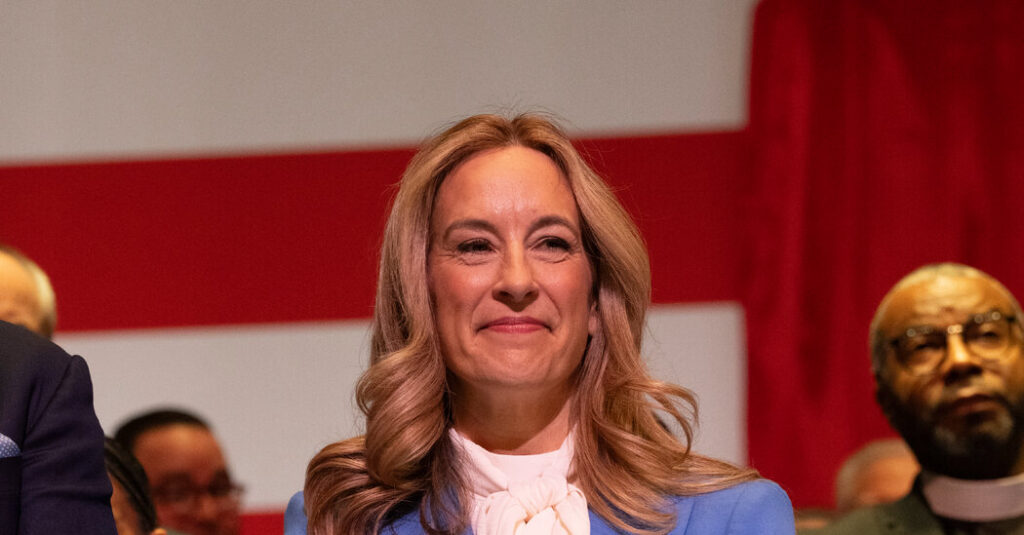
Two weeks before Mikie Sherrill was set to unveil her first budget as governor of New Jersey, she held a news conference in order to, as she described it, set the table.
The state, she warned, was on track to spend $3 billion more than it expected to take in over the next few years. Federal pandemic aid had dried up. President Trump’s federal funding cuts, including those to health care, were likely to leave an additional $100 million gap in the state’s budget by next year.
“I refuse to put off for tomorrow what we have to fix today,” Ms. Sherrill, a Democrat, said. “Washington isn’t coming to save us.”
On Tuesday afternoon, in an address to a joint session of the State Legislature in Trenton, Ms. Sherrill is expected to lay out her remedy for that fiscal crunch and offer the first robust preview of her policy priorities as governor.
At the news conference in February, Ms. Sherrill blamed prior administrations for making shortsighted budget decisions and signaled that she was prepared to release a spending plan on Tuesday that slowed the rate of state spending.
“We need to fix Trenton’s historic spending problem,” Ms. Sherrill said.
“Let’s face it, for decades, previous administrations have allowed for business as usual in Trenton and failed to solve things long term,” she added.
Philip D. Murphy, a fellow Democrat who was governor for two terms, was barred by term limits from running for re-election in November. Ms. Sherrill’s decisive 14-point win over her Republican opponent, Jack Ciattarelli, represented the first time since 1961 that either party had held control of the governor’s office in New Jersey for three consecutive terms.
But Ms. Sherrill’s victory also means that when she blames predecessors for the state’s fiscal woes, she is taking indirect aim at her own party, and the Democrats who have long held a majority in the State Legislature.
The budget must be adopted by July 1, the start of the next fiscal year, and the governor’s release of a spending blueprint is the first step in a monthslong negotiation with the Legislature.
State lawmakers are bracing for Ms. Sherrill to try to trim favored programs. One of the more expensive programs likely to face scrutiny is a popular tax-reducing measure called StayNJ, which was first approved in 2023 as a way to entice older residents to remain in New Jersey.
Under the program, homeowners 65 or older with an annual income of $500,000 or less are eligible for a $6,500 tax cut, starting this year.
The state’s budget swelled under Mr. Murphy, partly because he prioritized making payments to the state’s pension system, which had been severely underfunded for decades. New Jersey also borrowed billions of dollars to cover the extra costs associated with the deadly Covid-19 pandemic, a crisis that later led to an influx of federal aid — and an additional uptick in spending.
This year’s budget is $59 billion, up from $39 billion in 2019.
Republicans in the Legislature have long warned that the growth was unsustainable, and have estimated that the long-term gap between the state’s revenue and its spending is closer to $4 billion.
Matthew Hale, who teaches political science and public affairs at Seton Hall University, said Ms. Sherrill’s budget proposal offered her an “opportunity to really show how she is different from Governor Murphy.”
“The federal spigot has run dry,” Mr. Hale wrote in an email. “That funding allowed Governor Murphy to spend money pretty freely and still pay down the state pension debt obligations.”
Aaron Binder, New Jersey’s treasurer, said that failing to fully fund the state’s pension obligations before 2022 had left New Jersey taxpayers on the hook for $7 billion in annual pension payments. Had lawmakers not shortchanged the fund, which pays for employee retirement benefits, that cost would be closer to $1 billion a year, he said.
Relying solely on the state’s $7.2 billion rainy day surplus fund to plug New Jersey’s looming structural deficit, without also making cuts, would drain the reserve fund in just two years, he said.
“We clearly need to make major changes to veer off this path,” Mr. Binder said.
Ms. Sherrill has said her administration will unveil an online tool next month that will allow residents to view the draft budget and follow along as changes are made. It is part of a campaign promise she made to increase government transparency.
There is also legislation pending, pushed by a Democratic newcomer in the State Assembly, Andrew Macurdy, to shift the state toward a multiyear approach to budget planning.
“Businesses do this,” Mr. Macurdy said. “Other states do this. The idea is just to forecast down the line. What effect are the decisions you’re making today going to have in the future?”
Tracey Tully is a reporter for The Times who covers New Jersey, where she has lived for more than 20 years.
The post Fiscal Crunch Presents a First Big Policy Challenge for Mikie Sherrill appeared first on New York Times.