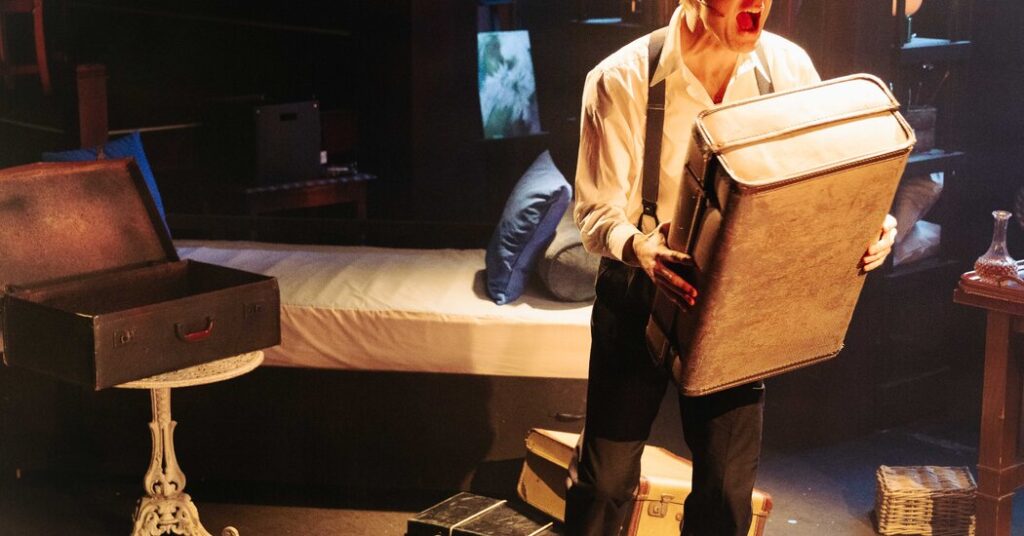
In a ramshackle onetime warehouse on the south side of London, with a leaky pitched roof, a shabby chic bar, and posters of shows gone by, a group of Americans gathered this winter to make a musical about a famous American writer.
It was a small show, “Beautiful Little Fool,” about the glamorous-but-tragic marriage of F. Scott and Zelda Fitzgerald. It had an accomplished American director, American writers and an American producer, who had looked around the United States for places to stage a first production of this show, but who chose London for a simple reason: cost.
About five miles east of the theater where “Beautiful Little Fool” was performed, another group of Americans spent the first weeks of the year in a rehearsal studio working on a much bigger musical, “The Greatest Showman,” adapted from the film about another singular American figure, the circus impresario P.T. Barnum. That show, being developed by Disney Theatrical Productions, has an almost entirely American creative team, but this month it is starting its stage life with a sold-out production in Bristol, England.
For American artists telling American stories, American productions remain the dream and the goal. But the costs of developing and running shows in the United States have skyrocketed — $20 million Broadway budgets, rare a decade ago, are now common. And profitability rates have plunged — just four of the 48 new musicals that opened since the pandemic have made money thus far.
As a result, investors have become increasingly skittish, leading to a wave of offshoring, allowing producers and artists to refine new work and build word-of-mouth before staging higher-risk productions in New York.
“London is very busy with American producers who are looking for better value,” said Matthew Byam Shaw, a British producer. And Kathy Bourne, the president of the trade association UK Theatre, said, “There is no question that we’ve seen a marked shift.”
“It is clear that putting on productions in the U.K. is altogether cheaper,” Bourne added, “so why not?”
It’s not just musicals. A new play, “High Noon,” which was adapted from the 1952 Western film and originally planned to open on Broadway, instead just ran in the West End, telling a very American story with an American star — Billy Crudup — to British audiences.
“Broadway is everybody’s dream, but Broadway is expensive,” said Paula Wagner, the lead producer of “High Noon.” “To do it in the West End is half, or even less than half, as expensive.”
Starting a new musical at an American nonprofit theater often costs the associated commercial producer $2 million or more. Mark Cortale, the lead producer of “Beautiful Little Fool,” said he had considered such a move before deciding on Southwark Playhouse in London, where the budget was $500,000.
Another data point: Cortale said he paid about $9,000 a week for a 214-seat theater at Southwark Playhouse. He said staging the play Off Broadway at the 299-seat Daryl Roth Theater in Manhattan would have cost $22,500 a week.
Why is it so much more economical for theater producers to work in Britain than in the United States? American producers say that in Britain every aspect of their work becomes less expensive — wages for cast and crew, rent to theater owners, payments to vendors and suppliers. The current minimum weekly salary for an actor in London’s West End is about $1,219; on Broadway it is $2,717.
The labor landscape in London is far less complicated than in New York: the Society of London Theater, which bargains on behalf of West End theaters and producers, negotiates with three unions, while the Broadway League bargains with 13 in New York City. Also, theater union work rules in Britain are less rigid, producers say, leading to further cost savings.
Government support is a major factor as well. Unlike the United States, Britain has, since 2014, had a national Theater Tax Relief program that gives most productions 40 percent of qualifying costs back as a tax credit. New York state had a post-pandemic tax credit for shows in New York City, but that program was less generous — it applied to 25 percent of qualified expenditures, with a cap — and it ran out of money late last year. Even if it is funded again, it excludes the many productions staged elsewhere in the U.S.
“On Broadway there are total wipeouts, but in London that’s very rare because the government gives you 40 percent of your hard costs back,” said Eric Kuhn, an American producer who mostly invests in shows in Britain. “Producers are able to take greater risks and bigger swings.”
London, like New York, has a lot of well trained and highly skilled theater artists, so producers say they have no problem mounting quality productions. And there are audience advantages: multiple producers said they believe that London has a more robust culture of theatergoing, partly because tickets are more affordable, which makes it easier to attract audiences to new shows with unfamiliar titles.
Chris Smyrnios, the artistic director and chief executive of Southwark Playhouse, where “Beautiful Little Fool” played, said that of the 40 shows his theater staged last year, about eight were produced or financed by Americans. “The message I’m getting is that to come to London, hire a theater like ours, pay for the flights and accommodations for the U.S. creatives and casts, it still works out cheaper,” he said.
But he said he’s also cautious because he doesn’t want spendy American producers to drive costs up for British consumers. “What’s happened in New York — I would hate for that to happen here,” Smyrnios said. “The pool of stuff becomes more conservative when there’s more money at risk.”
The London theater scene, particularly postpandemic, has been thriving. The 47 theaters that are part of the Society of London Theater drew 17.1 million patrons in 2024, outpacing the 13.4 million patrons who attended a show at the 41 Broadway theaters that year. “There’s no doubt we have recovered easier from the pandemic,” said Claire Walker, one of the two chief executives of the Society of London Theater.
So now American shows big and small are starting their stage lives in London.
“Sinatra The Musical,” with an American writer, an American director and a quintessentially American subject, had an initial run in Birmingham, England, in 2023, and will transfer to London’s West End in June. “Already Perfect,” a three-perfomer show written by and starring the American actor Levi Kreis (a Tony winner for “Million Dollar Quartet”), started in London this winter.
“We spent about the same amount of money to do a five-week production in London that we would have to do a one- or two-day presentation in New York,” said that show’s American producer, Larry Lelli.
Andy Sandberg, an American director and producer who runs the Hermitage Artist Retreat in Florida, has signed on to produce and direct an entire season of new plays, all set in America, at Riverside Studios in London, starting in September. “There is a challenge in the commercial industry in the U.S., so a lot of projects are being pitched as philanthropy and not as viable business models,” Sandberg said. “London has provided an interesting alternative model that is friendlier to investors without compromising the quality of the work.”
And Todrick Hall, the American singer, actor and television personality, has been workshopping his new musical, “Midnight,” in London. The show, a 19th-century love story with a company of 24, had an initial workshop last fall at Sadler’s Wells, and just wrapped up a second run there. Hall said he hopes to bring “Midnight” to New York, but that the lower costs in London made it obvious it should start there. “I just don’t know what the benefit of doing it in America would be,” he said. “To be financially responsible, it’s hard to justify doing it in America.”
As for “Beautiful Little Fool,” its team is now planning for an Off Broadway production next year. A five-character musical, the show is the brainchild of Hannah Corneau, who once played Elphaba in “Wicked.” The director is Michael Greif (“Rent” and “Dear Evan Hansen”), and the playwright Mona Mansour wrote the book.
The London production faced unexpected hurdles. Corneau, who had been playing Zelda, injured her ankle during previews, and was replaced by her understudy, so Greif spent much of the pre-opening process coaching rather than refining. And reviews were mixed.
But Greif said he found it invigorating to develop a show in London. “It feels like what Off Broadway felt like once upon a time,” he said. “It’s an opportunity for the show to be an investigation.”
Like many of the Americans working in Britain, Cortale and Corneau aspire to have an American production, but said that starting in London was a game changer.
“I am a musician, not an accountant or an economist, but the fact that it can be possible here, and is a little more financially possible, is amazing,” Corneau said. “We’re able to physically see our world come to life.”
Michael Paulson is the theater reporter for The Times.
The post Fed Up With High Costs, American Theater Takes a Trip to London appeared first on New York Times.