The Federal Reserve was already struggling to get inflation back to its 2 percent target before President Trump opted for an all-out confrontation with Iran.
Now, elevated energy costs, if sustained, risk delaying that progress further. That is entangling the central bank in yet another challenging debate about how to adjust interest rates at a time when the labor market looks increasingly fragile.
The Fed has paused rate cuts after a series of reductions late last year and is widely expected to again hold rates steady, at a range of 3.5 percent to 3.75 percent, when officials meet next week. The questions they will no doubt discuss are whether the Fed should maintain this strategy in the face of rising energy prices, or if officials should begin to game out how to respond to a shock that may simultaneously lift inflation and also hinder growth.
Investors now expect the Fed to delay its resumption of rate cuts by at least one meeting, with most now forecasting a move in September instead of July, as was the case before the conflict began.
“The Fed always has a problem on how to respond to a supply shock,” said Alan Detmeister, a former Fed economist now at UBS. “On the one hand, the inflationary aspects suggest you should be raising interest rates. On the other, the reduced output and increased unemployment suggest you should be lowering interest rates.”
“It’s not clear, and it just causes the Fed to wait and see which part of their dual mandate they think needs the biggest help,” Mr. Detmeister said, referring to the Fed’s goals of low, stable inflation and a healthy labor market.
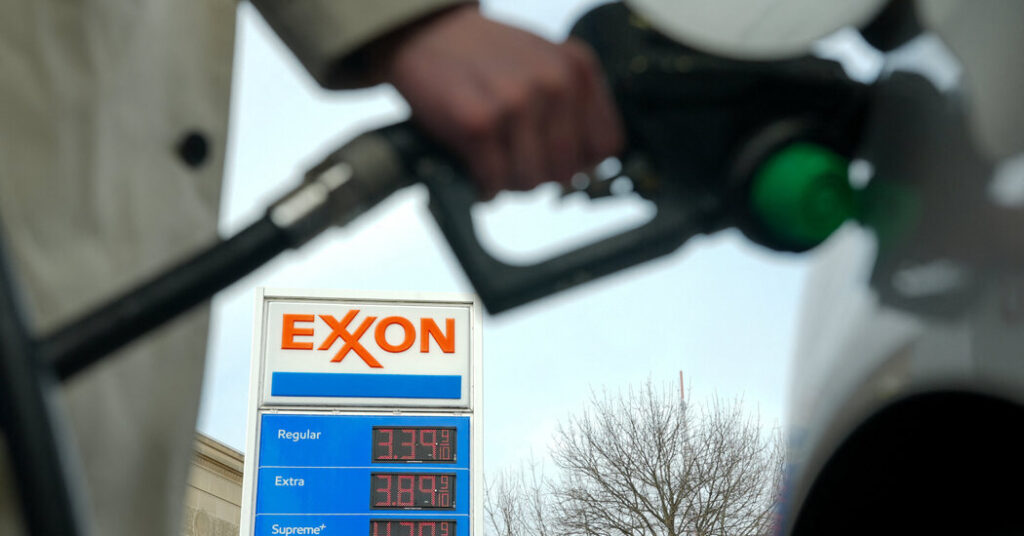
Oil prices have retreated from their recent peak of nearly $120 a barrel after Mr. Trump signaled on Monday that the war could be over “very soon,” but they remain above levels seen before the war began. That earlier run-up has already translated to higher prices at the pump for Americans across the country. Analysts have also warned that it will take time for global production to return to normal levels even if the conflict ended today.
Economists expect energy-related price pressures to push up inflation to some degree in the coming months. Whether this marks just a blip that the Fed can ignore or a more persistent problem that might alter the central bank’s decisions around rates depends squarely on how the situation evolves.
Resurgent inflation would present a particularly thorny problem for policymakers, who are simultaneously grappling with a flatlining labor market. Any attempt to shore up the economy with rate cuts could risk making inflation worse, while holding off could cause job losses to mount.
The Fed typically disregards swings in energy prices because it often takes a significant, long-lasting shock to fundamentally change the economic outlook. The same is true for other disruptions like natural disasters. The central bank has also taken a similar approach to Mr. Trump’s tariffs, with many officials concluding that those levies will lead to one-off price increases that do not permanently raise inflation.
The standard thinking is that higher oil prices, if sustained, can feed into higher prices for things like shipping and food. The impact can eventually filter into other goods and services, but with a significant lag and usually by a much smaller magnitude.
Mr. Detmeister estimates that every $10 per barrel increase in oil prices, if sustained, translates to a roughly 0.05 percentage point uptick in “core” inflation, which strips out volatile food and energy prices. The Fed pays closest attention to that measure because it is seen as the best gauge of underlying inflation. As of the latest data in January, the central bank’s preferred gauge, the Personal Consumption Expenditures Price Index, stood at 2.9 percent, well above the 2 percent target.
While inflation is often the first concern when an energy shock arises, a large one can end up denting consumer demand. Most Americans, many of whom have drawn down any savings, have only a limited budget. If higher gas prices eat up more of those funds, it leaves less to spend elsewhere, resulting in slower economic growth. That can also cap how elevated inflation eventually gets.
“It erodes purchasing power in general, and that means people tend to pull back,” said Kathy Jones, chief fixed-income strategist at Charles Schwab. Economists at Goldman Sachs reckon that each $10 per barrel increase in oil prices, if sustained, would reduce economic growth this year by about 0.1 percentage point.
Against this backdrop, Ms. Jones said that she expects the Fed to “sit tight and try to assess the duration and impact of this, knowing they could shift anytime they want to.”
Building a consensus around cuts might be tricky, however, especially given internal divisions that existed before the conflict. While the central bank’s top leadership appears to support the gradual resumption of cuts at some point this year, there is a vocal cohort who seem much more wary about doing so because of lingering inflation concerns.
That includes Beth M. Hammack, president of the Federal Reserve Bank of Cleveland. Ms. Hammack, who will vote on borrowing costs this year, suggested in an interview last week that the central bank should keep open the possibility of raising rates if the inflation outlook worsens. Minutes from January’s meeting suggested that several policymakers also wanted to keep that option open.
Michael Gapen, chief U.S. economist for Morgan Stanley, said that before taking any action, the Fed will likely need to have in hand clear evidence that price pressures are easing or the labor market is cracking in a more major way.
“This raises the bar on the margins to cut rates,” he said of the energy shock. “It’s harder to be pre-emptive. It probably doesn’t change where monetary policy is going, but it means they may start later, which could mean they end up doing more.”
A crucial part of the Fed’s calculations over how to proceed will also depend on how expectations of future inflation are shifting. So far, longer-term measures suggest the public has not lost confidence in the central bank’s ability to eventually get inflation back to 2 percent. But an extended conflict could start to test that.
“Unfortunately, this shock comes after years of high inflation and years in which inflation has never returned — not for a single month — to target,” said Riccardo Trezzi, a former Fed economist who runs the research firm Underlying Inflation. “At some point, you start asking yourself, ‘Are we really going back to target?’”
Colby Smith covers the Federal Reserve and the U.S. economy for The Times.
The post Elevated Energy Prices Add to Fed’s Dilemma on Interest Rates appeared first on New York Times.