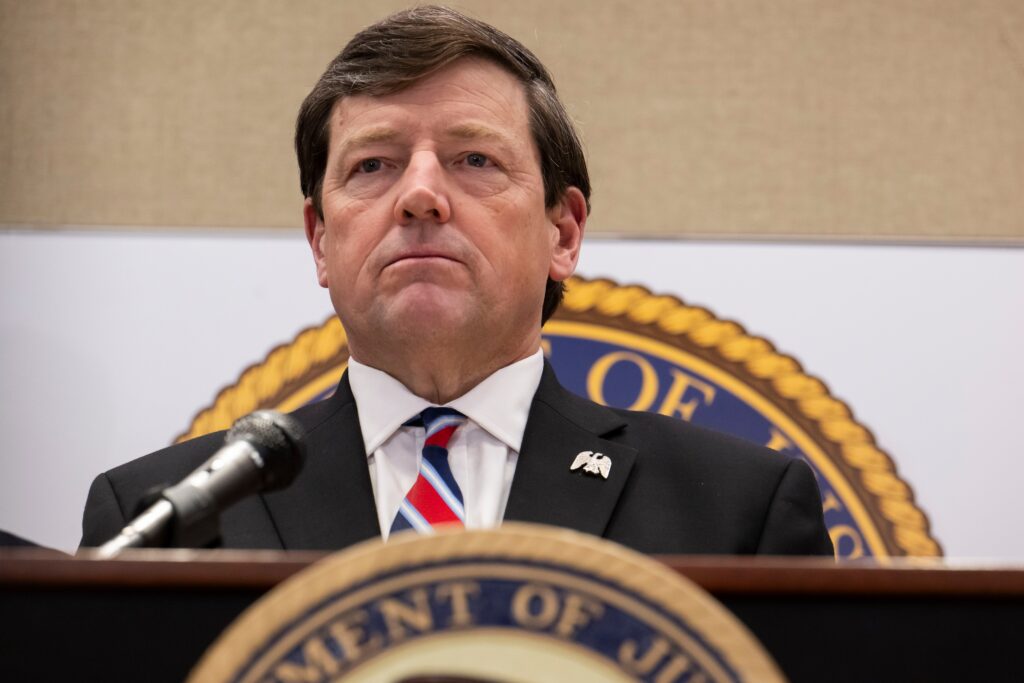
Senior Justice Department official and Trump ally Ed Martin is facing disciplinary proceedings over a letter he sent to Georgetown University’s law school asserting that his then-office would not hire anyone affiliated with Georgetown because of its apparent diversity, equity and inclusion (DEI) practices.
Martin — who organized the president’s “Stop the Steal” effort after his 2020 election defeat — sent the letter in February 2025 while he was serving as the interim leader of the D.C. U.S. attorney’s office. He is now the Justice Department’s pardon attorney.
The D.C. Disciplinary Counsel filed a complaint that details Martin’s unusual communications with then-law school dean William Treanor. In his letter to Treanor, Martin questioned whether Georgetown was using DEI practices and, if so, demanded the school change its curriculum. The complaint alleges that Martin was vague over what DEI practices he was referring to and told Treanor that he would punish the school by not hiring its students and graduates — even before the dean had an opportunity to respond.
“Acting in his official capacity and speaking on behalf of the government, he used coercion to punish or suppress a disfavored viewpoint, the teaching and promotion of DEI,” the complaint reads.
The Trump administration has worked to excise DEI efforts, which it has called discriminatory, from the federal workforce and schools. While universities must follow federal antidiscrimination laws, DEI is not itself illegal.
Martin did not immediately respond to a request for comment Tuesday afternoon. The complaint is the latest instance of his questionable legal tactics coming under scrutiny by his colleagues in the Justice Department and the broader legal and political communities. President Donald Trump pulled Martin’s nomination to lead the D.C. U.S. attorney’s office in May after he did not garner enough votes in the Senate.
Trump instead installed Martin as the U.S. pardon attorney and head of the Justice Department’s newly formed Weaponization Working Group — two positions in the law enforcement agency that do not require Senate confirmation.
As leader of the Weaponization Working Group, Martin played an important role in the largely unsuccessful prosecutions of Trump’s political foes, including New York Attorney General Letitia James, former FBI director James B. Comey and Sen. Adam Schiff (D-California). All three have denied wrongdoing.
During the summer, Martin was spotted posing for a photo outside James’s home in New York’s Brooklyn borough, ostensibly as part of the mortgage fraud investigation he was leading into the state attorney general. That stunt drew the ire of Deputy Attorney General Todd Blanche, who had grown frustrated with Martin’s handling of investigations, according to one person familiar with the matter, who spoke on the condition of anonymity to discuss internal deliberations.
In February, top Justice Department officials removed Martin from his leadership position with the Weaponization Working Group, stripping him of much of his power at the law enforcement agency. He still serves as the pardon attorney.
Still, Blanche defended Martin on Tuesday after the complaint was made public.
“The DC Bar is such a blatantly Democrat-run political organization,” Blanche said. “Thank God I’m not a member, and trust me, I never will be.”
The D.C. Court of Appeals is responsible for handling disciplinary investigations into D.C. attorneys accused of ethical wrongdoing. The court created the Board on Professional Responsibility to function as an administrative court for these matters, with the Office of Disciplinary Counsel serving as the prosecutors.
When a complaint is filed against an attorney, the Office of Disciplinary Counsel conducts an initial investigation. If the counsel determines that there is probable cause that wrongdoing occurred, the prosecutor files a complaint in the Board on Professional Responsibility.
In Martin’s case, prosecutors have lodged the complaint with the Board on Professional Responsibility, which must now rule on the matter. He could ultimately be sanctioned or disbarred for potential wrongdoing, though the litigation process can drag on for years.
While the disciplinary counsel and board are considered independent, they are funded by the D.C. Bar.
The Trump administration has denounced state bar associations across the country as politically motivated amid examinations of Trump administration attorneys for potential ethics violations as they pursue unusual cases and investigatory paths to carry out the president’s political goals.
In late February, Attorney General Pam Bondi proposed a federal rule that aims to allow the Justice Department to review any bar complaints before the attorney can participate in an investigation. The Justice Department could then ask the state bar association to delay its review while the federal government completes a review of its own.
Legal advocacy groups denounced the rule, claiming it was another example of the Justice Department trying to subvert oversight of its attorneys.
The initial complaint against Martin was brought by retired judge Phillip Argento in March 2025. According to the complaint, the Disciplinary Counsel forwarded the inquiry to Martin for his response. Martin, however, did not respond and instead sent a letter to request a meeting with the chief judge and senior judges of the D.C. Court of Appeals, complaining about the allegations and the attorney handling them. He also copied the White House Counsel on the letter.
The chief judge responded and said it would be improper for her to meet with Martin and instructed him to go through the regular disciplinary procedures to raise his concerns.
Martin did not do that, according to the complaint. The disciplinary board then wrote to him asking why he had not responded to the complaint made by Argento. Martin responded that he had communicated with the chief judge — even though the chief judge said she could not speak with him about the issue.
The complaint filed in court accuses Martin of violating his oath of office as an admitted attorney to the D.C. Bar and of communicating ex parte with a judge.
“Mr. Martin knew or should have known that as a government official his conduct violated the First and Fifth Amendments to the Constitution of the United States in,” the complaint states. “He demanded that Georgetown Law change what it teaches students and how it teaches them.”
The post Ed Martin faces disciplinary proceedings over actions as D.C. U.S. attorney appeared first on Washington Post.