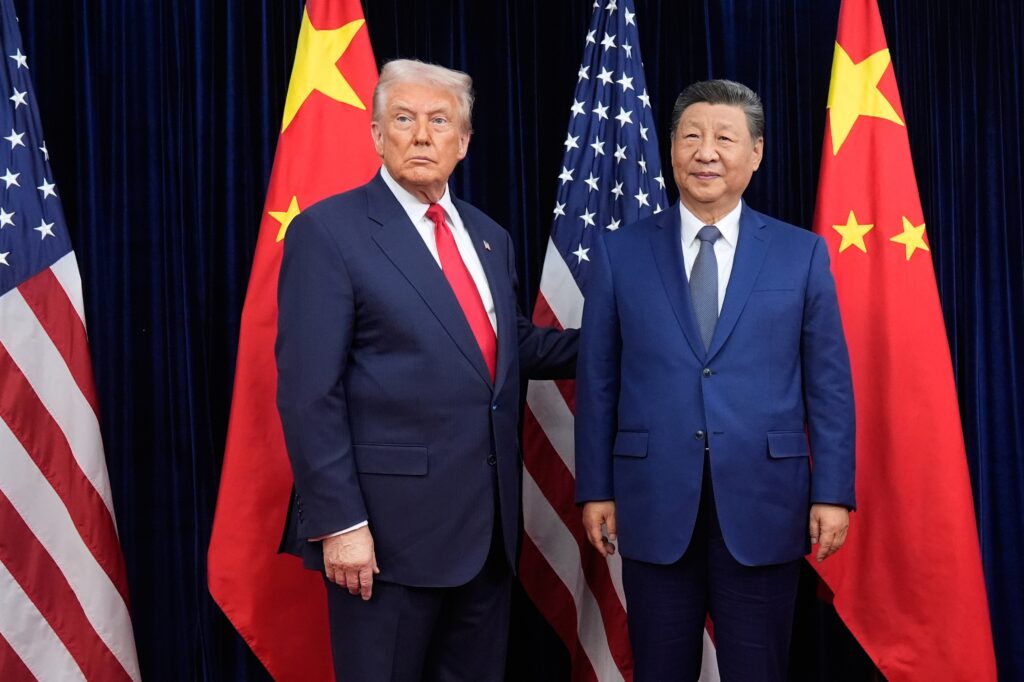
Senate Democrats argue in a new report that the Trump administration’s diplomatic and trade policies are weakening America’s advantage over China as the two countries compete to be the world’s leading economic and military power.
Published Tuesday, the report asserts that the administration’s vast use of tariffs, its uneven — and at times hostile — stance toward allies and loosened rules on the sale of advanced semiconductors risk “strategic failure.” Its release, less than a month before a high-stakes summit in Beijing between President Donald Trump and China’s leader, Xi Jinping, marks an attempt by Democrats to seize on a rare foreign policy issue that still has wide bipartisan consensus in Congress.
“Across nearly every domain central to U.S. strategic competition with China — domestic economic dynamism and innovation, diplomacy, strategic partnerships and alliances, and multilateral leadership — the Trump Administration has severely weakened U.S. standing on the world stage,” states the report, signed by each Democrat on the Senate Foreign Relations Committee.
Since the outbreak of war with Iran, Democrats’ principal criticism of the administration’s foreign policy has centered on the rapid depletion of scarce military resources as the president risks entangling the United States in an extended conflict without the approval of Congress.
But Democrats remain troubled about the administration’s approach to China, America’s most powerful adversary, and what the report characterizes as the White House’s inconsistent and often conciliatory policy.
“What this president is doing is falling farther and farther behind,” Sen. Jeanne Shaheen (New Hampshire), the committee’s top Democrat, said in an interview.
In a statement, White House spokesperson Kush Desai, argued that the administration’s policies had “flipped the script” on decades of “foolish policymaking” that damaged the American industrial base.
“Democrats need to come to terms with the reality that by leveraging our economy, the biggest and best consumer market in the world, President Trump has empowered America to finally operate from a position of strength in global diplomatic and trade matters,” Desai said.
The Democrats’ accusations have put their Republican colleagues in an awkward position. Many of the GOP’s China hawks support more aggressive policies toward Beijing and have spent years arguing that the Biden administration was too timid. Those frustrations have spilled into public view on occasion, even as Republican members attempt to avoid openly crossing the administration.
In January, the Republican-led House Foreign Affairs Committee advanced a bill that would give Congress more say over the export of critical technology, after the administration approved the sale of Nvidia’s advanced H200 chip to China late last year. David Sacks, the White House AI czar, panned the legislation in a social media post, though the Senate and House are still refining the bill for full votes in each chamber.
Last week, Republicans grilled the Pentagon’s policy chief, Elbridge Colby, asking why the administration had not spent hundreds of millions of dollars Congress approved for military aid to Taiwan, the self-governing island China claims as its territory.
Colby pointed to an $11 billion arms sale announced in December but declined to answer the question directly during the public hearing. The administration earlier this year had informally notified lawmakers of more potential sales to Taiwan totaling $13 billion but has since delayed the packages, multiple people familiar with the package said.
The New York Times and the Wall Street Journal reported previously on the prospective sales.
A spokesperson for Colby did not respond to a request for comment.
The Democrats’ report frames the administration’s actions as an opportunity for the China hawks to reassert Congress’s authority over foreign policy. It urges Republicans to block the administration’s further use of tariffs, take steps to guard advanced U.S. technology, pass bills to support Taiwan’s defense and renew foreign assistance programs Trump has gutted.
Otherwise, the report argues, China will fill the vacuum. As the administration eliminated USAID, the government’s foreign aid wing, last year, China rapidly increased its overseas assistance programs: spending more than $57 billion on the Belt and Road Initiative — an aid initiative American officials have argued is predatory — in the first half of 2025.
“What we saw last year was that China was looking at making inroads based on the U.S. withdrawal,” Shaheen said. “Now we have even more evidence confirming that.”
The post Democrats argue Trump’s China policy risks ‘strategic failure’ appeared first on Washington Post.