NONESUCH, by Francis Spufford
“Nonesuch,” Francis Spufford’s new novel, features a gutsy heroine who seeks to travel back in time to prevent a beautiful villain from reversing the course of history by assassinating Winston Churchill and thus preventing Britain from winning World War II. Spufford, whose previous novels include “Golden Hill” and “Light Perpetual” — another work of alternate history inspired by the war — is wizardly in his capacity to conjure lost times.
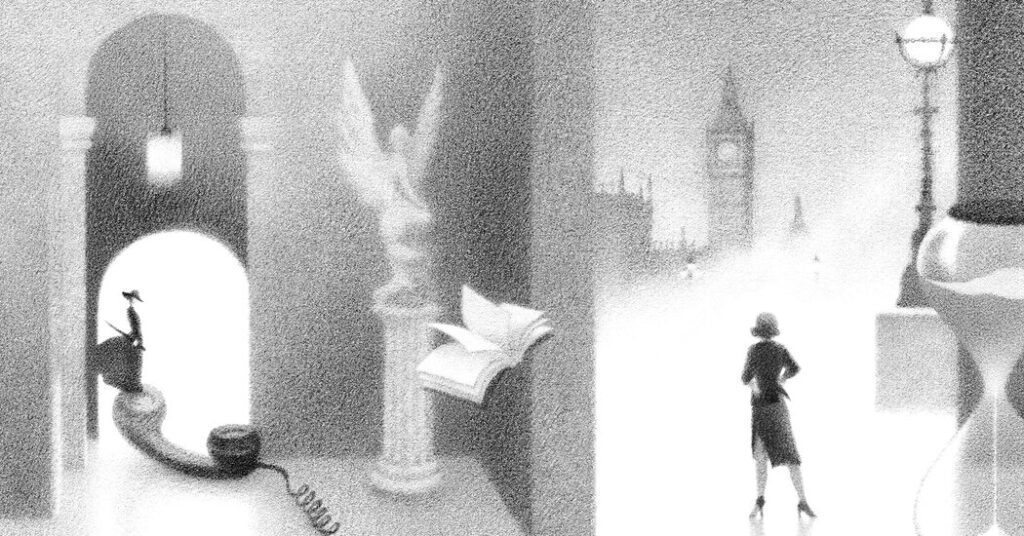
He transports readers back to London at the outbreak of the conflict, his descriptions alive to each day’s particular weather: the light on a skyline that no longer exists; the touch and feel of objects long gone (the receiver of an ancient landline is a “heavy black bone of Bakelite”); the scent of a clear autumn day touched by smoke from the previous night’s bombing.
And he does more than just carry us backward. The novel fairly cackles with glee at its capacity to summon excitement from all corners of time and space: Here’s your elaborate Miltonian magic; here’s the angel Raphael in the form of Doctor Manhattan; here’s a gloriously chilling monster that moves like an inflatable tube man. In an old country house with lewd wallpaper, we meet John Maynard Keynes. Our heroine, Iris, by night a sexual adventurer, by day a financial secretary with her eye on climbing the executive ladder, impresses him with her fiscal acumen.
All this is fun. The novel does what few time-travel fantasies do: It laughs about the pleasure that can be had once we grant ourselves the power to change history. At the same time, however, it asks questions, as all time-travel novels do, about who gets to tinker with time, and who lives at its mercy.
Like “The Magician’s Nephew,” the first book of “The Chronicles of Narnia,” a series with which this novel converses, “Nonesuch” occasionally transports us to the past only to offer us glimpses of what the narrator presents as an inevitable future: “A year later, when Iris had grown wearily familiar with bombs, and learned that the world was divided into those who in the crisis ran toward the bombs to help and those who ran away to hide, she would remember this moment.”
In such instances, the novel also reminded me of Muriel Spark’s “The Prime of Miss Jean Brodie,” famous for its frequent use of this device. All three books are about time, authoritarianism and free will. How much, these novels ask, can a character determine their destiny, if the author already knows how things will turn out? If the future is preordained, if our roles in society are fixed, does any of our meddling mean anything, really?
A character’s struggle for freedom in a system — the novel, time, human history — that has caged them is part of what I find so moving about time-travel novels, from Octavia Butler’s “Kindred” to Jenny Erpenbeck’s “The End of Days” and Solvej Balle’s series “On the Calculation of Volume.” These books feature regular women trapped in a spin cycle of days: trying to move forward, getting pulled back into history. Their protagonists are less concerned with changing the course of major events than in escaping the suffocating systems they’re stuck in.
“Nonesuch” is a different kind of book. It is not, after all, “The Prime of Miss Jean Brodie,” a novel that appears to align itself with the fascist teacher Miss Brodie, who refuses to allow her students life outside the aphoristic identities she assigns them. Nor is it “The Magician’s Nephew,” in which the narrator constantly shows himself to be pulling the taut strings on which his characters move. “Nonesuch” is looser; Iris operates on a long leash. Even the mere fact of its length — after 481 pages, it ends with the phrase “to be continued”; a sequel is apparently underway — distinguishes it from these other books, which seem to understand themselves to be complicit in the enclosure of their characters.
And yet, in the midst of this novel’s happy freedom, I still felt constraint. Iris is defined by a few traits: She’s ambitious in her career; she’s sexually adventurous. Of these facts we’re often reminded, including by the beautiful villain, who repeatedly calls Iris a derogatory epithet. Iris responds by flinging a different derogatory epithet back at her.
It’s one of the novel’s jokes, but it made me feel tired, perhaps more so because the novel allows itself such liberty. Is Iris a woman, or is she a type? Or is she a character in a story by an author who has more power than she does? Maybe that’s the point. Iris may be a heroine who has figured out how to travel in time, but somehow here we all are, face to face again with history.
NONESUCH | By Francis Spufford | Scribner | 484 pp. | $31
The post Chasing Fascists Through the London Blitz, With Time Travel and Angels appeared first on New York Times.