In a tiny hamlet of the Canadian subarctic, something was wrong with the fish.
Indigenous elders and university scientists stood over a tarp of dissected walleye on the banks of a channel near Fort Chipewyan, Alberta. The scientists clutched clipboards as they analyzed humpbacks, lesions, discolored scales and outsize livers. An elder, who had long relied on the waterway’s marine life for sustenance, knew simply by first glance: “No good.”
It was five days into their investigation on the freshwater Chenal des Quatre Fourches, in a place everyone just called Cutfish. They had pitched tents among the diamond willow and settled in for a week of dissections — their best chance at understanding the contaminants they believed were plaguing the food supply from one of the largest industrial operations on Earth.
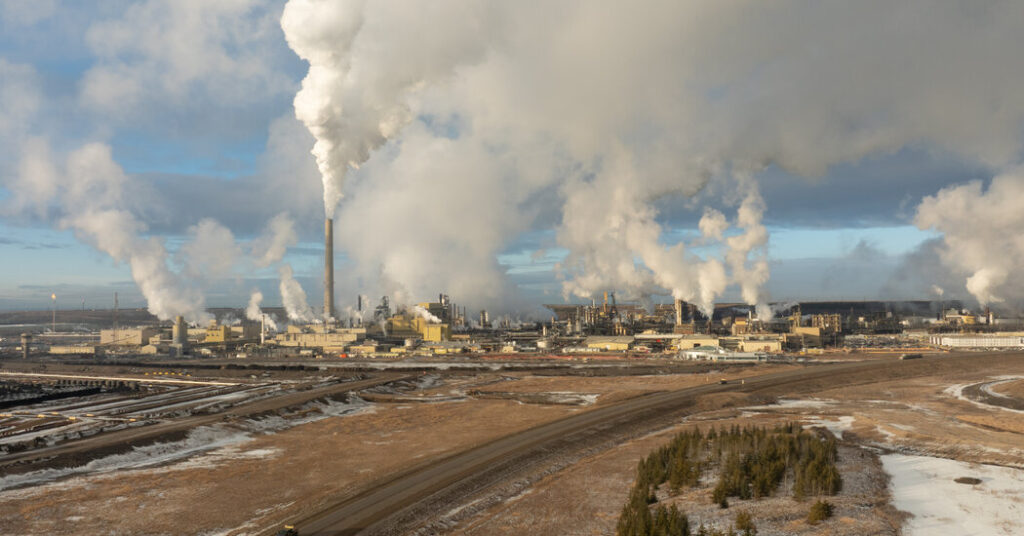
That operation was more than 100 miles upstream, where energy companies, including a subsidiary of Exxon Mobil, were drilling for a viscous form of petroleum called bitumen, using water from the Athabasca River to extract it from deposits that stretch out beneath some 140,000 square kilometers of boreal forest. Massive pools of toxic waste with known carcinogens — their collective volumes estimated at more than half a million Olympic-size swimming pools — sit near the river, and an analysis suggests they are leaking around 11 million liters per day into the groundwater. As oil-company operations have increased, so have bouts of unexplained illness among residents of Fort Chipewyan.
Now, the Canadian government is weighing regulations that could allow the companies to release the oil sands wastewater directly into the river system, so long as they first use filtration systems, microorganisms or other methods to reduce contaminants to safe levels. But scientists say there are no safe levels of exposure to some carcinogenic components — and no proven methods for fully eliminating them.
Environmental experts are worried about implications well beyond Fort Chipewyan, since the Athabasca River runs north through Alberta and the Northwest Territories, ultimately joining a vast river system that empties into the Arctic Ocean. They say pollution from the oil sands could threaten biodiversity and the waterway’s climate-stabilizing properties — and could share contaminants from the mining waste, known as tailings, with the rest of the world.
When the last walleye was examined, elders from the three Indigenous groups in Fort Chipewyan gathered in a tent for an emergency meeting. It wasn’t just the fish, they agreed: The muskrat dens had all but disappeared. The wild tern eggs were contaminated with mercury. Petroleum sheens were collecting around the water caves. And the rate of rare cancers in the hamlet was high. There were fewer than a thousand residents, but lately, there seemed to be a funeral every week, sometimes two.
“I don’t care how many times they treat that contaminated water — it’s going to end up here,” said Alice Martin, a Mikisew Cree elder with feathery gray bangs who was pleading with others to help make a plan to fight the oil companies. “We can’t depend on others to say what is important to us. It’s time. Because we’re going to die out.”
The wind rushed in from the marshlands, and the smell of mint tea wafted from a fire nearby. Ron Campbell, an elder who spent six decades in Fort Chipewyan, cleared his throat.
“For thousands of years, we have lived off this delta,” he said, adjusting his Toronto Blue Jays baseball cap. “It’s in our genetic makeup to hunt, trap, fish, gather. Now the food that kept us alive for thousands of years is killing us. Where do they expect us to go?”
Decades of Worry
From above, the oil sands tailings are a study in explosive growth.
Maps of the region, which was once known for its drinkable streams and vast green expanse, now include landmarks like “Bitumount” and “Tar Island.”
From the ground, it is a literal wasteland. Scarecrows in construction hats line the perimeters of the tailings to keep migratory birds away. An oily film coats the mailboxes, the doorknobs and the windshields of trucks that haul across open pits where pine trees used to be.
Environmental experts have worried for decades about the health impact of the oil sands on wildlife and humans. Tailings ponds contain elevated levels of naphthenic acids — considered carcinogenic in some contexts — as well as benzene and polycyclic aromatic hydrocarbons that have been known to disrupt hormone and immune function. The waste also contains lead, mercury and arsenic, all three of which rank among the World Health Organization’s 10 chemicals of public concern. Thousands of waterfowl, gulls and other animals have been found dead at the sites.
People living near the sites have long reported headaches, congestion, bloody noses, rashes, even fainting. But little research has examined the true health impacts. According to one analysis, only three out of 87 peer-reviewed articles on the health effects of resource extraction in Canada have examined communities exposed to emissions from oil sands.
In the early 2000s, Dr. John O’Connor, a family doctor working downstream in Fort Chipewyan, noticed unusually high rates of certain rare cancers in the hamlet, as well as high numbers of both autoimmune disorders and miscarriages. He consulted doctors in nearby Fort McMurray and, in 2005, alerted federal health authorities, but said he hadn’t received a response. After a radio journalist heard rumors about health issues in Fort Chipewyan and convinced Dr. O’Connor to participate in a segment, the College of Physicians and Surgeons of Alberta began investigating — not the cause of the sicknesses, but Dr. O’Connor himself. Health Canada had accused him of causing “undue alarm.”
Researchers from the Alberta Cancer Board who followed up on his concerns eventually agreed that the overall cancer rate was higher than expected, but said this might be attributable to increased detection or to chance. Their report suggested “closer monitoring of cancer occurrence in upcoming years.”
In 2014, two First Nations tribes collaborated with scientists to publish their own study, which found elevated levels of contaminants in muskrat, moose and duck. It also found that a fifth of all respondents to a survey in Fort Chipewyan had suffered from cancer. But with a population so small — and cancers with long latency periods — it was difficult to establish any causal relationship.
Last year, a letter from Alberta’s chief medical office of health to Allan Adam, the chief of the Athabasca Chipewyan First Nation, acknowledged that “the rates of all cancers combined in the Fort Chipewyan area were statistically significantly higher than those in the rest of Alberta.” Over three decades, the rate of non-Hodgkin’s lymphoma had been more than two and a half times what would be expected for the hamlet. Cervical cancer had occurred at four times the expected rate. The rate of a rare bile duct cancer in men had been more than nine times the expectation. And for other biliary tract cancers, the rate was 13 times what was expected.
But then came the familiar disclaimer: “The small population size of the Fort Chipewyan community limits the ability to interpret results.”
After years of pleas, the Canadian government finally announced in August 2024 that it would commission a 10-year study to examine the health impacts of the oil sands on Fort Chipewyan. But the work has not begun, and it has not specified a methodology or suggested any interventions to protect residents in the interim.
Oil companies are legally responsible for cleaning up their tailings and restoring the landscape, but even after more than 50 years of mining, those efforts have hardly begun here. There is little pressure from the province of Alberta — sometimes called the Texas of Canada — a petrostate that relies heavily on energy royalties for its budget. In a recent report, the auditor general of Alberta found the estimated cost to clean up the oil sands to be more than $51 billion. The funds that regulators have collected from companies thus far amounted to only $1.8 billion as of September.
In response to an inquiry from The New York Times, the Alberta Energy Regulator sent a long statement describing the regulatory process.
“The Alberta Energy Regulator provides for the efficient, safe, orderly and environmentally responsible development of energy and mineral resources in Alberta, and holds companies accountable through life cycle oversight, compliance and enforcement,” the statement said.
A yearslong probe by an environmental group found “consistent evidence of seepage” from Syncrude and Suncor tailings ponds into groundwater that was near tributaries to the Athabasca River. There are also occasional large-scale spills, such as in 2022, when industrial wastewater escaped from four locations belonging to Imperial, a partly-owned subsidiary of Exxon Mobil. But the Athabasca Chipewyan First Nation said they had not been alerted until nine months later, when the government announced it was investigating another “uncontrolled release.” Imperial estimated the second spill to be 2,000 liters. That figure later grew to 5.3 million.
Life in Fort Chip
People like Calvin Waquan are determined not to let anxiety destroy tradition. Mr. Waquan, a member of the Mikisew Cree First Nation, teaches his 8-year-old daughter to braid sweetgrass and takes his 12-year-old son to hunt moose and duck. But whenever an acute tailings spill upstream goes public, they must throw away all the meat in their freezer and replace it with processed foods for the winter.
At the local gas station that Mr. Waquan manages, nicknamed Chief’s Corner, he has begun displaying dozens of the community’s death notices behind his cash register, each with a neighbor’s smiling face.
There is Claire Cardinal, whose husband said she had undergone more than 200 rounds of chemotherapy before her death; her husband is a double lung transplant survivor himself and still wears her ashes in a locket around his neck. And there’s Warren John Simpson, whose aunt said his bile duct cancer had essentially starved him to death; she cooked him a last simple broth and held his hand as he died. There were various relatives of John Henry Marcel, who finally encouraged his children to move their young families away from Fort Chipewyan after his own battle with prostate cancer. Mr. Marcel lives alone and can’t afford to move, so he sits in an armchair near their photographs on the mantel each night. “This is how I see them,” he said.
Mr. Waquan said he had buried five family members, three of whom had cancer, since moving back to the hamlet about 11 years ago and tossing sand onto the graves of too many others for him to count. In private, his fears are growing: Mr. Waquan recently noticed blood in his stool. He is waiting for a colonoscopy to reveal whether he could be next.
“Cancer is a big word — everyone is afraid to say it,” he said. “But we are raising our families in the industry’s toilet bowl.”
An Uneasy Truce
Far up the river, Chief Adam was donning his headdress beside representatives of the oil industry.
It was the fifth annual cultural festival for the First Nations, but many of its sponsors and organizers were energy companies. Visitors were learning Dene language vocabulary and moose-hide-tanning techniques courtesy of Suncor. A gift shop of local Indigenous art was sponsored by the industry giant Canadian Natural Resources. The event’s main stage was presented by Imperial, the company that had hidden its 2022 spill.
Chief Adam strode past posters that had been plastered throughout the grounds: “We are thankful for these borrowed lands,” they read, “and the lessons of resilience they offer us.”
Indigenous leaders like Chief Adam are in a challenging position. On one hand, they are the drivers behind efforts to protect their land and health. They have filed lawsuits and traveled to Ottawa to protest companies’ plans.
But these same leaders are balancing the realities of a complex economic relationship. Hundreds of members of the Athabasca Chipewyan First Nation work in the oil sands, commuting from Fort Chipewyan for weeklong shifts or moving to the burgeoning neighborhoods near the operations, where they earn salaries multiple times that of any job available in their hamlet. And just as worries about the health impacts have grown, so have the number of new youth centers and community projects in the Indigenous communities, each of them branded with an oil company sponsorship.
“As chiefs, we have to think seven generations ahead,” Chief Adam said, watching his 8-year-old grandson practice a traditional tribal hand game. Before he came into office, the First Nation had a more than $300,000 deficit and no way out, he said. Now it has more than a dozen companies that provide contracting services to the industry, including equipment management and catering. Most of his funding now comes from the oil sands, he said.
“How do I walk away from all that?”
The Future of Fort Chip
The formal release of the tailings ponds into the Athabasca River seems, to many, all but imminent. Indigenous groups have met with federal officials through a working group to come up with alternatives to the river-dumping approach, such as drying the waste into stackable pucks, though that option would be costly.
A draft of federal rules that would set standards for wastewater treatment and release is expected later this year, and final recommendations could head to the country’s minister of environment and climate change soon after.
But Alberta is already deep into the planning process. A steering committee in the province recently recommended that the government “expedite” the development of standards, saying that continuing to accumulate the toxic substances where they are now “is not sustainable” and “creates environmental and financial liabilities.” The premier of Alberta also mandated in October that the then minister of environment and protected areas “accelerate” the finalized strategy.
Mike Mercredi, a councilor for the Athabasca Chipewyan First Nation, has shouted in the faces of regulators, accused them of “regulated murder” and held up glasses of water from the river, daring them to drink it. But on a recent morning, as he stood at the top of Monument Hill, near Cutfish, he admitted that he felt there was little left to do but wait.
He rolled juniper seeds between his palms, then smoothed his ponytail and the caribou-skin sheath on his waistband. To his right was the Lake Athabasca dock he jumped off as a child — long before it was reported to be contaminated and became off limits to his daughter.
“This view used to be restful for me, you know — a place for thinking,” he said, watching the sun dance across the ripples of the lake. “Now I know too much.”
On his way home, Mr. Mercredi parked his pickup truck outside the town’s jam-packed cemetery and wove carefully between the plots, surveying the names of loved ones on all the headstones.
“We could all move elsewhere and just be funeral operators, for how often we bury,” he said.
He stood for a while, then turned quickly to leave. “It never gets easier,” he added.
Blacki Migliozzi contributed reporting.
Emily Baumgaertner Nunn is a national health reporter for The Times, focusing on public health issues that primarily affect vulnerable communities.
The post Cancer Haunts Neighbors of Canada’s Oil Sands Wastelands appeared first on New York Times.