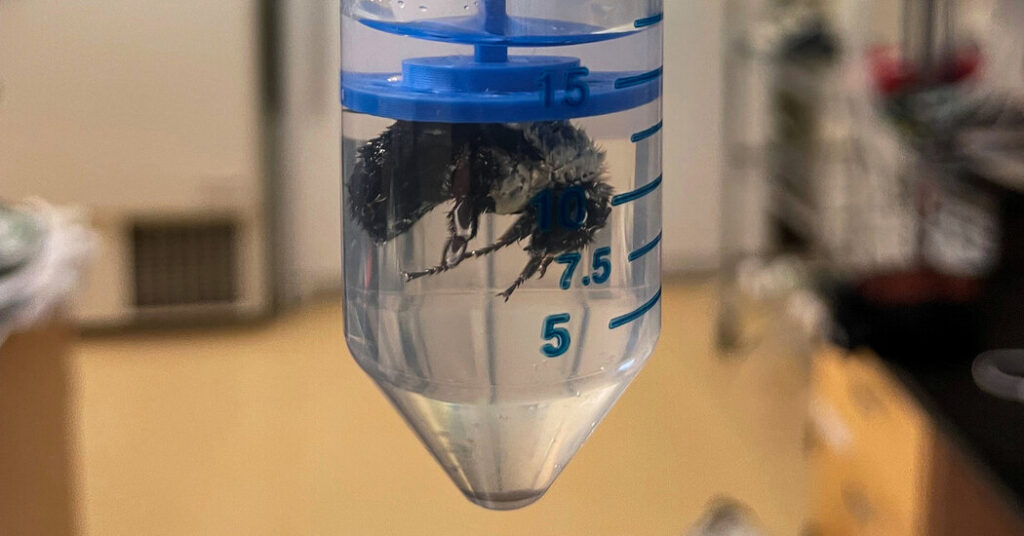
If you want to be queen, don’t hold your breath.
That is, if you’re a bumblebee. While surviving for a full week underwater, the insects have the ability to breathe even as they are fully submerged, according to research published Wednesday in the journal Proceedings of the Royal Society B.
It’s a critical ability because queen bumblebees spend six to nine months in diapause, a hibernation-like phase. They hunker down during those colder months in shallow burrows, which can become waterlogged from rainstorms and snowmelt. Surviving over the winter is crucial for the insects to be able to establish their colonies come spring.
Erin Treanore, a biologist who has studied bumblebee diapause and who was not involved with this study, called the finding “remarkable.” While much research into diapause has focused on cold temperatures or dry conditions, “this is one of the first studies I’ve seen in bumblebees that actually looks at flooding,” said Dr. Treanore, who is the manager of agroecology for Duke Farms, a center of the Doris Duke Foundation, which conducts research in conservation and sustainability.
The study of the bees’ submarine survival goes back to an earlier lab mix-up. Sabrina Rondeau, a co-author of the new study, was conducting research at the University of Guelph in Ontario about how pesticides affect bumblebees. To mimic natural winter conditions, she placed diapausing queens in soil-filled tubes in a refrigerator. But when she checked on them one day, some of the tubes had filled with water from condensation, leaving four queens completely inundated.
Dr. Rondeau was surprised to find that the queens were still alive. She then conducted a formal experiment with more than 100 diapausing Bombus impatiens queens, or common eastern bumblebees, and showed in a 2024 study that they can survive underwater for a week. The new follow-up study provides insights into how they manage not to drown.
Using specialized laboratory chambers and sensors, the researchers discovered that queen bees in diapause are consuming oxygen and producing carbon dioxide while underwater. Somehow, it seemed, the insects were breathing.
Even a small amount of oxygen available through underwater breathing can sustain a dormant queen bee because they lower their metabolism by 99 percent while in diapause, said Charles-Antoine Darveau, the study’s lead author. Their metabolism slows even more when underwater.
The study also showed that submerged queen bees supplement their breathing with anaerobic respiration, a form of energy production that does not use oxygen. Humans also do this during extremely intense activities like sprinting.
Seeing the bees reanimate was the most rewarding part of the study for Dr. Darveau. They began wiggling after two to three days out of the water.
“Putting these bees underwater is never something that you do for fun,” he said. “Seeing them coming back to life was that moment of relief.”
The next step is to figure out how bees breathe while submerged. Some insects use snorkel-like breathing tubes. Others carry a bubble of air akin to a scuba-diving tank.
Dr. Darveau suspects the most likely adaptation in bumblebees is a physical gill. This isn’t an anatomical structure, but rather a thin layer of air that surrounds the inundated animal, allowing fresh oxygen from the water to enter and carbon dioxide to leave.
Breathing underwater is typically associated with insects that live and hunt near water, like diving beetles or dragonfly nymphs. Bumblebees are better known for their flying than an aquatic lifestyle, Dr. Darveau said.
One reason no one associated flooding with bumblebee diapause before now is that scientists have little idea where queen bumblebees spend the colder months, Dr. Treanore said. She said there are few studies on overwintering queens in the wild. Most observations come from gardeners and community members who stumble upon them. For most species, “we essentially know nothing” about their winter environment other than that they are underground somewhere, she said.
But the findings make sense in light of evolution. The earliest bumblebee species likely originated 25 to 40 million years ago, when global temperatures plummeted. Ancient bumblebees flourished in cold Arctic and alpine environments — and with snow came snowmelt.
Therefore, of today’s roughly 250 bumblebee species, Dr. Treanore would expect this adaptation to be “super widespread,” she said.
“I think this really opens up a whole new line of research,” she said.
The post Bumblebee Queens Can Breathe Underwater appeared first on New York Times.