The U.S. has avoided putting American troops on the ground in Iran so far — but what about Kurdish ones?
It’s an option that’s been floated in recent weeks. Last week, my colleagues reported that Iranian Kurds based in Iraq, who have been armed by the U.S., are preparing to possibly join the volatile mix in Iran, much as Syrian and Iraqi Kurds partnered with the U.S. in their countries.
Today my colleague Alissa Rubin, who has reported from across the Middle East, writes about why the Kurds, a stateless ethnic group that stretches across parts of Turkey, Syria, Iraq and Iran, may be prepared to help the U.S. — even though they have been let down in the past.
Why the U.S. and the Kurds can’t quit each other
by Alissa J. Rubin
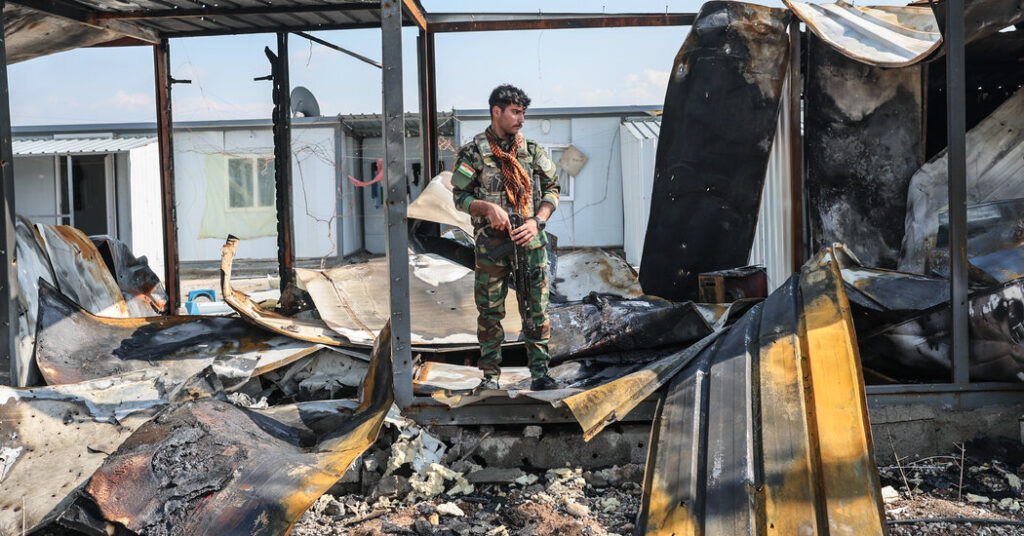
High in the snowy Zagros Mountains, on Iraq’s border with Iran, well-camouflaged camps of Iranian Kurdish fighters are preparing to potentially become the first American-allied “boots on the ground” against the Iranian regime.
Whether they’ll ultimately enter the fray is not clear. The White House has denied it is working with or arming the Kurds. In the last week, President Trump publicly welcomed the idea, only to reject it a couple of days later.
But if they were to enter, it would be in keeping with the U.S’s approach to the region. The U.S. has a fraught six-decade history with the Iraqi Kurds, and more recently, with the Syrian Kurds. In each case, the U.S. looked to partner with local forces who had experience with the enemy and the terrain; in each case, the Kurds fought alongside the U.S. in the hopes of gaining support for autonomy within their respective countries, only to be disappointed.
There are risks for each side this time around as well. But each is contemplating the partnership for the same reasons that have brought the U.S. and Kurdish groups together before.
For the Kurds, a partnership with the U.S. remains their best chance at a long-held — if aspirational — dream to have their own country. For the U.S., the Kurds are so often the partner of choice in the region partly because of their prowess as fighters, but also because their very status as a people without a state makes them convenient allies who can be dropped when necessary.
“The U.S. remembers the Kurds in situations when they need an ally,” because the Kurds have experience and arms, said Yunus Abakay, a Turkish Kurd and a fellow at the Institute of Arab and Islamic Studies at the University of Exeter. But they’re also non-state actors, who have no protection under international law, he said. “The U.S. can ask them to do something and when it’s done, walk away.”
The Kurds, he said, are “inexpensive political assets.”
Betrayals and resentments
That the U.S. is considering the tactic of using Iranian Kurdish fighters in exile in Iraq has echoes from history. In the early 1970s, the U.S. worked with the C.I.A. and Iran — then ruled by the shah — to smuggle arms through the mountains to Iraqi Kurds, to bolster an internal rebellion against Saddam Hussein. It did so again in the 1990s, when the U.S. began efforts to oust Hussein.
What came in 1991, however, is viewed by many Kurds as a profound betrayal: After the Persian Gulf war, the U.S. urged the Iraqi people to rise up to overthrow Hussein’s regime — and then stood by as the Kurds staged uprisings and were killed by the tens of thousands. Eventually, the U.S. and its allies imposed a no-fly zone in northern Iraq, and the Iraqi Kurds won some of what they set out to achieve — a semiautonomous area — but at the cost of thousands of lives.
In Syria, the U.S. turned to the Kurds in 2014-15 to help in the dangerous fight against the Islamic State. The Syrian Kurds hoped that this U.S. trust signified broader support for their de facto rule of their patch of northeast Syria. But after 12 years of working together, the U.S. abruptly ended the relationship in January, deciding to back the new Syrian government instead. Syrian Kurds I’ve spoken to are still deeply resentful.
Some advice from Syrian Kurds
We don’t know that much about the thinking behind the C.I.A.’s previous help to arm the Iranian Kurds, or what the administration might be thinking about encouraging a broader Kurdish incursion.
One Iranian Kurdish official told my colleagues that the hope is, once an insurgency is launched, inside Iran, it will embolden local residents to rise up against the government — especially now that it has been battered by relentless Israeli and American bombing.
For the U.S., the risk is that the gambit backfires and rather than inspiring the opposition, the Iranian Kurdish presence splits it. The Kurds’ aspiration to self-determination within Iran might be embraced by other ethnic minorities, but it is viewed with suspicion, if not hostility, by most of the Iranian opposition to the regime, the majority of whom are Persian. Two weeks ago, Reza Pahlavi, the former Shah of Iran’s son, who has promoted himself as a potential new leader, charged the Kurds with being “separatists” and endangering Iran’s “territorial unity.”
It’s also not just a matter of getting the Iranian Kurds on board. The Kurds are not a monolith; depending on where they live — in Syria, Turkey, Iraq or Iran — they have very different priorities. Iraqi Kurds are wary about drawing the ire of the Iranian regime by allowing the Iranian Kurds to use Iraqi territory. For Syrian Kurds, bitter about the U.S.’s recent abandonment, there is little talk of any official collaboration, despite a deep cross-border sympathy.
But there is nothing to stop individuals from joining and many I’ve spoken to seem torn between their loyalty to fellow Kurds and anger at the Americans. They had some advice for the Iranian Kurds for the weeks to come.
“Don’t make the mistakes we made,” said one Syrian Kurd, Fidan Kobani, 30, adding, “Which was to believe in the Americans, and depend on them.”
MORE TOP NEWS
‘Nothing will remain of Tehran’
The Iranian capital, Tehran, and other cities have been battered by fierce U.S.-Israeli bombardment for days. Some Tehran residents described the strikes overnight as among the worst they had experienced.
Defense Secretary Pete Hegseth said that Tuesday would be the “most intense day” of U.S. strikes against Iran. Trump said the U.S. would hit Iran “twenty times harder” if it tried to stop the flow of oil.
One resident in Tehran said that the sound of bombing was almost constant, from 10 p.m. to past midnight. “If they keep hitting Tehran like this for another 10 days, nothing will remain of Tehran,” he said. Follow our live updates.
Other developments:
-
Israel’s campaign against Hezbollah has driven nearly 700,000 people from their homes in Lebanon, the U.N. said.
-
The Trump administration loosened some restrictions on Russian oil exports in a bid to ease disruptions in energy markets.
-
Unlike in past conflicts, most Americans oppose the Iran attacks, polls show.
-
My colleague Charlie Savage describes the efforts by Trump’s allies to avoid labeling the war in Iran as a war. Watch the video.
OTHER NEWS
-
A South Korean government report found that officials cut costs when building a concrete wall and hid safety risks, leading to a deadly crash at the end of a runway in 2024.
-
The family of a student who was wounded in a mass shooting in Canada is suing OpenAI, accusing it of failing to alert the police of disturbing content in the shooter’s ChatGPT account.
-
The trial of four men accused of plotting to kill Haiti’s president in 2021 is beginning in Miami.
-
USA Today named Jamie Stockwell to be its next top editor, the third person named to the job in three years.
Top of The World
The most clicked link in your newsletter yesterday was about a knitting protest in Denmark.
SPORTS
Football: Australia granted asylum to five players on the Iranian national women’s team after Iran’s state media called them “traitors” for not singing their national anthem.
Tennis: Mirra Andreeva, the defending champion at Indian Wells, cursed the crowd after losing in an upset.
World Cup: FIFA cut $100 million from its operating budget for this year’s tournament.
WORD OF THE DAY
Tranche
— In French, it means a slice. Online searches confirm the word is popping up everywhere. The spike in use is related to the release of documents from the Epstein files. Dropping “tranche” in a conversation makes you sound “like you know what you’re talking about,” a linguist said.
MORNING READ
Wildlife trafficking and the trade in animal products, like pangolin scales and elephant tusks, generates an estimated $20 billion a year, making it one of the world’s most lucrative criminal enterprises. Now baby chimpanzees and gorillas are a growing target of traffickers.
Experts say cute footage on social media of the animals acting like humans — rolling around on the couch, looking at cellphones, riding motorbikes — drives up demand.
My colleagues pieced together the story of Bili, an infant gorilla captured in Cameroon, advertised to rich buyers abroad on social media and later rescued in a sting operation in Nigeria. Read it here. The Congolese photojournalist Arlette Bashizi took these images of Nigeria’s efforts to stop wildlife trafficking in Africa.
AROUND THE WORLD
They just want to surf again … in Munich
Munich is more than 300 kilometers from the sea, but until recently, it was a surf spot. Many people in the German city flocked to a creek called the Eisbach, where a man-made obstruction created a small but steady artificial wave in the freezing current. Surfers would wait in long lines to jump on their boards and see how long they could ride before being thrown off and swept downstream.
But the wave vanished after the authorities dredged the canal last year. Now the Munich surfing community — yes, there is such a thing — is trying to remake it. Read about what’s getting in the way.
RECOMMENDATIONS
Watch: Our critic says Chris Fleming’s “Live at the Palace” is the funniest comedy hour of the year so far.
Read: Michael Pollan’s “A World Appears” explores where consciousness comes from.
Hydrate: Influencers say drinking hot water before breakfast can help with digestion, bloating and more. Here’s what experts think.
Learn: Here’s what you really need to know about hernias.
RECIPE
This one-skillet Japanese curry combines store-bought curry roux bricks with ground beef and vegetables for a meal that tastes complex but requires little effort.
WHERE IS THIS?
Where are these people?
TIME TO PLAY
Here are today’s Spelling Bee, Mini Crossword, Wordle and Sudoku. Find all our games here.
You’re done for today. See you tomorrow! — Katrin
Alissa J. Rubin was our guest writer today.
We welcome your feedback. Send us your suggestions at [email protected].
Katrin Bennhold is the host of The World, the flagship global newsletter of The New York Times.
The post Boots on the Ground — but Whose? appeared first on New York Times.