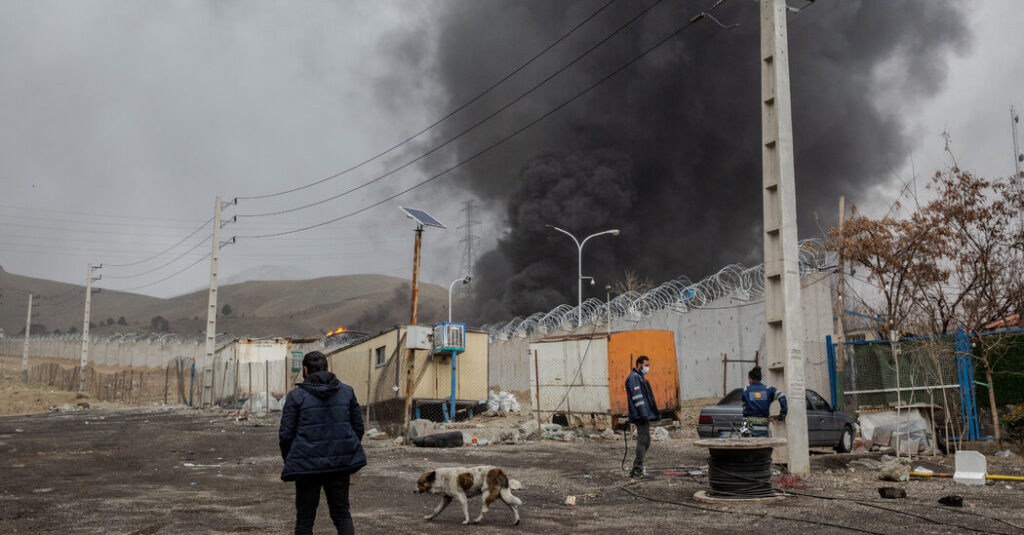
Soon after dark plumes of smoke began settling over Tehran early Sunday morning, residents noticed a bizarre phenomenon: black rain. Some also reported a thick, oily film covering their cars and roofs like paint.
Then the migraines, dizziness and coughing set in.
Health experts were not surprised. Iranian fuel depots had just been hit as American and Israeli forces intensified their campaign against the Iranian government.
Jonathan Levy, chairman of the environmental health department at Boston University School of Public Health, called it a “flashback” to the first Gulf War, when burning oil fields in Kuwait set off a vast array of health consequences.
Only a day after the strikes in Tehran, the health effects were being been felt miles from the depots. One resident told The New York Times that she had awoke to a pitch-black sky and gone outside. When she got back home, her face was itchy and covered in “black dots,” she said.
After just 15 minutes in a car, another Tehran resident developed burning eyes and airway congestion. “It almost feels like tear gas in the air,” she said. “The war has entered our throats.”
Burning oil releases enormous quantities of carbon dioxide, according to Marsha Wills-Karp, a researcher at Johns Hopkins Bloomberg School of Public Health who focuses on environmental determinants of disease. That gas quickly displaces oxygen, which is why people near the site of a burn often show early signs of suffocation. The heart rate increases, breathing speeds up, and people may experience headaches, dizziness, and the strong sensation that they cannot get enough air.
The dark debris raining from the sky was composed of fine particles known as PM2.5, experts said, including black carbon, which gives the pollutant its color. Various other toxins were released as well: carcinogenic compounds called polycyclic aromatic hydrocarbons; gases like sulfur dioxide and nitrogen oxides; heavy metals like lead, arsenic and mercury, all of which are among the World Health Organization’s top 10 chemicals of public health concern.
After the drops have fallen, a host of dangerous chemicals remain suspended in the air, Dr. Levy said, many of them linked to heart and lung disease, cancers, and cognitive issues like neurodevelopmental disorders and Alzheimer’s disease.
In the short term, skin and eye irritation are common reactions to the toxins. Many people also begin to cough as a natural protective mechanism, “clamping down on your airways to keep those substances from getting in,” Dr. Wills-Karp said. Compounds in the air can also enter the body through the olfactory bulb just above the nasal cavity, which leads to the brain.
Even people far from a burn site may experience a narrowing of blood vessels in the brain, which can cause dizziness.
Long-term effects depend on both the length and intensity of exposure, the experts said. The impact is most worrisome for children, elderly people and those with pre-existing heart and lung conditions. Pregnant women and fetuses are also particularly vulnerable to the chemicals, which can inflame the placenta.
The health risks may be exacerbated for those caught in a conflict. Stress and trauma can compromise the immune system. And access to health care may be limited. “This is not happening in a vacuum,” Dr. Levy said.
The threat may not be limited to Iran.
Pakistan’s meteorological officials have issued an alert that wind could carry pollutants from Iran across the border, and the director-general of the World Health Organization released a statement warning of potential food and water contamination.
Anyone who is unable to move away from the pollution should stay indoors with all windows sealed, experts said, and when available, wear a mask and use air filtration systems.
Dr. Levy acknowledged that this may be easier said than done. “We recognize it’s a far more challenging set of recommendations to give to people in the midst of war,” he said.
Emily Baumgaertner Nunn is a national health reporter for The Times, focusing on public health issues that primarily affect vulnerable communities.
The post Black Rain and Health Fears After Strikes on Iran Fuel Depots appeared first on New York Times.