Murib Zaman worked as a driver in the United Arab Emirates for two decades, living more than a thousand miles away from his family in northwestern Pakistan and sending home $300 each month.
The manicured city of Abu Dhabi, the Emirati capital, seemed much safer than his remote village, where Pakistani Taliban militants roamed. So when his family received word that he had been killed in a faraway war — struck by debris that fell from an intercepted Iranian missile, according to a statement by the U.A.E. — they were shocked.
“Every family wants to send its youth to the Middle East because there are no jobs here, and the security situation is difficult,” Mr. Zaman’s cousin, Farman Khan, said in a phone interview. “But now it appears that even those countries are no longer safe.”
Tens of millions of men and women like Mr. Zaman, who was in his 40s, form the backbone of the economy in the Gulf states, oil and natural gas-rich countries that depend heavily on foreign workers. Since the U.S.-Israeli assault on Iran began, Iran has fired hundreds of missiles and drones in retaliation at Gulf countries. It is migrants who are paying the highest price.
At least 12 civilians have been killed in attacks across the Emirates, Saudi Arabia, Kuwait, Qatar, Oman and Bahrain, according to a New York Times tally of official sources. All but one of them were foreign nationals.
The first Gulf citizen death was announced on Tuesday, when Bahrain’s ministry of interior said that an Iranian attack on a residential building had killed a 29-year-old woman.
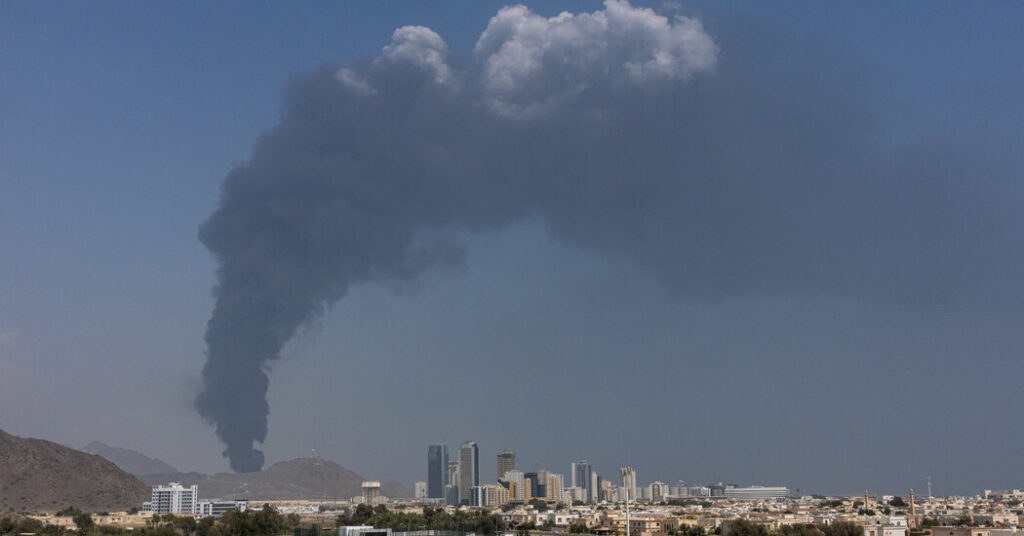
Iranian officials say that they are attacking U.S. military bases and American interests in the Gulf countries, not civilian targets. But Iranian strikes have hit civilian infrastructure, too, setting five-star hotels ablaze and damaging a vital water desalination plant. And while Gulf militaries possess advanced air defense systems, the interception of missiles and drones can cause shrapnel to rain down, with deadly effect.
Last week in Kuwait, an 11-year-old girl was killed after shrapnel fell on her home; Agence France-Presse reported that the child, named Elna Abdullah Nea, was an Iranian national. And on Sunday, Mosharraf Hossain, a Bangladeshi cleaner and father of two, was killed alongside a co-worker when a “military projectile” fell on their company housing area in Saudi Arabia, according to the kingdom’s civil defense authority and Mr. Hossain’s cousin.
“His death has left his family with an uncertain future,” the cousin, Mizanur Rahman, said in a phone interview. “They are especially worried about the future of their children. He was the sole breadwinner.”
While much public attention has focused on travelers and workers from the U.S. and Europe trying to leave the region, most migrants to the Gulf come from the rest of the world — Africa, Asia and other countries in the Middle East. Undoubtedly, one reason that almost all of the civilians killed have been foreign nationals is that they make up the majority of the region’s population. In Saudi Arabia, foreign residents are roughly one third of the population; in the Emirates and Qatar, the proportion is an estimated 80 to 90 percent.
But low-paid migrant workers are also uniquely vulnerable as the conflict widens. They are more likely to live in overcrowded housing with insufficient exit routes, putting them at greater risk if explosions or fires occur. And they are more likely to hold essential jobs, as grocery store cashiers, sanitation workers and delivery drivers, that require them to continue working as usual while many citizens and wealthier foreign residents can take shelter.
“For more than a week, whenever there is a blast or a missile interception, we rush outside our labor camps or workplaces to try to save ourselves, but we don’t know what to do or where to hide,” said Majid Ali, 34, a Pakistani worker employed by a private dairy company in Dubai.
On Feb. 28, the day the war began, Mr. Ali said, he saw police officers gathered around debris that had fallen in the area where he lives. “Since then, we have been hearing explosions almost every day,” he said. “We fear the debris could fall on us and kill us.”
In total, four people have been killed and more than 100 injured in the Emirates.
For many people, life has mostly continued as normal in Dubai, the Middle East’s business capital and the biggest Emirati city, even as Iran has fired more drones and missiles at the Emirates than at any other country.
Despite the barrage of attacks, an Ethiopian massage therapist named Yordanos Aman drove from the emirate of Ajman to Dubai every day to the homes of her clients.
Traffic on the city’s main highway was lighter than usual, but the bookings had not slowed, she said in an interview. Clients still wanted deep tissue massages and help with stiff shoulders from long hours at a desk. Often, alerts of incoming attacks sounded in the middle of a session. She continued her work.
“There is a strong sense that the authorities are committed to our safety,” said Ms. Aman. “Even in times of uncertainty, you know there is someone looking out for you.”
On Saturday afternoon, as an emergency alert flashed across phones urging residents to shelter in place as interceptors targeted Iranian missiles, the Dubai Hills Mall carried on with its weekend rituals. Families queued for lunch, and children shrieked with laughter in soft play areas. At a Pilates studio, the wait list stretched into the afternoon.
Every so often, a distant boom cut through the hum of the mall. People glanced down at the alert on their phones, and then, more often than not, returned to their conversations.
Later that night, when debris struck a vehicle and killed a Pakistani driver in the city, Basudev Das, a Nepali who also works as a driver, was at home less than four miles away.
“My first reaction was concern,” he said. “Still, Dubai has always been a place where I feel safe, because authorities respond quickly to ensure security.”
Other migrants said they have felt torn about whether they should try to join the crowds of tourists and wealthy residents who fled to safety through neighboring countries.
Marigold Tan, a Filipina coordinator at an e-commerce company, was among those who decided to stay in Dubai, despite her fears.
When the attacks began, Ms. Tan, 38, did not know whether to rush home and start packing for the Philippines or stay put, she said in a phone interview. The attacks jolted her family awake at ungodly hours, sending them scrambling to the basement, she said.
She had their emergency bags packed, but did not know where they would go.
“As a parent, you also try to stay calm for your children,” Ms. Tan said.
Relatives in Manila have urged her to come home, Ms. Tan said, but she hesitates. Even now, Dubai offers more than what she had back home. “Simply put, I feel more secure here, particularly when it comes to safety and health care,” she said.
For Ms. Tan, the war has changed even the smallest family routines. Her husband used to go to the grocery alone. Now the family of four goes together, in case something happens. They keep their passports on them at all times.
The children mostly stay indoors, and Ms. Tan has begun teaching her eldest daughter what to do when the next alert of an attack sounds. “Take your sister to the hallway,” she tells her, “and stay away from the windows.”
Leaving is a choice that is typically not available to the lowest-paid migrants, who are bound by employment contracts, debts or family obligations. And whatever the risks they face in the Gulf countries — more common than war is abuse and exploitation — they keep coming, because the remittances they send home are a lifeline.
On Saturday, hundreds of people gathered to mourn Mr. Zaman, the Pakistani worker who was killed in Abu Dhabi, after his body arrived home, said his cousin, Mr. Khan.
Born in 1982, Mr. Zaman had migrated to the Emirates at the age of 18. His income had supported five children and his extended family, including the children of a deceased brother, Mr. Khan said.
“The war should end soon,” Mr. Khan said. “Otherwise, poor families in Pakistan will not survive.”
Mansi Choksi contributed reporting from Dubai, United Arab Emirates, Saif Hasnat from Dhaka, Bangladesh and Muktita Suhartono from Bangkok, Thailand.
Vivian Nereim is the lead reporter for The Times covering the countries of the Arabian Peninsula. She is based in Riyadh, Saudi Arabia.
The post As War Comes to Gulf States, Migrant Workers Pay the Highest Price appeared first on New York Times.