In addition to raising concerns about a humanitarian crisis and setting off a global energy crisis, the war in Iran is emerging as a major environmental disaster.
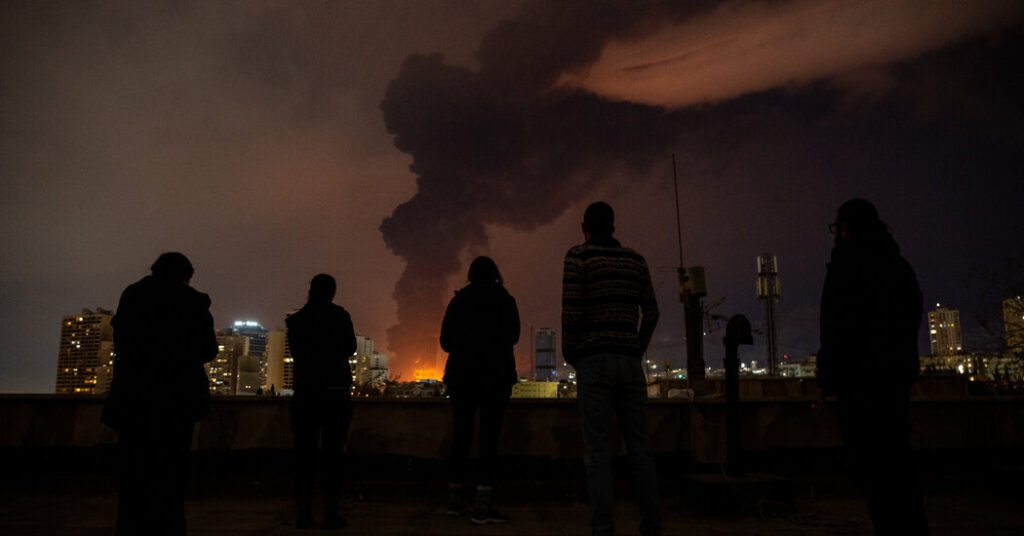
Over the weekend, Israeli strikes ignited four fuel depots near Tehran, unleashing toxic black clouds of smoke over the city of around 10 million and leading to apocalyptic scenes across the Iranian capital.
“The night turned into morning and the morning into night,” one resident told The Times. “With the fire, it felt like night became day, and then with all the smoke the day turned back into night again.”
Black rain fell from the sky, as airborne oil droplets mixed with precipitation and coated streets, cars, plants and pets. Residents reported feeling sick almost immediately after the attacks. Across the city, people said their eyes were burning. Some reported migraines, dizziness and coughing, Emily Baumgaertner Nunn and Parin Behrooz report.
“There are all sorts of nasty, complex hydrocarbons in those black clouds of smoke,” said John Balmes, professor emeritus of environmental health sciences at the University of California, Berkeley. “The smoke from a bombed oil depot would include benzene, formaldehyde and other carcinogens.”
Esmaeil Baqaei, a spokesman for the Iranian Foreign Ministry, said the strikes were “releasing hazardous materials and toxic substances into the air” that were “endangering lives on a massive scale,” according to the BBC.
Beyond the immediate health effects, exposure to the smoke and black rain could have lasting consequences. Numerous studies have demonstrated a link between exposure to toxic smoke and the incidence of several types of cancers. Dr. Balmes said he could not recall any other similarly sized oil fires in such a densely populated area.
“Can you imagine an oil depot fire in Manhattan?” he said. “That’s what we’re talking about.”
Polluted waters
The burning oil depots probably also contaminated parts of Tehran’s water supply. In the hours after the strikes, spilled oil poured into gutters and drains and caught fire, polluting public waterways. Iran’s government warned of acid rain.
Another environmental concern is the targeting of desalination plants, which could threaten fresh water supplies for millions and has raised fears about the functioning of critical infrastructure.
First, Iran accused the United States of attacking a desalination plant on Qeshm Island, which supplies water for 30 villages. The U.S. military denied the allegation.
Later, Bahrain, which is heavily dependent on desalinated water, said an Iranian drone had “caused material damage” to a desalination plant there, accusing Iran of “indiscriminately” attacking civilian targets.
Even before the war, Iran was in a water crisis, in part driven by climate change, Lisa Friedman writes.
“Drought cycles are becoming more frequent and severe, and last year marked one of the driest periods in the last 20 years for Iran,” Friedman writes. “Extreme weather — like a 2023 heat wave that led to a two-day nationwide shutdown when temperatures reached 123 degrees Fahrenheit — has made water shortages worse. At the same time, snowmelt in the mountains that feeds rivers has been declining.”
And as the conflict spills into the waterways around Iran, ships and oil tankers are being targeted, leading to fears of oil spills.
Since the war began, at least five tankers have been hit, including a 273-meter ship hit by a naval drone off the coast of Muscat, a chemical tanker set on fire in Omani waters and a crude tanker off the coast of Kuwait, resulting in an oil spill.
Living near a war zone
As the war grinds on, residents near the strikes face numerous health risks from the conflict, Dr. Balmes said.
“The bombs themselves, and the crushed buildings from the bombs, all that dust is also bad for the respiratory track,” he said. “So it’s kind of a double whammy. There’s smoke and there’s dust, and both can be harmful to the lungs and the cardiovascular system.”
But the effects could extend outside Iran. Days after the strikes on the Tehran oil depots, the plume of smoke from the fires headed east, across Afghanistan, China and into Russia, according to the Conflict and Environment Observatory, a nonprofit organization. Beyond simply spreading the pollution across the globe, the wafting smoke opens the door to soot accumulation at high altitudes, where it could accelerate the melting of glaciers.
After Iran’s brief war with Israel last year, Naghmeh Mobarghaee Dinan, a member of the Supreme Council for Environmental Protection of Iran, said the conflict had been more than a military confrontation.
Instead, she said, it was “a crisis that goes beyond the battlefield — with consequences for ecosystems, wildlife and public health that we are only beginning to understand.”
The insurance crisis
Two identical homes. Two very different home insurance rates.
This winter, I met two friends in northern Minnesota who purchased practically the same house in mid-December. The homes were both new. They had the same number of bedrooms, the same layout, the same price and were just a few blocks from one another.
But one friend paid $2,898 per year for home insurance. The other paid $1,272.
The friends even used the same insurance agent.
As it turned out, one homeowner was facing a steep price penalty because she had a weaker credit history, having years ago missed some payments on a credit card.
For most people, it’s now just as expensive to have a credit score of “fair” as it is to live in an area that’s likely to experience a natural disaster. About 29 percent of consumers have credit scores that are categorized as “fair” or “poor.”
Two recent research papers have found that this credit penalty is shaping the home insurance market more than we knew. In many states, people with lower credit are paying more than twice as much for insurance as their neighbors are.
The combination of weaker credit and high disaster risk can set people up for a downward spiral: Disasters tend to be followed by decreases in credit scores as people use credit cards and bank loans to recover. That can lead to higher insurance rates, pushing monthly housing costs further out of reach.
That’s part of the reason a handful of states have banned or limited the use of credit scores in setting home insurance premiums, despite opposition from the insurance industry. — Claire Brown
Pollution
A Trump order protected a weedkiller. And also a weapon of war.
When President Trump issued an abrupt order last month compelling the production of glyphosate, the controversial chemical featured in the weedkiller Roundup, he angered health activists who have long campaigned to ban the product for its links to cancer.
But largely overshadowed in the furor was the order’s mention of something contentious in another way: the manufacture of munitions used by the United States military.
Bayer, which makes glyphosate, is also the only company in the United States that manufactures a form of elemental phosphorus called white phosphorus, which it uses to make the weedkiller.
That white phosphorus is also used to make munitions deployed as smoke screens and incendiary devices that can violently burn property or people.
Concerns about the availability of phosphorus for defense played a significant role in Trump’s move to deem Bayer’s operations a national security priority, according to two people with direct knowledge of the administration’s deliberations. — Hiroko Tabuchi
Number of the day
Down 14 percent
Solar energy maintained its position as the largest source of new electricity generation in the United States — and that’s despite installations falling 14 percent last year, Ivan Penn reports.
A new report and data published by the Solar Energy Industries Association and Wood Mackenzie, an energy research firm, show the effects of the Trump administration’s efforts to hold back the growth of renewable energy.
One potential bright spot for renewables: The energy industry is adding a lot of batteries. “Last year, U.S. energy storage installations grew 30 percent above the previous record, set the prior year, and were four times what the industry installed just three years ago,” Penn writes.
More climate news from around the web:
-
Heavy rains and flooding have killed 42 people in Kenya, Reuters reports.
-
“The number of days where extreme heat makes it too dangerously hot to walk the dog, sweep the porch and engage in other ordinary pursuits has doubled around the world over the past 75 years,” Bloomberg reports, citing a new study.
Read past editions of the newsletter here.
If you’re enjoying what you’re reading, please consider recommending it to others. They can sign up here.
Follow The New York Times on Instagram, Threads, Facebook and TikTok at @nytimes.
Reach us at [email protected]. We read every message, and reply to many!
David Gelles reports on climate change and leads The Times’s Climate Forward newsletter and events series.
The post An Environmental Crisis in Iran appeared first on New York Times.