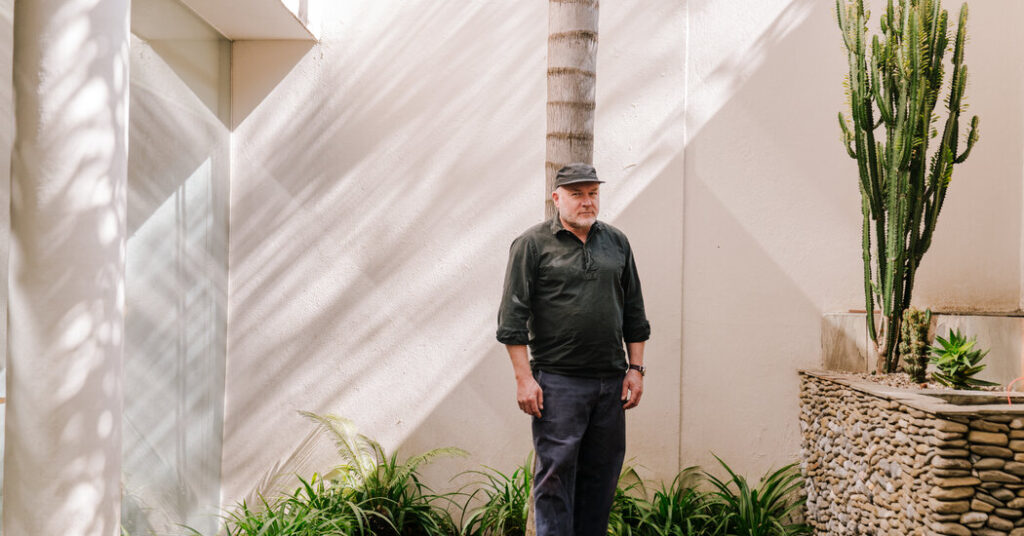
The sculptor Alma Allen, a relatively unknown artist chosen last November to represent the United States at the 2026 Venice Biennale, announced Tuesday that he was joining the roster of Perrotin, a French art gallery with nine locations around the world.
Allen was previously represented internationally by two other galleries, but both quickly cut ties with him after he accepted the State Department’s nomination for the exhibition, at what is known as the art world Olympics.
At the time, some artists at those galleries — Mendes Wood and Olney Gleason — said they opposed his participation, because it came as the Trump administration was mounting a pressure campaign on the culture sector, cutting grants to hundreds of organizations and criticizing program choices at the Smithsonian Institution.
Others have expressed concern that the State Department chose Allen without following its normal selection process, which involved convening a panel of museum curators and previous commissioners to judge applicants.
Allen said that conversations with Perrotin’s owner, Emmanuel Perrotin, had started before his selection for the American pavilion, adding that the two men had met in late October.
“We see him as an artist who has had a quiet and consistent practice over many years,” said Rowena Chiu, a director of the gallery’s London outpost, who recently made a visit to Allen’s studio outside of Mexico City, where he has lived since leaving the United States in 2017. “He comes from a family without means — he is a completely self-made person,” Chiu said. “He feels that art is something that should be able to transcend current politics.”
Allen is in the final weeks of preparing his exhibition at the Venice Biennale, with a shipping deadline at the end of the month for seven or eight new artworks he is presenting alongside a selection of older sculptures. He called them abstract expressions of his personal history.
Earlier this month, Allen filmed an educational video that the State Department made about the creation of this year’s U.S. Pavilion and also included interviews with its curator, Jeffrey Uslip, and members of the newly formed American Arts Conservancy, a nonprofit group based in Tampa, Fla., that is overseeing and organizing the exhibition. It was the first time the artist had met Uslip in person. In October, Uslip, a conservancy board member, had called Allen with an offer to represent the United States.
“Allen has spent the last 30 years creating forms that are sculpturally captivating and materially grounded in the landscape of the Americas,” Uslip said in a previous statement.
After filming the education video, Jenni Parido, the conservancy’s executive director, joined a private culture summit at the White House, where she spoke on a panel about the exhibition alongside Trump administration officials who included Erin Scavino, head of the State Department’s Art in Embassies program, and Matthew Taylor, a senior adviser at the National Endowment for the Humanities who was recently appointed to the U.S. Commission of Fine Arts.
Despite concerns in the art world about the pavilion’s ties to the government, Allen said that he had maintained full artistic control over his exhibition. He has previously stated that he is representing the United States and not the current administration.
“I love the difficult context,” Allen said. “Honestly, it makes the work more interesting. If I could choose, I would always find a bit of a fraught situation to do work in.”
But the artist said he was upset by what he described as an “orchestrated campaign” among gallerists, curators and museum directors who tried to convince him to pull out of the Venice Biennale. He said they included David Resnicow, the founder of a strategic communications firm that handles media relations for major cultural institutions, including previous editions of the pavilion.
“I never told anyone not to work with Alma Allen,” Resnicow said in a statement to The New York Times. Speaking about the American Arts Conservancy, he added: “I have voiced concerns about the organization selected to serve as the commissioner for the pavilion being able to realize the project successfully. This is based on having worked with the commissioning institutions for the U.S. pavilion for six of the past seven art biennales.”
Perrotin said it would provide some of the logistical and operational support for the Venice Biennale exhibition. (The State Department contributes $375,000 to the exhibition, but that is just a fraction of the millions of dollars that commissioners typically need to raise.) Allen plans on showing about 20 new works in his debut show with the gallery, which is scheduled for one of its Paris locations in the fall.
The sculptor will have his Venice Biennale debut at the beginning of May.
“As an artist, you want people to view the work in an open way,” Allen said. “In this context, that’s a fantastic way. The people will try to decipher the meaning.”
Zachary Small is a Times reporter writing about the art world’s relationship to money, politics and technology.
The post After Venice Biennale Fallout, Artist Representing U.S. Signs With Mega-Gallery appeared first on New York Times.