On a day when the fighting in the Middle East sent tremors through global markets, President Trump offered contradictory signals about the war, suggesting that it could be ending “soon” and then a few hours later leaving the timing open-ended.
Mr. Trump first said the war was “very complete, pretty much” during a phone interview on Monday with a CBS News reporter. “We’re very far ahead of schedule,” he added.
Oil prices and stocks, swung wildly all day, as investors appeared preoccupied by the lack of a clear offramp for the fighting, which has disrupted a significant share of the world’s oil, gas and fertilizer exports.
But markets, which had plummeted in the early hours of U.S. trading, rebounded on Monday afternoon with Mr. Trump’s comment that the war was close to complete. The price of oil dropped.
Then, after markets closed for the day, Mr. Trump made a series of comments that moved in another direction. He told a gathering of Republican lawmakers in Florida that “we have won in many ways, but not enough.”
“We go forward more determined than ever to achieve ultimate victory that will end this long-running danger once and for all,” he said, adding: “We will not relent until the enemy is totally and decisively defeated.”
Then, at a news conference Monday evening, Mr. Trump delivered a string of ambiguous messages. He said he was not happy with the current Iranian leadership. “I was disappointed to see their choice” of new supreme leader, he said, stopping short of his previous statement that the slain supreme leader’s son would be “unacceptable.”
He listed what he said were the U.S. accomplishments of the war, the decimation of missile launchers, the setbacks to the Iranian nuclear program and the killing of many Iranian leaders. The U.S. Navy will also escort ships through the crucial gateway of Gulf oil and gas, the Strait of Hormuz, Mr. Trump said, adding, “If needed.”
Asked again when the war would end, he said, “I think soon, very soon.”
His comments came after Iran had displayed defiance, both with a barrage of missile and drone strikes across the Middle East and with the selection of Mojtaba Khamenei as its new leader.
As Israel’s military launched what it called a “wide-scale” attack across Iranian territory on the 10th day of the war, Iran’s foreign minister, Abbas Araghchi, taunted the United States and Israel on social media about the soaring oil prices, calling the attacks on his country “Operation Epic Mistake.”
“We, too, have many surprises in store,” Mr. Araghchi said.
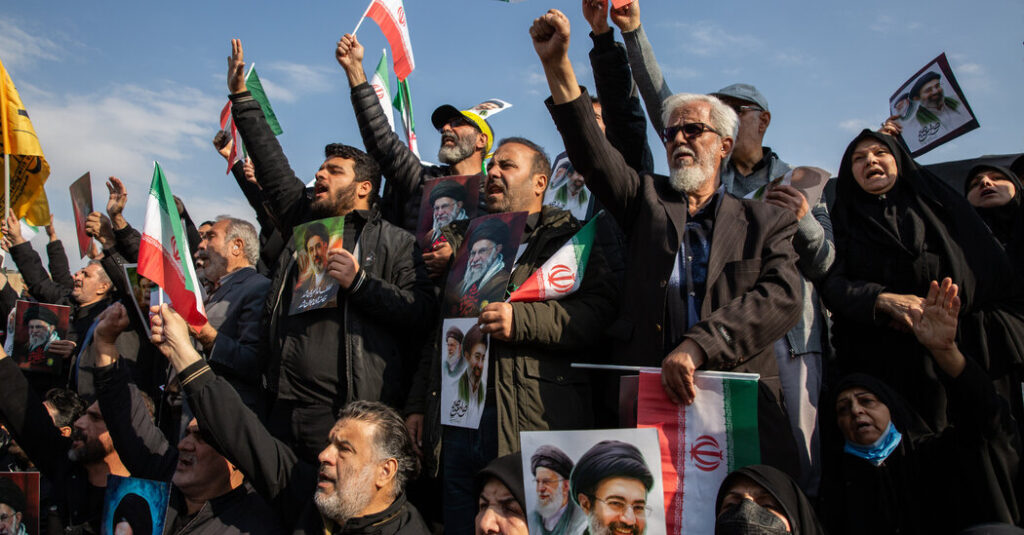
Iran’s selection of a conservative cleric, Mr. Khamenei, to succeed his father, Ayatollah Ali Khamenei, as supreme leader appeared to signal that the theocratic Iranian establishment was digging in its heels. Ayatollah Khamenei, 86, was killed on the first day of the U.S. and Israeli attacks.
The appointment of Mojtaba Khamenei, 56, and Iranian strikes against Israel, Turkey and Persian Gulf nations helped send oil prices soaring. But later on Monday, oil prices moderated after officials representing the Group of 7 large industrialized economies met by video and left open the possibility of tapping their countries’ oil reserves to address the sharp declines in supplies from the Gulf.
In Bahrain, the state-owned energy company declared that it could no longer fulfill its contracts, citing the fighting and a recent attack on its refinery complex.
Saudi Arabia said on Monday that it had intercepted attacks headed toward the kingdom’s huge Shaybah oil field; drones over Riyadh, the capital; and ballistic missiles targeting an air base.
International oil prices settled up 7 percent at $98.96 a barrel on Monday after a wild trading session in which prices approached $120 a barrel late Sunday. That suggests anxiety has eased somewhat about access to energy from the Persian Gulf.
At the pump, the price of gasoline in the United States jumped on Monday to an average $3.48 a gallon, according to the AAA motor club, a nearly 17 percent increase since the first U.S.-Israeli attacks on Iran on Feb. 28 and the highest level since 2024.
Mr. Trump at his new conference also seemed to suggest he might lift oil sanctions against Russia, saying: “We are also waiving oil-related sanctions to reduce prices. So we have sanctions in some countries, and we will take the sanctions off until this straightens out.” He did not name the countries.
At least four Arab governments — Egypt, Jordan, Qatar and Saudi Arabia — lashed out at Iran on Monday with statements condemning the country’s drone and missile attacks. Iranian strikes have hit U.S. diplomatic missions, hotels, oil tankers and crucial infrastructure, including desalination plants.
In a televised interview, Qatar’s prime minister described the Iranian attacks as a “betrayal.” Saudi Arabia also warned Iran it “would be the greatest loser” in the event of “a widening of escalation.”
The conflict has increasingly ensnared the European Union. Soon after the United States and Israel attacked Iran on Feb. 28, an Iranian-made drone targeted a British air base in southern Cyprus, the most eastern member of bloc. On Monday, President Emmanuel Macron of France visited the island as a show of solidarity.
“When Cyprus is attacked, it is Europe that is attacked,” Mr. Macron said at a news conference there, speaking alongside Prime Minister Kyriakos Mitsotakis of Greece.
Iran’s attacks across the Middle East have killed more than 30 people. At least 1,300 people have been killed in the U.S. and Israeli strikes in Iran, the Iranian ambassador to the United Nations said on Friday.
On Monday, NATO defenses downed a missile launched from Iran toward Turkey, the Turkish Defense Ministry said. It was the second such announcement in six days, after officials said a previous Iranian attack had been aimed at the Incirlik Air Base in southern Turkey.
Iranian strikes on Turkey are particularly incendiary because Turkey is a member of the NATO alliance, whose nations are bound to defend one another. Iran denied targeting Turkey and has yet to comment on NATO’s announcement on Monday.
The decision by senior clerics in Iran to name Mr. Khamenei as supreme leader came in direct defiance of Mr. Trump, who last week declared him an “unacceptable choice.”
President Vladimir V. Putin of Russia on Monday congratulated the new supreme leader on his selection, wishing him success in uniting the Iranian people in the face of severe difficulties. “I would like to reaffirm our unwavering support for Tehran and solidarity with our Iranian friends,” Mr. Putin said in a statement. “Russia has been and will remain a reliable partner of the Islamic republic.”
Yuri Ushakov, a foreign policy adviser to Mr. Putin, said the Russian leader had spoken with Mr. Trump for about an hour on Monday about the Middle East, the conflict in Ukraine and the global energy market. Mr. Ushakov stressed that Mr. Trump had initiated the call to address the “current developments in the international area.”
The last call between the two leaders took place in October. Mr. Ushakov said that Mr. Putin had expressed hope for a “swift political and diplomatic resolution” to the Iranian conflict. According to Mr. Ushakov, Mr. Trump “expressed interest in seeing the conflict in Ukraine conclude with a swift cease-fire and a long-term settlement.”
In Israel, at least one person was killed during an Iranian missile attack Monday morning, according to Magen David Adom, the Israeli emergency service, raising the death toll in the country to at least 11.
And in Lebanon, Israeli strikes have killed nearly 500 people, state media reported, and have displaced more than 600,000 people, according to the Lebanese president, Joseph Aoun. In a call with European officials, Mr. Aoun presented what he called an initiative to end the fighting, according to his office. Lebanon’s government, he indicated, would hold direct talks with Israel under international supervision to disarm Hezbollah, the Iran-backed militant group.
In response to rocket fire by Hezbollah, Israeli forces have pushed into southern Lebanon and bombed Hezbollah strongholds. Israeli fighter jets also bombed the southern outskirts of Beirut, the Lebanese capital, sending huge explosions echoing throughout the city.
Reporting was contributed by Yan Zhuang, Anushka Patil, Catherine Porter, Vivian Nereim, Hwaida Saad, Aurelien Breeden, Ben Hubbard, Lara Jakes, Raja Abdulrahim, Christina Goldbaum, Ben Hubbard, Paul Sonne and Rebecca F. Elliott.
Aaron Boxerman is a Times reporter covering Israel and Gaza. He is based in Jerusalem.
The post After Global Economy Shudders, Trump Zigzags on Whether War Will End Soon appeared first on New York Times.