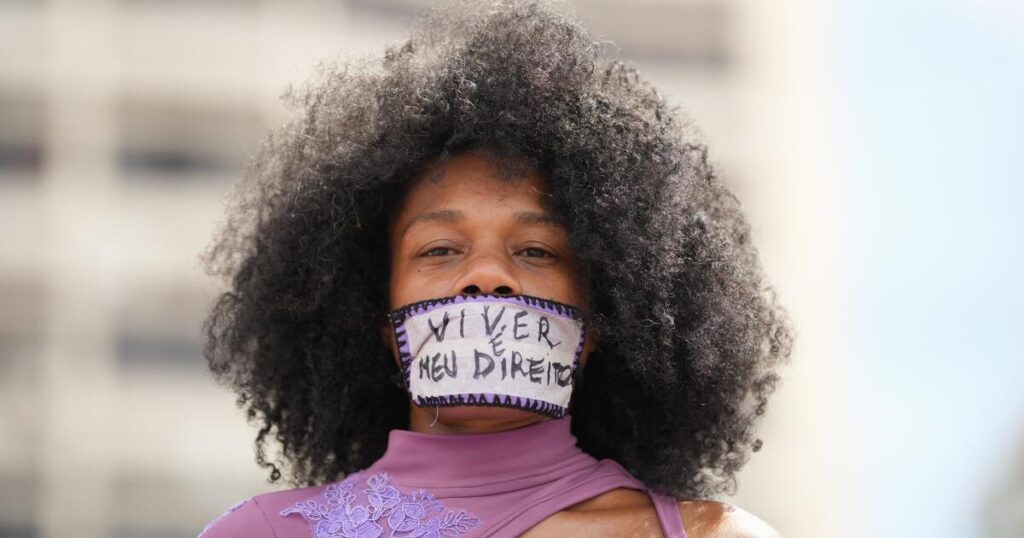
RIO DE JANEIRO — Sunday’s marches in Brazil for International Women’s Day served as a rallying cry against gender-based violence, fueled by the latest case to outrage the country involving the alleged gang rape of a 17-year-old girl in Copacabana.
The case in Rio de Janeiro’s famed beachside neighborhood, which allegedly took place in January, gained national traction last week when four suspects handed themselves over to authorities. Described by police as a gang rape, the case has added fuel to outrage in a nation where reports of violence against women have surged in recent months, sparking nationwide protests and a flurry of digital activism.
At least 15 protests were planned across the country, with organizers calling for the defense of women’s lives and an end to femicide.
Rio’s Civil Police said the four young men in pretrial detention will be charged with rape, while a fifth suspect — a minor — turned himself in Friday to face an equivalent charge under juvenile law.
Authorities issued an arrest warrant for the minor after his alleged involvement in another case of sexual violence came to light with similar circumstances to the Copacabana episode, the Rio state prosecutors’ office said in an email.
Lawyers for two of the suspects have denied any wrongdoing, while legal counsel for the other three have yet to comment on the case publicly.
A police investigation revealed that in January, the victim received a message from a classmate at her prestigious school inviting her to a friend’s home. Once inside the apartment, she was taken to a room and locked in with the suspects, where she was sexually assaulted and subjected to physical and psychological violence, a police statement on Wednesday said.
Last week, security camera video of several men arriving and then leaving the scene circulated widely on social media.
Public interest in the case intensified after the local press widely reported that the father of one of the suspects served as undersecretary for governance and compliance within Rio’s state social development and human rights department. After the allegations against his son, the official was dismissed from his post, according to a decision published Wednesday in the state government’s official gazette.
The general public, women’s rights groups and public figures including ministers Anielle Franco and Sonia Guajajara took to social media to denounce the incident.
“It’s impossible not to feel indignation when a 17-year-old young woman suffers such brutal sexual violence,” said Racial Equality Minister Franco as she called for mass protests on International Women’s Day. Franco is the sister of Marielle Franco, a Rio councilwoman, feminist and human rights activist who was assassinated in 2018.
Violence against women in Brazil continues to climb, with 1,568 reported femicides in 2025 alone, a 4.7% increase from the previous year and more than three times the number in 2015, according to the Brazilian Forum on Public Safety.
Other crimes against women — such as threats, stalking, psychological violence, bodily injury, rape and attempted femicide — have also been increasing consistently in recent years, the think tank said in a report released ahead of International Women’s Day.
“Women’s bodies continue to be seen as someone else’s territory, which can be threatened, assaulted, sexually violated and murdered,” it said.
After a string of high-profile cases last year and the ensuing protests, Brazil’s government increased protective measures. And earlier this year, the administration of President Luiz Inácio Lula da Silva announced a multipronged effort involving the executive, legislative and judiciary powers to combat femicide.
Last week, Brazil’s government introduced emergency measures that include a national task force to execute approximately 1,000 arrest warrants for known aggressors, the implementation of an electronic tracking system for individuals with protective orders and the deployment of 52 mobile units to assist women in situations of violence.
Government actions have an important symbolic value and show that authorities deem violence against women unacceptable, said Isadora Vianna, a sociology researcher from Rio de Janeiro State University. But, she added, “it would be more effective to invest massively in policies of prevention and support networks.”
Vianna also noted the importance of further regulating the internet to stop the rapid circulation of misogynistic content.
Tatianny Araújo, a 47-year-old longtime women’s rights activist, said International Women’s Day feels different this year for her in the wake of high-profile reports of sexual violence, including the alleged gang rape in Copacabana. Her 13-year-old son goes to the same high school as two of the suspects, who are in the process of being expelled.
“We feel bad, we cry, we’re consumed by rage and by pain,” Araújo said. “But at the same time we cannot stop. We have to mobilize, we have to do something.”
Hughes writes for the Associated Press.
The post Women’s Day marches in Brazil decry gender-based violence, fueled by gang rape case appeared first on Los Angeles Times.