The American-Israeli war on Iran has spiked oil prices, as tankers hesitate to transit the Strait of Hormuz, a narrow waterway connecting the Persian Gulf to the Indian Ocean through which some 20 percent of global oil trade passes. To keep oil flowing from the region, President Trump has promised U.S. naval protection to ships traveling through the strait, if necessary.
This is not a new idea, but a continuation of President Jimmy Carter’s 1980 pledge to defend the Persian Gulf after the 1979 Islamic Revolution, which, compounded by the Soviet invasion of Afghanistan, heightened threats to the global oil supply. Mr. Carter’s commitment led to the creation of CENTCOM, the U.S. Central Command, and became the driving rationale for a permanent U.S. footprint in the region.
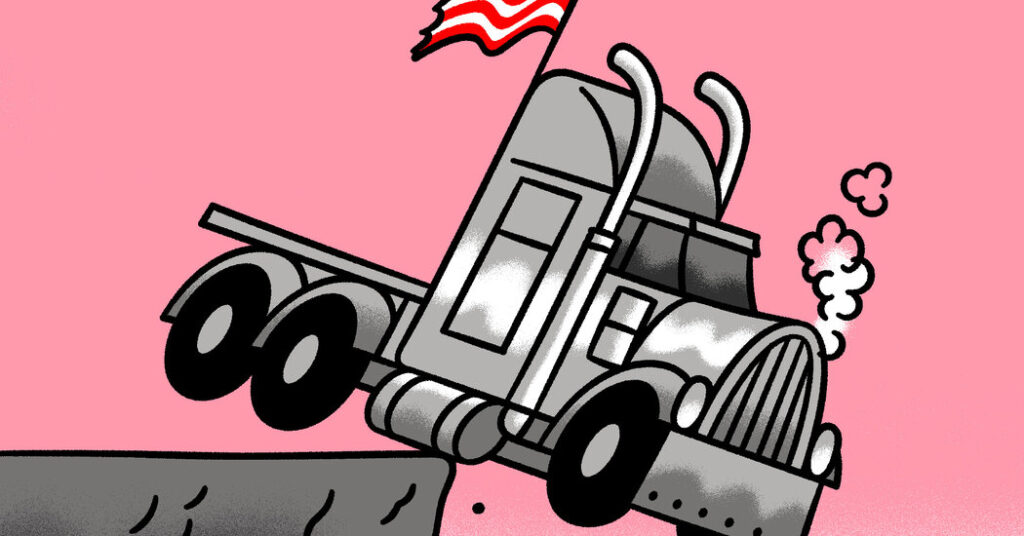
But long-term U.S. military basing has failed to stop Iran from attacking Gulf shipping, even as it has discouraged investment in a more robust global oil transportation network, setting the stage for today’s oil price spike worries. As the Iran crisis plays out, the United States has better options than doubling down on Mr. Carter’s approach, but they require us to understand and correct America’s unique vulnerability: The country is more exposed to oil price shocks than any other major power, including China.
Many Americans might be surprised to hear this. The United States is the world’s largest oil producer and a net petroleum exporter. But oil trades in a global market at a single market price. Experts compare the oil market to a giant bathtub with many spigots and drains. The total level of oil in the bathtub, plus market speculation about whether that level will go up or down, determines the oil price — even for countries such as the United States, which pours a lot of crude into the tub.
Every country that draws from the bathtub suffers from price shocks, but the United States suffers more than its peers. The U.S. economy has a high oil intensity; it consumes a lot of oil to produce each dollar of its gross domestic product. America’s economy is more than 40 percent more oil-intensive than China’s, even though China is a net oil importer and sources much of its oil from Persian Gulf countries, including Iran. The European Union’s economy is half as oil-intensive as America’s. Even Russia, a petrostate, is about 20 percent less reliant on oil per unit of economic output than the United States is.
China is still a developing country in many ways. Developing countries tend to consume more oil than fully industrialized ones. But China also recognized its strategic vulnerability to oil shocks years ago and has been methodically decreasing it — not with warships, but with electric vehicles and high-speed electric rail. Chinese gasoline consumption appears to have peaked in 2023, far earlier than analysts expected. According to an analysis by BloombergNEF, some two-thirds of all electric vehicles sold worldwide are purchased in China, and within the next year, China’s E.V. sales are projected to exceed the entire U.S. car market.
The United States’ oil intensity problem is set to worsen relative to China. The Trump administration has ended E.V. subsidies, discouraged investment in charging infrastructure and weakened U.S. fuel economy standards. The International Energy Agency has revised projections of American E.V. adoption sharply downward to only 20 percent of new American car sales by 2030, compared to over 40 percent under previous policies. That number is expected to be around 80 percent in China.
So what should Washington do right now? In the short term, the U.S. government can reassure markets by releasing oil from the U.S. Strategic Petroleum Reserve, which was built for moments like this. The reserve currently holds about 415 million barrels and can begin deliveries within two weeks. Every previous emergency drawdown — during the 1991 Persian Gulf war, Hurricane Katrina, NATO’s airstrikes on Libya and Russia’s invasion of Ukraine — helped to stabilize global markets.
The White House should have planned for an emergency drawdown from the reserve before launching a reckless war on Iran, especially since Secretary of State Marco Rubio admitted last week that officials anticipated that prices would spike during the conflict. The delay suggests that the Trump administration was overconfident that the war would end quickly, before the oil market noticed.
The United States should coordinate its petroleum reserve release with the International Energy Agency’s member countries, which collectively hold 1.2 billion barrels in government stockpiles. Combined global oil inventories, which include government stocks and those held by private companies, stand at 8.2 billion barrels — theoretically enough to compensate for a complete Hormuz closure for over a year. The current energy crisis is manageable, whether or not the U.S. Navy intervenes in Hormuz, particularly if governments act together.
Promising U.S. military intervention to protect Persian Gulf oil, as Mr. Carter did, sends a bad signal. He encouraged the oil market to over-rely on a single, vulnerable choke point — the Strait of Hormuz — for petroleum commerce. If he hadn’t, oil companies and governments would have had more reason to diversify the routes on which Mideast oil could move — through pipelines or on railways to ports on the Mediterranean or Red Sea.
Over the long run, the United States needs to do what China is already doing: invest in E.V.s.
U.S. electricity production is already more than 99 percent independent from oil, running instead on coal, natural gas, nuclear power and green energy. Electrifying America’s vehicle fleet would slash U.S. oil intensity and reduce exposure to price shocks from the Persian Gulf, Russia and beyond.
Transitioning away from internal combustion engines should not be tangled in the toxic partisan politics of climate change. Electrification is crucial for the United States to mitigate a strategic vulnerability that its rivals are already solving. If the United States relies less on oil, it can care less about the Persian Gulf. That would be one more reason to bring home the tens of thousands of U.S. troops stationed there.
Rosemary Kelanic is the director of the Middle East program at Defense Priorities.
The Times is committed to publishing a diversity of letters to the editor. We’d like to hear what you think about this or any of our articles. Here are some tips. And here’s our email: [email protected].
Follow the New York Times Opinion section on Facebook, Instagram, TikTok, Bluesky, WhatsApp and Threads.
The post Trump Is Making the U.S. More Vulnerable to Oil Shocks appeared first on New York Times.