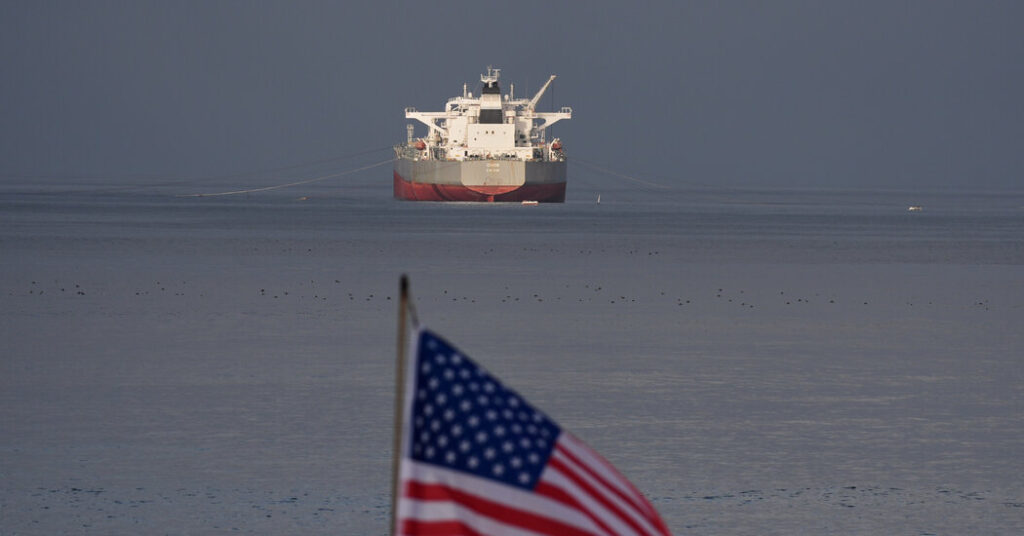
From the capture of Venezuela’s Nicolás Maduro to the war in the Middle East, 2026 has served as a powerful reminder of oil’s enduring influence in geopolitics and the global economy.
Oil has been both a prize, as in Venezuela, and a potent tool of political coercion, as seen in the U.S. blockade that is starving Cuba of energy. And now, with oil trading above $100 a barrel for the first time in almost four years, the economic risks of going even a short time without full access to energy from the Persian Gulf are becoming clearer by the day.
With oil front and center, it feels almost like revisiting an earlier time, before countries began embracing renewable energy and before the United States became the world’s biggest producer of oil and natural gas.
There is little sign that the war with Iran will cause the kind of economic pain experienced about a half-century ago, when oil met almost half of the world’s energy needs and an embargo by members of an oil cartel caused prices to quadruple in a matter of months, tipping the U.S. economy into a period of high inflation and stagnant economic growth. But it is clear that going without as much oil and natural gas as the world is used to, even briefly, will strain economies around the world.
“The old game is back more than people thought it would ever be,” said Elliott Abrams, who served as a special representative for Iran and Venezuela during the first Trump administration.
The world remains dependent on reliable oil and gas supplies, even though two-thirds of global spending in the energy sector now go to cleaner alternatives such as solar power that are growing much more quickly.
While oil now meets a smaller share of global energy needs than it used to — less than 30 percent, according to the International Energy Agency — the world uses almost twice as much of the fuel as it did in the early 1970s. And natural gas, used to heat homes and generate electricity, underpins much more of the economy than it used to.
“The post-oil world remains far in the future,” said David Sandalow, a fellow at Columbia University’s Center on Global Energy Policy who served in the Clinton and Obama administrations. “We’re in the early to middle stages of an energy transition, but energy transitions take time.”
Of course, disruptions like the war in Iran may accelerate the move to alternative sources of energy, particularly in places that lack easy access to fossil fuels, while pushing countries to use energy more efficiently. U.S. fuel-economy standards are an enduring legacy of the 1973 oil embargo, for example.
The widening conflict in the Middle East, which began with U.S.-Israeli attacks on Iran on Feb. 28, has all but blocked the Strait of Hormuz, a narrow waterway that serves as the gateway to market for one-fifth of the world’s oil and substantial amounts of natural gas. Several refineries in the region have shut down or cut processing, some after sustaining damage, according to Kpler, a research firm. That means they are turning less oil into fuels like gasoline, diesel and jet fuel.
That disruption — and concern that it might last for some time — sent international oil prices up around 50 percent since late February. Fuel prices quickly followed, with especially large gains in the cost of diesel and jet fuel.
Qatar, meantime, stopped cooling natural gas for export last week, citing military attacks. That sent natural gas prices soaring in Europe and in Asia, which depend heavily on imported fuel. The United States, as the world’s top natural gas producer, has been comparatively insulated. Prices at the main domestic trading hub had risen about 20 percent as of Sunday evening. (The natural gas market is much more regional than the oil market, largely because the colorless fuel is harder to transport.)
Gasoline and diesel prices have been climbing at a time when many Americans are already worried about the economy and inflation. Many of those economic concerns can be traced to the last major energy disruption, after Russia invaded Ukraine in 2022.
Gasoline prices, which briefly topped $5 a gallon that year, had fallen considerably, so much so that the relatively low cost of filling up served as a counterweight to rising prices elsewhere in the economy — and a point of pride for President Trump. The war with Iran carries political risk for Mr. Trump, not least because of the toll that higher energy prices will most likely take on the U.S. economy.
It is no coincidence that oil has re-emerged as both geopolitical tool and economic threat during a period when the United States is unwinding trading relationships and clashing with other great powers, said Meghan O’Sullivan, a deputy national security adviser for Iraq and Afghanistan under President George W. Bush.
“The energy weapon never went away, but there’s a whole confluence of global conditions — and then individual decisions by the Trump administration and others — that have really brought it back to the fore,” said Dr. O’Sullivan, now a professor at Harvard University’s Kennedy School. “Energy can be a tool of foreign policy, but it can also be an objective.”
For the latter, look no further than Mr. Trump’s pursuit of oil in Venezuela. And in recent weeks, the United States has blocked Cuba from accessing oil in an attempt to topple the country’s Communist government. Starved of energy, the island nation, which is exceptionally dependent on imported fuel, is facing a humanitarian crisis and widespread power outages.
In the Middle East, Iran has leaned on one of its strategic advantages: its ability to disrupt the flow of oil and natural gas through the Persian Gulf and hurt economies around the world.
“This is going to underscore yet again how exposed countries are to energy sources that are produced outside their borders,” Dr. O’Sullivan said.
How countries respond to the war in the long run will hinge partly on the severity of the economic fallout from higher energy prices. Reactions are also likely to vary by region, pushing countries in Asia and Europe that do not produce much oil or natural gas to adopt renewable energy faster. The United States, awash in oil and natural gas, may continue to lean into those strengths, at least under Mr. Trump, even though burning the fuels accelerates climate change.
“For any country that does not have substantial supplies of oil and gas, a no-brainer conclusion is that investment in renewables plus storage is strategic from an energy security point of view,” said Kelly Sims Gallagher, a former Obama administration official who is now dean and professor of energy and environmental policy at Tufts University’s Fletcher School.
Clean energy comes with its own geopolitical risks, including greater reliance on China, which dominates the production of everything from solar panels to wind turbines and rechargeable batteries.
But unlike oil and gas, which countries need on an ongoing basis, securing wind and solar equipment is more of a one-time risk. Once a country has the tools to harness the sun and the wind, the energy sources themselves cannot be taken away.
“You can’t weaponize the sun,” said Catherine Wolfram, a deputy assistant secretary for climate and energy economics in the Treasury Department in the Biden administration. “You can’t weaponize the wind.”
Rebecca F. Elliott covers energy for The Times.
The post ‘The Old Game Is Back’: Oil Is a Potent Geopolitical Tool Again appeared first on New York Times.