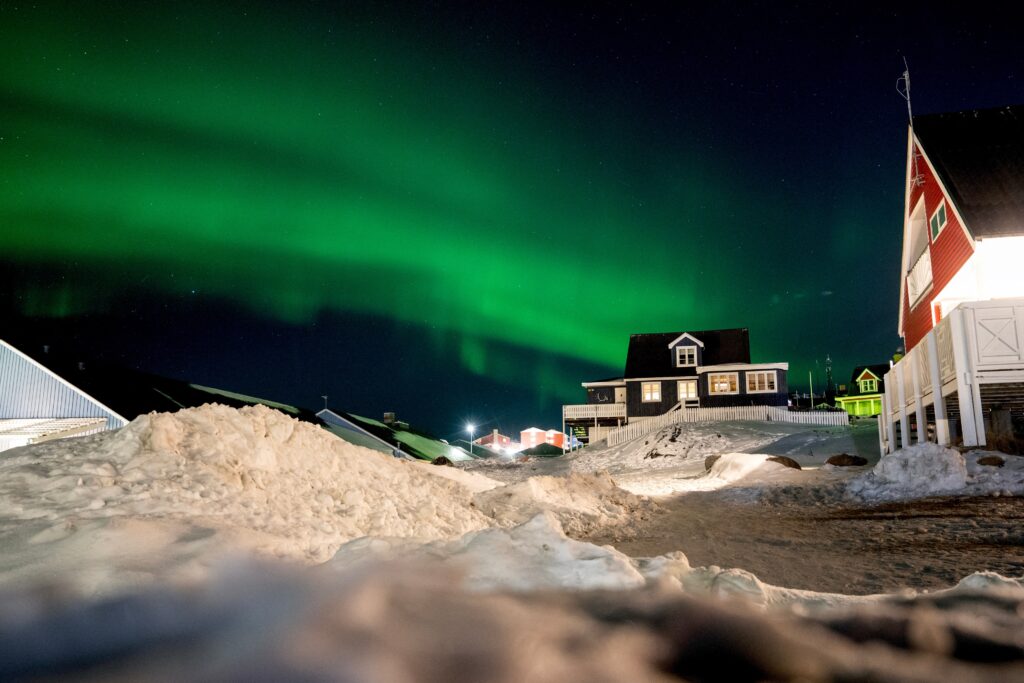
After a spectacular run, the aurora borealis is taking its final bow.
In the past two years, the northern lights, which peaked in October 2024, have appeared in skies as far south as Florida and Mexico and in urban centers stretching from San Francisco to Washington. The displays have been especially electric, with neon swirls of green, purple and magenta.
As the 11-year cycle downshifts from solar maximum to solar minimum, the lights will begin to diminish in frequency and intensity. They’ll also beam closer to the auroral oval, the region encircling the Earth’s magnetic poles. Sightings in the Lower 48 will become even more rare.
“Sometimes eruptions or magnetic weirdness from the sun will jangle Earth’s magnetic field and give a stronger aurora, so there is a chance,” said Shauna Edson, an astronomy educator at the Smithsonian Institution’s Air and Space Museum, “but the northern lights are mainly going to be at high latitudes during the quiet period.”
The aurora-viewing season roughly falls between September and April. The lights can be especially vibrant around the equinoxes: March 20 for spring and Sept. 22 for autumn.
To catch the encore performances before the solar slowdown, Tom Kerss, chief aurora chaser at Hurtigruten, a cruise line based in Norway, recommends traveling to see the lights before the end of 2027.
“There will be a noticeable downturn in the intensity of aurora storms, even in the Arctic. So there is a sense that the best time to go is now,” Kerss said.
Light shows from Scandinavia to Shenandoah
For an unpredictable attraction, the destinations within the auroral oval are the closest to a sure thing.
A number of towns — Tromso and Alta in Norway; Abisko, Sweden; Rovaniemi, Finland; Fairbanks, Alaska; and Yellowknife and Whitehorse in Canada, to name a few — have positioned themselves as the north star of northern lights tourism. Visitors have a “high statistical probability” of seeing the aurora in these places, said Vincent Ledvina, a Fairbanks guide known as the “Aurora Guy.”
However, astronomy experts say, don’t rule out the Lower 48 just yet. The aurora borealis could sporadically appear post-peak and during summertime, when polar regions are experiencing the midnight sun.
“As you get down to lower latitudes, one thing we have going for us is that we don’t get the midnight sun,” said Elizabeth MacDonald, a heliophysicist at NASA Goddard Space Flight Center. “So if there was a larger event during the rest of the year, it could happen in the summer.”
Edson, who has viewed the natural phenomenon in Iceland and Silver Spring, Maryland, said aurora chasers should look toward the northern reaches of the United States, such as Upstate New York and Michigan’s Upper Peninsula, but keep an eye on dark skies over Pennsylvania, West Virginia and Virginia, too.
For optimal viewing, she recommends places with no light pollution or dense forest that obstructs the vast sky, such as Pennsylvania’s Cherry Springs State Park or Shenandoah National Park in Virginia.
A snapshot of aurora destinations and tours
The easiest path to the northern lights is on a guided land tour or cruise where the experts will take care of all the logistics and forecasting. Some operators and hotels will even message you when the show is starting, limiting your exposure to the cold.
“We will text you a few minutes before it’s time to come outside — that’s how good our forecasting methods are,” Kerss said. “We can get you out for the full 20 minutes of excitement and then straight back to the bar.”
If you go with a group, Kerss warns, avoid mass tours led by inexperienced guides who truck hundreds of people to the same spot, an experience as unpleasant as convoys of safari vehicles gawking at a lion.
Aurora experts have their favorite places and ways to view the lights — by car or ship, dog sled or snowshoe, in the elements or ensconced in a glass-roofed shelter.
- In Norway, the Coastal Express has been transporting mail, cargo and locals between Bergen and Kirkenes since 1893 — and now carries northern lights pilgrims. Passengers can stay on board for Hurtigruten’s 12-day cruise or hop on/hop off at any of 34 ports along the 2,500-nautical-mile route.
- Viðja Jónasdóttir, sales manager of Nordic Visitor’s Iceland team, said the company’s Iceland Full Circle in 10 Days, a self-drive adventure, includes several nights in the countryside for “optimal aurora-viewing conditions.”
- Tricia Dowhan, who has been developing tours for VBT | Country Walkers for more than 29 years, described the northern lights as “one of those magical travel moments you can’t schedule to the minute — but you can put yourself in the right place for it.” That right place could be on the company’s Iceland Guided Walking Tour by Yacht. Dowhan said guests have reported seeing the aurora borealis on the 10-day excursion.
- Ledvina has several favorite spots around Fairbanks, including Cleary Summit; Murphy Dome, a 2,890-foot peak; Creamer’s Field, a wildlife refuge; and Harding Lake State Recreation Area, whose lake horizon faces the north.
For warmer alternatives, Travel Alaska, the state’s tourism office, suggests the steaming pools at Chena Hot Springs, the resort’s yurts atop Charlie Dome or the heated lodge at Aurora Pointe.
In Canada, Yellowknife, the capital of the Northwest Territories, and Whitehorse, the capital of Yukon, sit directly beneath the auroral oval. In fact, Yellowknife registers up to 240 nights of northern lights a year.
The Northern Lights Resort & Spa in Whitehorse offers an Aurora Spring package in March and April that includes nightly guided aurora-viewing by a bonfire from 10 p.m. to 1:30 a.m. For next winter, the resort’s new Aurora 360 Flight Special will feature a scenic Arctic Circle flyover with guaranteed window seats. Wild Adventure Yukon, meanwhile, lets guests sleep in heated domes with glass roofs, so they can view the aurora borealis in bed.
How to plan a DIY aurora borealis trip
Independent travelers can try chasing the aurora borealis, too, with a little help from our friends at the National Oceanic and Atmospheric Administration and NASA, and on Facebook. (And don’t forget meteorologists — the fewer the clouds, the better the display.)
Though the tools aren’t exact, they are a window to solar activity and a good starting place for planning a spontaneous trip, assisting with where to go and how fast you’ll need to mobilize.
NOAA’s Space Weather Prediction Center, for instance, provides a three-day forecast of space weather conditions called the Kp index. According to the agency, a higher Kp number means the lights will be more vibrant and more visible beyond the poles. If the report is at least a Kp 6 — out of 9 — you might want to start checking flights or gas up the car.
“It gives us a couple days’ warning of when that material from the sun will travel,” MacDonald said. “We can’t tell you precisely when, but people can start to think about their travel plans.”
The Aurora Forecast, which is run by the University of Alaska at Fairbanks’s Geophysical Institute, also shares solar weather reports three days out.
In 2014, MacDonald launched Aurorasaurus, a citizen science project supported by NASA. The online platform, which is free to join, acts like Waze for aurora seekers, with members alerting the community to sightings within a three-hour window. On Friday, for example, a participant named Malcolm posted a report describing red, green and amber arcs and pulsating patches from his base in Scotland.
Members can also sign up for email alerts for their location and check the Storm Tracker, which forecasts the strength of auroras in short increments.
Finally, Facebook groups supported by regional aurora enthusiasts can be a fount of information, tips and aspirational photos. Sign up for groups in destinations both within driving distance and farther afield — across the country or even over a border or ocean — such as Fairbanks, Manitoba and Iceland.
The post The northern lights have peaked. Here’s how to see them before they fade. appeared first on Washington Post.