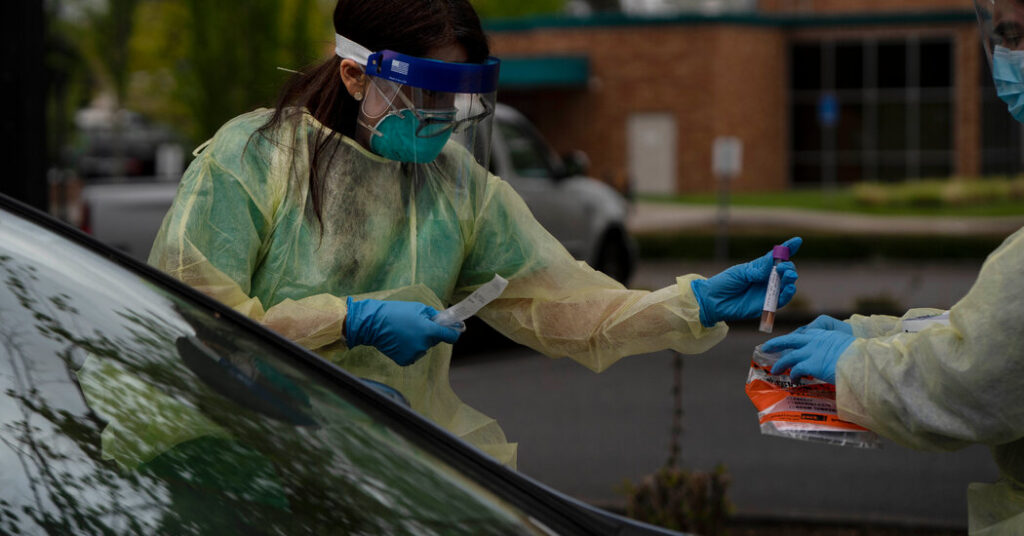
The Covid pandemic was an extraordinary moment in history. Starting at the end of 2019, a virus new to science swept across the planet, killed more than 25 million people and caused trillion of dollars in economic damage.
But as outbreaks go, Covid was pretty ordinary, a new study finds.
Scientists compared seven viral outbreaks that occurred in recent decades, including epidemics of Covid, Ebola and influenza. For the most part, the researchers found, the outbreaks were not preceded by any unusual genetic changes in the viruses. In all but one case, in 1977, the viruses circulated in animals and gained the ability to spread to and among people only by unfortunate coincidence.
“We see that time and again,” said Joel Wertheim, a virologist at the University of California San Diego. He and his colleagues published the study on Friday in the journal Cell.
Dr. Wertheim and his colleagues reconstructed the evolutionary history of these viruses by looking at their genes. They tracked how viruses gained different kinds of mutations before causing outbreaks and looked at that pattern after the viruses jumped into the human population.
In one line of research, the scientists examined the influenza pandemic of 2009. In that year, a new strain of influenza emerged in North America and went on to infect one-quarter of all people on Earth and kill 230,000.
Other studies of the virus have revealed that it came from pigs, where influenza viruses gain mutations on a regular basis. Some mutations made it harder for the viruses to spread to other pigs. Others provided an evolutionary edge; still others had no effect.
The viral strain that jumped into humans in 2009 had split off as its own evolutionary branch at least a decade earlier. Until it reached humans, its evolution looked ordinary; the pattern of mutations gained and lost by the virus resembled what scientists would expect to see in any flu virus thriving in pigs.
Only after the virus jumped to humans did things change, and dramatically.
After infecting humans in 2009, the flu virus gained many new mutations. In pigs, those mutations would probably have hindered the virus’s ability to multiply and caused it to be outcompeted by other viruses infecting the animals.
But once the virus settled in a new host, those old constraints were gone. It began adapting to spread more successfully in humans.
Dr. Wertheim and his colleagues ran the same analysis on other outbreaks, including the Ebola epidemic that swept across West Africa in 2013 and is thought to have originated in a bat, and the 2022 outbreak of mpox, a virus that causes painful blisters and is believed to be harbored by African squirrels. Again and again, the researchers saw the same pattern: The viruses that eventually jumped into humans did not evolve in an unusual way beforehand but did change dramatically afterward.
“Once it gets into humans, it’s a new day,” Dr. Wertheim said.
But one virus turned out to be a major exception to that rule, the new study found. Its unique mutations suggest that it may have been set loose by a scientific accident.
In 1977, the world was hit by a pandemic that came to be known as Russian flu, because the first cases were reported by the Soviet Union. Scientists were baffled by the virus: Its closest relatives were not in pigs or other animals but instead looked a lot like viruses that were circulating in the early 1950s, a quarter-century earlier.
Some scientists speculated that the Russian flu was not a spillover from a pig or a bird. Rather, they suggested, it had emerged from a scientific mishap, perhaps a vaccine trial that had gone wrong in the Soviet Union or China.
The vaccine makers might have used a common technique that involved producing a vaccine made of weakened viruses. Viruses growing in Petri dishes in a lab accumulate mutations that would harm them if they were infecting a person. Scientists speculated that Soviet or Chinese scientists thawed out some old flu virus to make a weakened vaccine but used faulty techniques that allowed the virus to spread from person to person.
Since then, researchers have not found direct evidence to test this scenario or others like it. But the new study by Dr. Wertheim and his colleagues concluded that the 1977 virus underwent some odd evolution before the pandemic — and that the mutations it gained bear patterns identical to those found in viruses that are grown in labs.
Gigi Gronvall, a biosecurity expert at Johns Hopkins University, said that the new study suggests that the 1977 pandemic began as a vaccine trial. “It’s more evidence that they were trying to create an attenuated vaccine and failed spectacularly,” she said.
Spyros Lytras, a virologist at the University of Tokyo who was not involved in the new study, said the study’s methodology offered a new tool for tracing the origin of outbreaks. “The genetic data holds a robust signal that can distinguish between lab passaging and manipulations versus natural spillovers,” he said.
James Lloyd-Smith, a disease ecologist at the University of California, Los Angeles, said that detecting the genetic signature of lab evolution in the Russian flu was “very cool.” But he cautioned that scientists typically only capture a fraction of the evolution of viruses in their samples. “This approach isn’t a magic wand, and the study still faces the same challenges of limited data that have dogged the field,” he said.
Of the several outbreaks that Dr. Wertheim and his colleagues analyzed, only the Russian flu proved to be an exception to the rule. The virus that caused Covid — SARS-CoV-2 — was not.
The researchers found no peculiar changes in SARS-CoV-2 before it jumped into humans. It gained mutations as it spread from bat to bat, just like other bat coronaviruses did; only after the virus emerged in humans did it undergo a marked shift. Within a year, radically new variants were evolving, with mutations that made them exquisitely well-adapted to humans.
The new study adds to the ongoing debate over Covid’s origins. In a January interview with The New York Times, Dr. Jay Bhattacharya, the director of the National Institutes of Health, asserted that SARS-CoV-2 emerged from a lab. “I think if you just focus on the scientific evidence alone, I would say it’s certain,” he said.
Some experts who favor a lab-leak origin point to just how well prepared SARS-CoV-2 was to spread among humans from the start of the pandemic. In November, Dr. Robert Redfield, former director of the Centers for Disease Control and Prevention, claimed that the Chinese military had created SARS-CoV-2 as an inhaled vaccine. “I think that was all engineered,” Dr. Redfield said in a podcast interview.
But last month, a group of experts assigned by the World Health Organization to examine Covid’s origins came down in favor of SARS-CoV-2 having originated in bats, which then passed it to animals sold in a market in Wuhan.
“Most of the peer-reviewed scientific evidence supports this hypothesis,” the scientists noted.
Dr. Wertheim has helped collect some of that peer-reviewed scientific evidence. The new study adds more evidence in favor of an animal origin, he said.
If SARS-CoV-2 was reared in a lab, its mutations would unfold in a pattern like that of the Russian flu. Instead, Dr. Wertheim and his colleagues found, its mutation pattern matched the five naturally occurring outbreaks they studied.
Instead, Dr. Wertheim said, Covid appears to have arisen from some really bad luck. As the precursor virus was adapting to infect bats, it ended up ready to start a pandemic among people. “It’s coincidentally exceptionally good at being a human virus,” Dr. Wertheim said.
David Robertson, a virologist at the University of Glasgow who was not involved in the new research, said that the study offered insights not just for Covid but for any zoonotic virus — a virus that spreads from animals to humans. “It’s a key point for understanding zoonotic risk,” he said. “Viruses can be circulating in nature without requiring adaptations to infect or transmit successfully in humans.”
If that’s the case across a wide range of zoonotic viruses, Dr. Wertheim said, we can expect more pandemics in the future. “It’s what we don’t know that’s going to get us,” he said. “They’re out there, and they’re ready to go.”
Carl Zimmer covers news about science for The Times and writes the Origins column.
The post Scientists Get a Glimpse to How New Pandemics Are Made appeared first on New York Times.