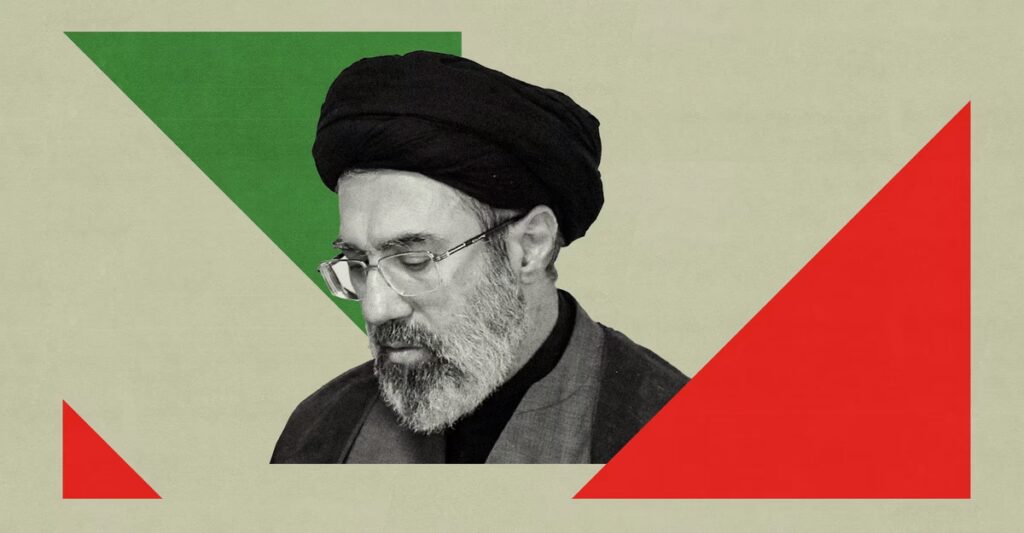
Fittingly for Iran, the news that Mojtaba Khamenei, the ultimate theocratic nepo baby, will be the new supreme leader can be described as both expected and bizarre. The 56-year-old has long been touted as a possible successor to his father, the late Ayatollah Ali Khamenei. I first heard the rumor more than a decade ago from conspiracy-minded cab drivers in Tehran. Now Iranian reality has shown itself to be as strange as any conspiracy theory.
What makes the appointment baffling is Mojtaba’s total lack of public profile, let alone the religious qualifications that once underpinned the idea of clerical leadership as God’s vice-regency on Earth. A nation of 90 million is now going to be led by a man who has never given a single public interview or speech. His only known audio message is a 2024 announcement that he was, without explanation, putting an end to his classes at the Qom Seminary, where he had taught since 2009. Before teaching at Qom, he studied there, having started his clerical career relatively late, in 1999, at the age of 30. Even the biographies now hastily being published by the regime don’t list any other jobs for him. They claim that he speaks English and Arabic.
[Graeme Wood: ‘The most dangerous man in the world’]
Being his father’s son has apparently been Mojtaba’s whole life. The Islamist revolutionaries of 1979 might have brought down centuries of monarchical rule, but the entire basis of their Shiite faith is the hereditary succession of religious leadership (the Shiites’ progenitors broke from Sunnis in the seventh century because the Sunnis believed that the community’s leaders should be selected by the elders, whereas Shiites chose to follow the descendents of the Prophet Mohammad.) Sons of clerics have often played important roles in running their father’s household, but Mojtaba used his status to build ties with the country’s security forces. One place where his name has always appeared is in the complaints of many losers of the regime’s internal fights: The former speaker of the Parliament Mehdi Karroubi, former Deputy Interior Minister Mostafa Tajzadeh, and the former head of the state broadcaster Mohammad Sarafraz have all publicly attested to Mojtaba’s outsize influence over the security forces’ handling of the cases against them.
In recent years, Mojtaba has slipped out from the shadows, and some in the establishment openly promoted him as a potential supreme leader. Knowing full well the desire of Iranian society for change, some tried selling him as a modernizer, rather like the popular crown prince of Saudi Arabia, Mohammed bin Salman: “MBS for Iran.” Last year, the reformist daughter of former President Ali Akbar Hashemi Rafsanjani Faezeh Hashemi endorsed this possibility and backed Mojtaba for succession. Since Mojtaba’s selection as supreme leader was announced yesterday, other supporters have pressed the narrative of clerical scion as agent of change. An influential Iranian journalist claimed that Mojtaba’s rule will be “centered around nationalism” (which, in the theocratic regime, is code for de-emphasizing Islamism) and will bring about “changes in governance.”
Such hopes are hard to square with Mojtaba’s association with repression. In the week after his father’s killing, the battle lines in the Iranian political class were clear: Most anti-Western hard-liners lobbied for Mojtaba, and the more pragmatic figures, such as the former President Hassan Rouhani, unsuccessfully pushed for the Assembly of Experts to delay picking a new leader until the war with the United States and Israel is over.
Now that Mojtaba Khamenei is officially selected, regime bodies are showing remarkable cohesion and have quickly swung their support to him. But this doesn’t preclude factional infighting, which has been a feature of the Islamic Republic for decades and has manifested between the lines in messages of congratulation to the new leader. A top adviser to President Masoud Pezeshkian wished Mojtaba success but asked him to seek counsel from others, including his rival Rouhani. Ali Larijani, the nation’s top national security adviser, expressed the wish that under Mojtaba Iran could “go on the path of development, for economic conditions to become better and for people to find prosperity and calm.” In regime-speak, development and prosperity and calm are codes for avoiding hard-line anti-Westernism.
Mojtaba’s most enthusiastic backer appears to be Mohammad Baqer Qalibaf, the speaker of Parliament and a major force in the Islamic Revolutionary Guard Corps, the militia that controls much of Iran’s economy, politics, and security. In his message, Qalibaf emphasized that he saw no difference between Mojtaba and his two predecessors as supreme leader, Ayatollahs Ruhollah Khomeini and Khamenei. But he also claimed that the new leader is a “modernizer.”
If Khamenei Jr. is to step out of the shadows and successfully run a country that is currently at war with Israel and the United States, he will need to overcome three obstacles. One of these is the zero-sum scramble of Iranian politics. Qalibaf and others in the IRGC may well imagine that the young Khamenei, who is currently nursing war injuries, will be a weak leader who will allow real power to remain in their hands. The system of collective leadership that has effectively run Iran since last year could limit his reach, as could his lack of experience and gravitas in an ecosystem where regime factions compete for authority over the country’s direction. But then, Khamenei Sr., too, came into the office on the sufferance of more powerful figures, including Rafsanjani, who had imagined he would be weak and malleable. The nearly absolute power afforded to his position—and which Ali Khamenei expanded and militarized over the course of his rule—gave the lie to such expectations and could easily do so again.
Mojtaba Khamenei faces a second and even more existential obstacle, which is the American and Israeli war that is now engulfing the region. Changing Iran’s leadership is a stated goal of both the United States and Israel. The Israeli defense minister has openly pledged that his country will work to kill any new supreme leader, and Donald Trump expressed particular dissatisfaction with the possibility of Mojtaba’s selection even before it was made official. The U.S. and Israel could target the new leader personally—or just continue hitting Iran in hope of getting their desired change. Even if they were to end the war tomorrow, Iran would be left smoldering, its economy tanking, and surrounded by angry and anxious Arab neighbors.
[Colin P. Clarke: What Iran might do when it has nothing to lose]
Finally, Mojtaba will have to contend with the beleaguered population of Iran, which has come out in wave after wave of protests against the Islamic Republic. From 1989 to last Saturday, Iranians had been led by one man who degraded their country and brought it to war. For him to now be followed by his undistinguished son is a slap in the face. New protests may be some time in coming, but Mojtaba will face serious Iranian discontent that this dynastic succession will only inflame.
Khamenei’s father overcame a similar slate of obstacles to remain in power for 37 years by means of severe domestic repression and redoubled anti-American and anti-Israel ideology. Together, these brought Iran to the worst place it’s been in 100 years. Mojtaba cannot stabilize the Islamic Republic, let alone modernize it, without correcting this course.
Orderly succession, even in an autocracy, doesn’t always mean lasting regime continuity. Joseph Stalin’s death, in 1953, initially didn’t seem to alter the course of the Soviet Union, but within three years, Nikita Khrushchev denounced his predecessor and changed tack. When Mao Zedong died, in 1976, his successor as China’s paramount leader, Hua Guofeng, ruled as an uninspiring Maoist, following most of the Great Helmsman’s policies. But within a couple of years, he found himself sidelined by the reformer Deng Xiaoping, who jettisoned much of Mao’s legacy and took a swift pro-capitalist turn. Khamenei Jr. might yet prove to be his country’s Hua: a footnote in Iran’s long history.
The post Meet the Nepo-tollah appeared first on The Atlantic.