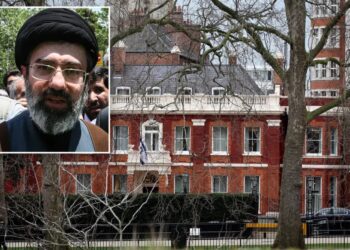
Iran’s selection of Mojtaba Khamenei — a powerful regime insider deeply intertwined with the Islamic Revolutionary Guard Corps — to succeed his father as supreme leader cements hard-line theocratic rule in the country and sends a strong message of defiance against President Donald Trump as Iran remains locked in a conflict with the United States and Israel.
An assembly of Iran’s top Shiite clerics chose the 56-year-old son of Ayatollah Ali Khamenei, who dominated the country for more than three decades before he was killedin Tehran as the U.S. and Israel attacked Iran on Feb. 28.
With deep ties to the country’s security establishment, Mojtaba Khamenei has long been a key power broker in the regime, despite never holding a formal role or becoming a senior cleric.
His selection, in an announcement carried by state media Sunday, comes during a war in which Trump has suggested he aims to topple the Iranian regime. Over a week of punishing U.S. and Israeli airstrikes on Iran have devastated the country’s military infrastructure and senior leadership ranks but are not yet showing signs of weakening the regime’s grip on power.
Trump has said he believes he should have had a role choosing Iran’s supreme leader and that the choice of Mojtaba Khamenei would be unacceptable.
Trump told ABC News earlier Sunday that if Iran’s next supreme leader “doesn’t get approval from us, he’s not going to last long.” He said there are “numerous people that could qualify” for the role.
Iran’s assembly of experts was said to have arrived at the decision of tapping Mojtaba Khamenei days ago, but was divided over whether to make the announcement during wartime, according to an individual close to Iran’s clerical establishment speaking under the condition of anonymity to describe sensitive closed-door deliberations. Many assembly members believed that such an announcement was too dangerous amid threats from Israel that it would target the next supreme leader, the individual said.
Israel Defense Forces warned Sunday before the announcement that “Israel will continue to follow any successor and anyone who seeks to appoint a successor,” saying it would “not hesitate to target” any of the dozens of members participating in the meeting.
“Iran not having a leader,” IDF spokesperson Nadav Shoshani said, “is something that makes it hard for them to operate the war machine against us.”
The Assembly of Experts has already been targeted twice by Israeli airstrikes since the strikes began. One attack targeted the group’s headquarters in Tehran and another hit the group’s main building in Qom. In response, the powerful religious body decided to hold deliberations and votes on the next supreme leader virtually.
Mojtaba Khamenei was long considered to be the top contender for the position, but he was initially discounted because of concerns that passing the position to a descendant of Ayatollah Khamenei could be controversial. The Islamic revolution in Iran was waged in part against hereditary rule of Iran’s Shah, and hereditary succession is generally frowned upon by the Shiite Muslim clerical establishment.
As head of the supreme leader’s office, Mojtaba Khamenei acted as a kind of informal chief of staff for his father, using the position to build influence, especially within the Islamic Revolutionary Guard Corps.
The U.S. imposed sanctions on Mojtaba Khamenei in 2019, saying that his father “delegated a part of his leadership responsibilities” to him. The designation also said Mojtaba worked closely with the IRGC’s Quds force and the Basij, the paramilitary forces responsible for internal security under the IRGC, “to advance his father’s destabilizing regional ambitions and oppressive domestic objectives.”
This was the second succession process for supreme leader in Iran’s history.
The selection of Mojtaba Khamenei demonstrates the enormous influence the IRGC has within Iran’s religious and political establishments, said Alan Eyre, a senior State Department official on Iran during the Obama administration.
“It’s going to take a while for [Mojtaba Khamenei] to exercise real power and to have his own power base,” Eyre said. Still, Eyre said, regardless of who was chosen, Iran’s next supreme leader was always poised to begin as “a hand puppet to a large extent of the IRGC,” he said.
The appointment shows the Iranian regime is “hardening and doubling down” according to Behnam Ben Taleblu, the director of the Iran program at the Foundation for Defense of Democracies. But Taleblu said there are also signs that the regime is under immense pressure.
Mojtaba hasn’t been seen in public since the start of the war, and the country has yet to hold a public funeral for his father. “The regime is still fighting,” Taleblu said, “but it is also afraid.”
Sammy Westfall contributed to this report.
The post Khamenei’s son chosen as Iran’s supreme leader, extending hard-line rule appeared first on Washington Post.