After shifting among different explanations for waging war on Iran, the Trump administration appears to have settled on the goal of regime change. Its strategy seems to be to first turn Iran into a failed state — or, as President Trump has put it, “go in and clean out everything.” At the end of all this, he said, he wants Iran to have good leaders. And he wants to decide who they should be.
What’s capturing the president’s imagination as a model for Iran seems to be not the U.S.-imposed change of leadership in Venezuela but the one in Syria. Perhaps he is envisaging skipping over Syria’s long civil war to get straight to state collapse and an Iranian version of Ahmed al-Shara, the onetime leader of an Al Qaeda-allied group who metamorphosed into Syria’s America-friendly president.
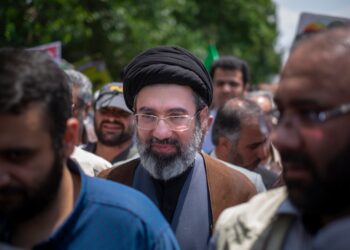
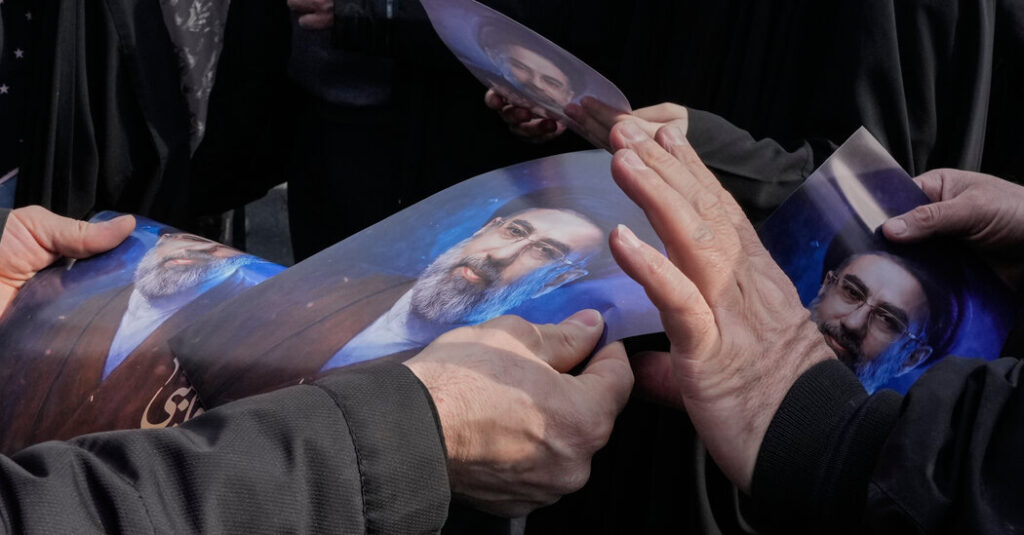
But Iran is not about to surrender to the president’s plans. On Sunday, Iran chose Mojtaba Khamenei, a son of the slain Ayatollah Ali Khamenei, as the new supreme leader. It was a clear signal that Tehran is determined to resist. Mr. Trump had warned Iran against choosing him, a leader who symbolizes defiance and someone best placed to lead Iran in continued resistance to the United States. Mr. Khamenei is a man of the regime, closely associated with its core values and institutions and his father’s legacy. He has been selected not to break with all that but to preserve it.
Mr. Khamenei is the choice of the hard men at the forefront of the war. Before becoming a cleric, he served during the Iran-Iraq war in the 1980s in the Islamic Revolutionary Guards Corps and has since remained closely tied to the force. Hossein Taeb, a former intelligence chief of the Guards infamous for his brutality in cracking down on political dissent, was Mr. Khamenei’s wartime comrade and remains a political ally. The new supreme leader was believed to be his father’s principal adviser for much of the past three decades, deeply involved in his management of the country and the ties that bind the various nodes of power in the Islamic republic. Despite all that, Iranians know very little about him; he has exercised influence behind the scenes.
The selection of Mr. Khamenei makes one thing clear: Rather than compelling Iran to change course, Mr. Trump’s war plan is pushing the country to dig in. Surrender is not an option for the Islamic republic. It knows how to resist and to thrive in resistance; that has been its credo since its founding nearly 47 years ago. The Islamic republic was shaped by the bruising Iran-Iraq war; defying U.S. plans in Lebanon, Iraq and Syria; facing economic sanctions; and confronting Israel.
Iran has been designed to endure, with authority dispersed among many nodes of power and exercised through a web of relations among clerical, military and bureaucratic institutions and power brokers inside and outside the government. The supreme leader is the ultimate arbiter in this system, but the multilayered state can function during a crisis. This resiliency is now the target of U.S. and Israeli bombing campaigns.
Resistance will not remain limited to Iran’s military force and its core supporters. The United States and Israel have hoped that bombing will pave the way for a popular uprising against the deeply unpopular and weakened regime. They may hope that Mr. Khamenei’s rise will only make that more likely. But the obverse could happen. The fundamental threat posed by this war is not just to the Islamic republic but to the whole country.
Indeed, many Iranians harbor deep anger toward the Islamic republic. It was, after all, only two months ago that nationwide protests calling for the end of the Islamic republic were brutally suppressed, killing thousands of people. But under constant bombardment Iranians are growing increasingly worried about the devastation of their country. They worry that U.S. and Israeli support for Kurdish and maybe even Azeri and Baloch separatists will break up the nation. These concerns are constantly circulating in public forums and are seen nightly in the form of antiwar demonstrations across the country and are morphing into an emerging sense of national resistance.
Since the 16th century, Iranian nationalism has been forged in the crucible of persistent threats to the country’s survival, resisting and defying plans by powerful neighbors and imperial powers to dominate and divide it. Over those centuries Iran has survived defeats and loss of territory to the Ottoman, Russian and British Empires and occupation and near division of the country during the two world wars. Iranian nationalism has relied on Persian language and culture fused with Shiism. It has stood in opposition to the state in different ways, rejecting foreign support for the 1953 coup that returned the shah to the throne and, later, to the Islamic republic’s abuse of power. It has surged and thrived in the face of outside pressure and in defense of the country’s survival.
This moment will not be different. If Iranians come to see this war as waged against Iran — and not just the Islamic republic — then Iranian nationalism may be mobilized in the service of resistance. America and Israel’s strategy of regime change by bombing military and government industries and infrastructure in Iranian cities, towns and neighborhoods and threatening Iran’s territorial integrity by arming Kurdish militias will not drive a wedge between the population and the regime and produce a popular revolution.
Mr. Trump’s apparent goal of finding an Iranian Ahmed al-Shara looks increasingly unattainable. To get there, Mr. Trump will have to break Iran’s resistance. That will be a long war and one that cannot be waged from the air. America would have to invade and occupy Iran and commit to a war that could last far longer than Mr. Trump — and certainly most Iranians and Americans — wants to see.
Vali R. Nasr is a professor of international affairs and Middle East studies at the Johns Hopkins School of Advanced International Studies and the author of “Iran’s Grand Strategy: A Political History.”
The Times is committed to publishing a diversity of letters to the editor. We’d like to hear what you think about this or any of our articles. Here are some tips. And here’s our email: [email protected].
Follow the New York Times Opinion section on Facebook, Instagram, TikTok, Bluesky, WhatsApp and Threads.
The post Iran Has Made a Choice: Defiance appeared first on New York Times.