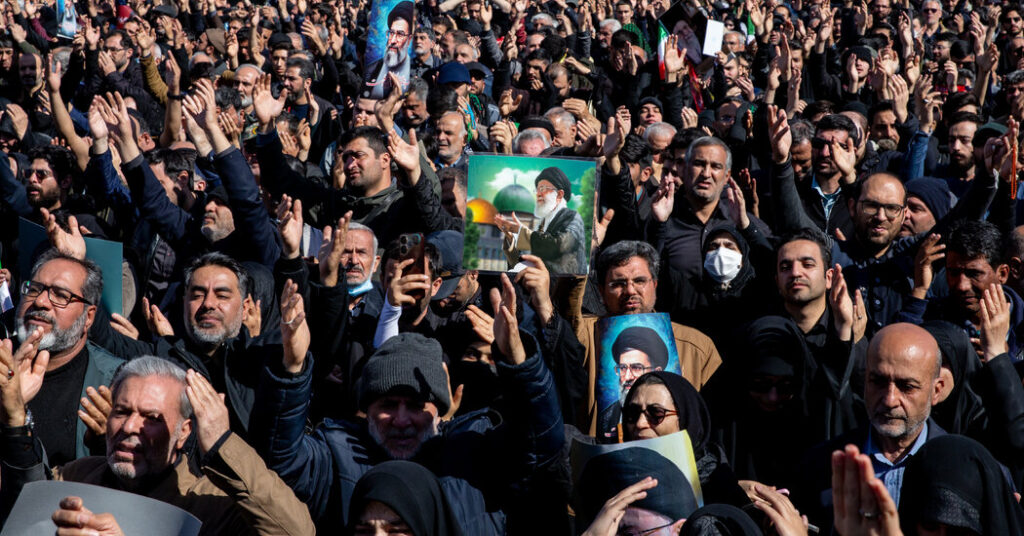
When the United States and Israel attacked Iran, it set in motion a deadly bombardment that is reverberating around the world.
At The New York Times, the war has prompted a journalistic mobilization on multiple continents, where reporters and editors collaborate to gather facts, assess video footage and make broader sense of the chaos.
It is challenging, messy work.
“You’re trying to figure out who you’re going to need on the ground; who you’re going to need for breaking news; who you’re going to need for deeper coverage; how are we going to work with photo, video, audio, graphics,” said Adrienne Carter, a senior editor on The Times’s International desk who is leading the war coverage from London. “We shift resources to ensure that we can cover the totality of the conflict.”
I spoke with Adrienne to better understand the effort, which also involves our newsrooms in New York, Washington and Seoul.
These are edited excerpts from our conversation.
In a typical year, The Times reports on the ground from roughly 160 countries. We care a lot about witnessing events as they unfold and talking to people living through them. But we don’t have reporters in Iran right now. Why is that? And how do we get reliable information from inside the country?
Iran, like a number of countries, is very restrictive in terms of access for journalists. In the past couple of years, we have had two or three visas to go into the country. Not during the recent protests. Not during the 12-day war [last summer]. We got one around Iran’s presidential election [in 2024] and after the recent war. It is very circumscribed. You have a government-assigned minder. You have a translator. They know where you are going at all times.
We have a team of reporters, many of whom speak Farsi. Many have been there or lived there. They tap into every connection — government sources and other contacts they met and developed over the years. They’re also trying to get an understanding from ordinary people who live there. Every time there’s a major news event, you end up calling hundreds of people in the hopes that you can talk to one. And that’s assuming internet and phones are working in Iran, where they are often shut down by the government at sensitive times.
Visual material is also very important in moments like this. Verified visual material. We work very closely with our Visual Investigations team to see what user-generated content and satellite imagery is out there.
It’s complicated. It’s one of the hardest places in the world to report on.
This conflict doesn’t involve American troops on the ground — at least so far. We’re reporting on missile and drone strikes over a vast area. Different officials assign blame to different groups. How do we figure out what’s going on?
You have to truth squad in the moment. I think we’re pretty up front with what we know and what we don’t know. When you first are reporting something, attribution is especially critical. Where did this information come from? How do we know something or not know something? Sometimes we don’t report things that have been put out in an official statement because we have reason to believe it is not accurate.
So much is happening every hour in multiple countries — the military operations, the human toll, the destruction, the politics, the behind-the-scenes actions. How do you decide what to focus on? Readers often wonder if there is a priority list.
When a war is starting, almost everything is important. You are covering everything possible, and you’re doing it in a multitude of ways. You’re covering the real-time element of the war — update after update — then also pausing and saying: “Not every reader is going to look at every little thing. So can we provide a step-back piece?” You do a “What to Know,” an explainer on a topic.
Then you look for more analytical ways into the story. To understand the context, the back story. You’re appealing to a variety of readers.
As a story moves on, you’re looking for inflection points and how it’s evolving, how it’s expanding. You’re looking to paint a broader picture, for themes and changes.
Several readers argued that we initially underplayed the deadly strike on a school in southern Iran compared with how we covered Iran’s strikes on Israel. How do you see it?
The strike on the elementary school in Iran that killed so many children has been a reporting priority from outset. Once we became aware of the strike and its magnitude, reporters tried to identify the families of victims and witnesses to the tragedy.
Satellite imagery, social media posts and verified videos are incredibly important reporting resources. A body of evidence assembled by our Visual investigations team suggests that an American missile hit the school, contradicting claims by President Trump.
But we are not on the ground in Iran. Communications are limited in the country. So the reporting is always going to be more difficult and slower than in places like Israel and Lebanon, where we have reporters who can see firsthand what is happening.
When you look at the strike in Israel, which is the one you’re comparing it to, we could drive there. It is 20 minutes outside Jerusalem. We could talk to witnesses. We were able to better understand because we could be there.
The school strike is just unfathomable. This is something that warrants and merits investment of resources and reporting. We are continuing to push to reach people who can talk to us about the strike and to learn about the children who were killed. It is a priority.
Sometimes a single headline can drive arguments online and protests in the street, as we saw with reporting on the Israel-Hamas war. How do we decide on those precious few words?
We spend a lot of time on headlines. We think carefully about what we’re trying to convey. In more difficult moments, we are slow and cautious.
So, for example, we had been preparing for the potential that the United States was going to strike Iran for weeks. There had been hints. We had been reporting on it. President Trump had been threatening it even as diplomacy efforts continued.
We were prepared. The first confirmation we had of a strike was the Israeli military. There was no confirmation that the U.S. had engaged. So that very first headline was the Israeli military saying it struck Iran. And we were trying to figure out if the United States was involved. We know they’re in the area. We know this was always meant to have been a U.S.-led operation. But that’s not what we could say yet. I’m pretty sure in the first hour, maybe the first two hours, we probably had six different versions of the headline based on the information that we had.
We get that people want us to move more quickly. But we base it on the reporting that we have in any given moment and move as quickly as we can to make it as accurate as we can and to hold parties to account when we are comfortable with the reporting.
Some readers question our language choices — passive voice versus active voice, decisions over when to attribute a fact, how much context to include, the use of the term “war” versus “conflict.” Do you wrestle much over the language?
When do you call the fighting in Iran a “war”? How do you describe the attacks on the rest of the Middle East? Is it a “war,” versus a “conflict?” The words matter, and you’re trying to convey the scale of what is happening and the scope of the fighting.
Our language evolves over time. In any given moment, it reflects our best, most verifiable understanding of the news as it is unfolding. Initial claims don’t always bear out, and so we have to be conscious of the sources and the information, and take that into account when writing our initial headlines and stories.
When it’s clearer, you evolve. The language you start with is not the language you end with.
Everything is being done in real time, and we are all coming at it from the same place, the push for accurate, reported information that explains what is happening without prejudice, without bias.
How do we ensure the safety of our journalists in the Middle East, including some from countries that the U.S. government is urging Americans to evacuate?
Security is a 24-7 operation. We have teams outside of those countries who are monitoring things. In riskier places, we have security teams on the ground that are working with our correspondents. Our journalists are trained in this sort of coverage, and many have been doing it for years. Our bureau chiefs, alongside our top editors, are critical in ensuring the safety of their teams.
Look, we don’t send anyone to a conflict zone who isn’t versed in this, who doesn’t understand the risks. But we have staff and families in many of these countries who aren’t journalists, and we want to make sure they’re out of harm’s way, so we relocate people as needed.
It’s also important to check in with people, making sure they are feeling OK. Even the most versed journalists still want to hear, “How are you doing?” These are people who are living through the story they have to cover.
Civilian deaths and injuries are among the most wrenching parts of any war. Some readers wonder if there’s a bias in Western media coverage, leading to more focus on American deaths. How do we approach reporting on these incidents?
I think the civilian deaths are the hardest to fathom.
To me as a journalist, as a human, civilians are the innocents in this. They did not make the decision to go to war. I think we take very seriously the responsibility to share their stories.
Whether that is in Ukraine or Russia, whether that is in Gaza or Israel or Lebanon, whether that is in Iran, whatever you’re feeling about the war itself, these are civilians. And I think it is our responsibility to share their stories to understand why they were killed and to hold the militaries to account for those losses.
Times Insider explains who we are and what we do and delivers behind-the-scenes insights into how our journalism comes together.
Mike Abrams is the deputy editor for Trust, working to help readers understand The Times and its journalistic values.
The post How The Times Reports on the War in Iran and Beyond appeared first on New York Times.