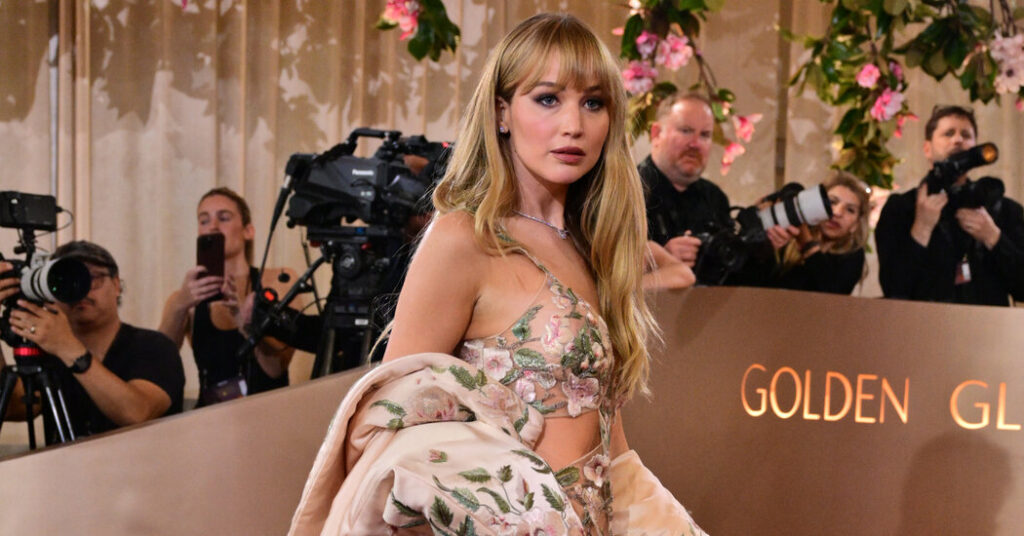
Naked dresses seem to be everywhere. Can you trace the origins? Is it a recent phenomenon? — Gary, Schuyler, Va.
Sometimes it seems as if awards season should be renamed naked dress season. As the competition to dominate the attention economy heats up, the inclination of female celebrities — because, let’s be honest, the naked tuxedo is yet to take off — to wear less and less becomes almost impossible to ignore.
It started this year with the Golden Globes, where Jennifer Lawrence made waves in a sheer Givenchy by Sarah Burton gown strategically embroidered with flowers. It continued through the Grammys, where Chappell Roan hung her (topless) frock from her nipples and Karol G modeled sheer blue lace. And, most recently, it showed up at the Actor Awards, where Li Jun Li wore a crimson sequined column held together by only a handful of bows at each side.
Earlier there were the various premiere naked dresses seen on Dakota Johnson and Margot Robbie, and the most naked dress of all, worn by Bianca Censori, Ye’s wife, to the Grammys in 2025. That was less a dress than a scrap of transparent something and reportedly may have inspired the organizers of the Cannes Film Festival to issue last year’s ban on naked dressing. (The edict was vague enough that it didn’t entirely work.)
This can seem like a modern phenomenon, driven by the rise of smartphones and our ability to see everything at any time so that anyone seeking the spotlight has to go to ever-further extremes to stand out.
Indeed, the term “naked dress” was reportedly coined only in 1998, during an early “Sex and the City” episode when Carrie is going on her first date with Mr. Big and wears a backless nude-toned Donna Karan slip dress. “Let’s just say it, it’s the naked dress,” said Charlotte, and a whole category was born.
But unofficially, the naked dress has been with us for centuries. Going back to Lady Godiva’s naked ride through Coventry in 1040 (prompted by a deal to change her husband’s tax policies) when she was clad only in her very long hair.
In the 1920s and ’30s, naked dresses as we know them were showing up onstage and on the screen. Mae West wore a lace frock in her 1936 film “Go West, Young Man” that was similar to the vintage Jean-Louis Scherrer lace gown worn by Jennifer Lopez at the Golden Globes this year.
But the dress that really kick-started the current era of nakedness was most likely the nude-toned, curve-hugging Jean Louis creation Marilyn Monroe wore to croon “Happy Birthday, Mr. President” in 1962 (the one Kim Kardashian controversially wore to the Met Gala in 2022). Things just steamrolled from there.
In the 1960s and ’70s, Jane Birkin was famous for her see-through minis, and Cher became known for her see-through Bob Mackies. By the turn of the millennium, Ms. Lopez’s cut-to-the-navel palm tree-print Versace was so searched that it inspired the creation of Google Images. Little wonder that, at this point, the presence of at least one naked dress is practically a given in any situation that involves a red carpet.
What it all means has inspired reams of academic treatises, pop culture psychoanalyses and continuing debate: Does the omnipresent naked dress represents sexism and voyeurism at its most prurient, or are women taking ownership of their own bodies? Is it about the triumph of the male gaze or female empowerment.
Whatever the answer — and it depends on the mind and eye of the beholder as much as the intention of the wearer — one thing is inarguable: As the Oscars loom, it is likely to continue.
Your Style Questions, Answered
Every week on Open Thread, Vanessa will answer a reader’s fashion-related question, which you can send to her anytime via email or X. Questions are edited and condensed.
Vanessa Friedman has been the fashion director and chief fashion critic for The Times since 2014.
The post How Did the Naked Dressing Trend Start? appeared first on New York Times.