It was February 2020 — a month cold enough to freeze the Detroit River — when Sgt. Shannon Jones, a missing persons detective, ushered her guest into a conference room at the Detroit Police Department headquarters.
Antonio Wiley, the bearded, middle-aged man who took the seat across from her, was a familiar face. They’d met about four years earlier, in this same building, when Antonio had come to seek help with an investigation of his own. Now she had summoned him back, ready to share a break in a case that had haunted her files for years, and Antonio for three decades.
It involved his mother, Anita Wiley.
Antonio had not seen her since he was a teenager, when, at age 29, she vanished from their apartment on Detroit’s west side. At first, he could only look for her in the faces of strangers on the street. Later, he searched for clues to her whereabouts in newspaper clippings, in dusty police archives, in interviews with his older relatives. He amassed stacks of notes and documents, but the truth remained out of reach.
Then in his late 40s and raising children of his own, Antonio could only hope Sergeant Jones had new information.
It turned out she did. After more than 30 years, he could stop looking.
Anita Wiley had become a parent before she had the chance to grow up herself. Her mother died soon after Antonio’s birth, and Anita, just 14 when Antonio was born, was left to care for her siblings along with her son.
Antonio remembered his mother doing everything she could to afford him a stable life, even as they frequently moved from apartment to apartment. She filled their home with music, made sure he kept his grades up, pulled their family together for every birthday and holiday.
But over the years, he got glimpses of her tumultuous relationships and struggles with drug addiction. Anita tried to shield Antonio from her troubles, but he saw signs in the journals she kept, in overheard arguments between her and his step-grandparents.
One day in the summer of 1987, Antonio returned home from a weekend with his cousin to find his apartment empty. That was not unusual; his mother would sometimes stay out late into the night. But the days turned into weeks, with only an occasional phone call from her, from who knew where. Antonio began taking odd jobs and selling mixtapes at school to keep the fridge stocked.
“Even while I’m trying to compose these little mixtapes to take with me the next day to school, I’d have the phone right there, just hoping it would ring,” he said.
Sometimes Anita checked in on how he was doing, whether he was keeping up with his schoolwork. Antonio tried desperately to keep her talking. He asked when she would be coming home. Soon, she said. She’d be home soon.
The calls were always brief, Antonio remembered, and his mother’s voice seemed strained. He began to wonder if it was even really her he was talking to.
Eventually, the calls stopped coming. But Antonio held out hope. His birthday was coming up, and he was sure his mother would not miss it.
With nowhere else to turn, Antonio contacted his father, whom he barely knew but who welcomed him into his new family all the same. Antonio hoped it was a temporary arrangement. Anita still didn’t turn up, though, and her family decided enough was enough.
Antonio’s aunts tried to alert the authorities to his mother’s disappearance, but in a city ravaged by crime after the decline of the auto industry, the police were overwhelmed by cases like hers. It took the family multiple tries, Antonio recalled, just to get an officer to take a report.
To be the loved one of a missing adult is often a kind of purgatory. Every year in the United States, about 600,000 people are reported missing. And while a vast majority quickly turn up, some are never located. That’s in part, experts say, because the police are often reluctant to invest scarce resources in cases in which a conviction is unlikely, or when it’s unclear anybody broke the law to begin with.
So years pass, and families and friends of the missing live on in directionless grief, with the burden of keeping their loved ones’ cases alive.
Antonio carried that burden largely on his own. On the cusp of adulthood, he began showing up at his family members’ houses with a notepad, a pen and questions. What was going on in his mom’s life when she disappeared? What did they think happened to her?
He learned from those conversations what he could only have suspected as a child: that his mother had become involved in Detroit’s drug trade and become addicted herself. As for what happened to her, Antonio heard plenty of theories — that she’d been murdered, that she’d started a new life somewhere else.
He would come to form his own suspicions, largely centered on a man who had entered his mother’s life shortly before she vanished. His best guess was that she had been held against her will somewhere, and that the last calls she had made to him had been under duress.
Through it all, a part of him held onto the hope that his mother was still out there — seriously hurt, maybe, but alive.
“I would still kind of catch glimpses of her shadow in a person at a checkout line at the grocery store, at a restaurant,” he said. “She was very much still alive to me.”
While Antonio attended college in Detroit, he expanded his search to include public records, police reports, newspaper archives. Internet search engines, when they came online, yielded still more resources.
He tracked down contact information for anybody — reporters, detectives, the local F.B.I. office — who might have information. He conducted interviews on lunch breaks and between classes.
Sometimes he got tantalizing signs of progress. A retired detective who had interviewed the man Antonio suspected in his mother’s disappearance insisted Antonio was on the right track. He found his mother’s nickname, Neet, dropped in a newspaper story about a crime committed years after she disappeared. It felt, he said, like “a message from the grave.”
He tried to get his mother’s original missing person report, the one his relatives had submitted years earlier, so he would at least have a file number to reference when seeking help from the authorities. But police told him they could not find it, and, after days of scouring the cramped archives room at the old police headquarters, he couldn’t either.
Later, Antonio heard about an event for the families of missing people at the Police Department’s new headquarters and decided to stop by.
A woman introduced herself when he entered. She was stoic, dressed plainly, with her dark hair pulled back and a badge hanging from her neck. It was Sergeant Jones, the missing persons detective. The two found a quiet spot to talk. Her straightforwardness and the diligence of her questioning struck Antonio.
Together, they agreed to create a new missing persons report for Anita. But Sergeant Jones also made a request of Antonio: She wanted his DNA, to help identify Anita if her body was ever found.
Antonio was uneasy at first, tired and distrustful after years of apparent indifference from the police. But he also wondered if the DNA technologies Sergeant Jones had access to could help. Later that day, he handed over a sample.
“I think if it was anyone else that had asked me, I would have said no,” Antonio said. “But she won me over.”
United Memorial Gardens rests just beyond the fringes of metro Detroit, a sprawling cemetery with neat lawns and signs lending quaint names to each section. There’s a Garden of Memory, a Garden of Life, a Garden of Faith.
Not long ago, in the back corner of the Garden of Hope, Sergeant Jones looked out over a field where only a handful of grave markers rose from patches of dandelions. This part of the cemetery appeared to be mostly empty, but she knew better. During some of Detroit’s most violent years, hundreds of bodies were buried here in pauper’s graves, unclaimed or unidentified.
When Sergeant Jones joined the missing persons unit around 2013, she inherited a long backlog of cases, along with the mystery of who was buried in those graves and what had happened to them.
She thought it likely that many of the people in her files were the same ones now buried in that cemetery. But the remains had been placed in those graves long before it was standard to take DNA samples from unidentified bodies.
Sergeant Jones approached a longtime colleague, F.B.I. Special Agent Leslie Larsen, head of the agency’s local evidence response team. She suggested to Larsen that they team up to exhume some of the bodies and take DNA samples, then compare them with DNA in law enforcement databases, as well as the genetic material Sergeant Jones had collected from relatives of missing persons. The effort, which came to be known as Operation UNITED, was in its infancy when Sergeant Jones met Antonio Wiley.
The sergeant and Ms. Larsen started with the modest goal of exhuming a couple of unidentified bodies every year. They began with cases where an investigation into police records made them confident of the victim’s identity before shovels hit the earth.
But what if, Sergeant Jones wondered, they cast their net wider? What if they exhumed as many bodies as they could on the chance their recovered DNA would match the sample of a genetic relative — a parent, a sibling, a child — already in their system?
In 2019, Sergeant Jones and Special Agent Larsen set out with a list of about 24 unidentified bodies — all believed to be homicide victims — to exhume and sample. The work was grueling. Antiquated cemetery records, some written in pencil or crayon, at first made digging a process of trial and error. Bodies turned up where they weren’t supposed to be. And since the remains were often buried in the most waterlogged sections of the cemetery, digging was near-impossible in all but the driest months of the year.
Of the first two dozen bodies, they were able to locate and take DNA samples from just seven.
In 2020, they got their first match. A young woman, buried back along the fence line at United Memorial Gardens, just beside the highway.
Firefighters had found Anita Wiley’s body on Nov. 11, 1987, in the ruins of a vacant, burned-out house near Detroit’s northern limits.
Investigators at the time concluded Anita, as yet unidentified, had likely been killed much earlier. They took the testimony of a witness who had seen someone leaving the house before fire consumed it. But with officials seeing no promising leads, both the fire and the killing fell into a deep backlog of unsolved cases. Anita’s body was interred with the others at United Memorial Gardens.
Now, more than three decades later, it had been exhumed, and a lab had matched the dead woman’s DNA to the sample her son had provided to Sergeant Jones.
When the sergeant gave Antonio the news, he said, the two could do nothing for a moment but look at each other.
“It was a moment of pause, and reflection and excitement and heartbreak, all rolled into one,” he said.
For Sergeant Jones, the identification of Anita Wiley proved the strategy behind Operation UNITED could work. The early success would attract support for the project, with F.B.I. teams traveling from across the country to join the dig. She and her team have now exhumed and sampled hundreds of bodies on her list, stretching back to the 1950s, and put names to more than 30 sets of unidentified remains.
The scale of the project, experts said, has little precedent among missing persons investigations in the United States.
After Antonio received the news about his mother, he drove straight to United Memorial Gardens to see where she had been all that time.
Years had passed since Antonio had shed tears over his loss. But at that gravesite, so close to the city where he had been searching, he broke down crying.
Antonio still wants justice for Anita — wants to identify her killer and hold that person accountable, in whatever form that might take after more than 30 years. The man he has long suspected is now in prison on other charges, and he hopes the police will follow up. Sergeant Jones said the police continue to work with families of newly identified crime victims on open homicide cases.
During his search, Antonio learned of an aunt he had never known, NPR journalist Tonya Mosley, an experienced crime reporter who occasionally offered guidance. In the years after Anita’s body was identified, they worked together on a podcast telling Anita’s life story and exploring the theories behind who had killed her.
He also remains in touch with Sergeant Jones, communicating about his mother’s case.
“Even now, he’ll randomly text me,” she said of Antonio. “On Mother’s Day, he’ll text me, ‘Thank you. I went and saw my mom,’ or random things. He just reaches out.”
Surveying the field at United Memorial Gardens during an interview last year, when the grass had long since regrown over the upturned graves, she added: “A lot of the families still do.”
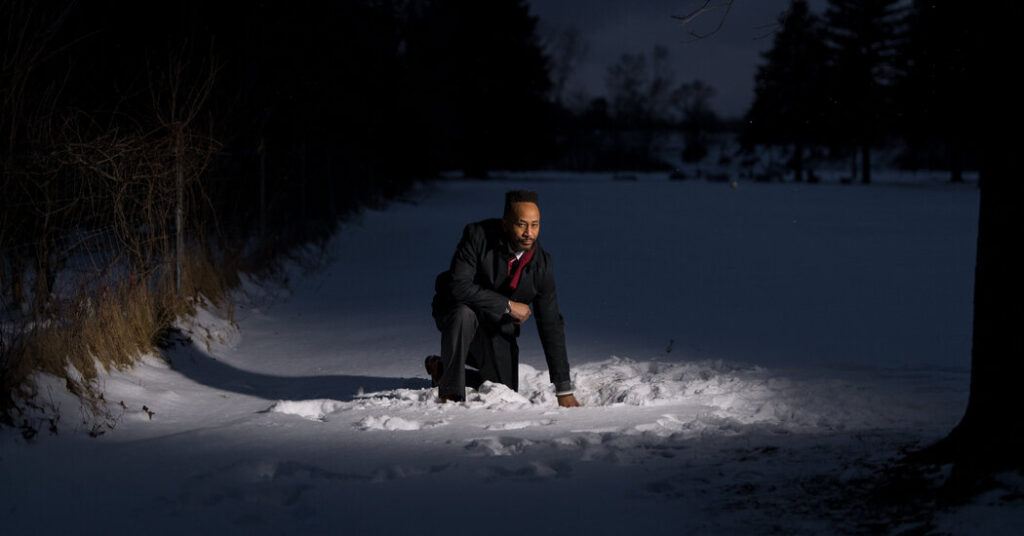
Late on a winter afternoon, as the pale gray sky faded into twilight, Antonio stopped his car along a gravel track at United Memorial Gardens and stepped out into the snow.
He had made this trip many times. In March 2020, with the pandemic looming, he gathered his relatives here for a memorial service. Standing at Anita’s graveside, they cried together and shared stories. Later, Antonio returned with his own children to lay flowers. The eldest of them, an adult daughter, bears Anita’s name.
Sometimes, like that afternoon, he came by himself.
His boots sank in the snow as he approached the fence line, where a few red tags — leftover markers used by Sergeant Jones’s forensics team — clung to the chain link. Past them, the interstate traffic droned. It was bitterly cold.
Antonio’s first memory of his mother was on a day like this one. He could picture her — still a teenager herself, but seemingly big enough to protect him from the big, cold world outside — coming home on a winter day.
He knelt and brushed snow from a patch of ground. Here was the product of decades of hoping and searching for answers. At long last, a modest headstone. An epitaph. A name.
Anita A. Wiley, it read. Loving mother. Truly missed.
Audio produced by Tally Abecassis.
Chris Hippensteel is a reporter covering breaking news and a member of the 2025-26 Times Fellowship class, a program for journalists early in their careers.
The post His Mother Vanished When He Was 14. 33 Years Later, He Found Her. appeared first on New York Times.